

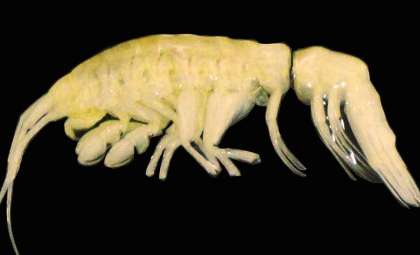
Researchers have identified a tiny hunter dwelling in one of Earth's most remote and extreme habitats: the Atacama trench. This newly discovered crustacean, named Dulcibella camanchaca, was located at nearly 8,000 meters beneath the ocean surface, highlighting the vast mysteries still hidden in the deep seas.
The specimen was gathered in 2023 during an expedition led by the Instituto Milenio de Oceanografía (IMO) aboard the research vessel Abate Molina. Subsequent analysis verified that this organism represents a previously unidentified genus.
Extending roughly 3,700 miles along South America's western seaboard, the Atacama trench—also known as the Peru-Chile trench—plunges to depths exceeding 26,000 feet off the coast of northern Chile. This trench lies within the hadal realm, characterized by complete darkness and near-freezing waters.

Though the Mariana trench’s Challenger Deep holds the record as the deepest ocean location, reaching about 35,876 feet, the Atacama trench remains an isolated and unique deep-sea environment, separated from other hadal zones by vast ocean distances.
Predatory Crustacean with Specialized Features
The discovery of Dulcibella camanchaca started with four individuals collected at a depth of 7,902 meters in October 2023. A female specimen about 1.5 inches long served as the primary basis for identification.
Examinations of its anatomical traits combined with genetic analysis of two mitochondrial gene regions, 16S and COI, which are commonly used for species classification, revealed it did not closely match any known amphipod species.

Researchers concluded that the combination of DNA evidence and morphological features indicated the creature represents a novel genus. Johanna Weston, the lead scientist from Woods Hole Oceanographic Institution (WHOI), commented that:
“Most excitingly, the DNA and morphology data pointed to this species being a new genus too, emphasizing the Atacama Trench as an endemic hotspot.”
The research, published in Systematics and Biodiversity, highlights the unique hunting adaptations of this predator. Unlike many amphipods that feed primarily on detritus descending from upper ocean layers, this species possesses large forelimbs for catching prey and specialized mouthparts for tearing food apart.
Although its feeding behavior remains unobserved, the anatomical evidence supports the idea that it actively hunts in the darkness rather than passively scavenging.
Surviving in Extreme Ocean Depths
The environment inhabited by this crustacean is extraordinarily harsh. At roughly 25,925 feet deep, the pressure reaches approximately 790 times greater than atmospheric pressure at sea level. Despite these extreme conditions, the organism carries out essential activities like swimming, molting, and predation. Scientists continue investigating the physiological mechanisms that enable its survival under such immense pressure.
This finding also opens the question of the species’ distribution. Is Dulcibella camanchaca exclusive to the Atacama trench, or might it reside elsewhere? Deep-sea research suggests some amphipods inhabit multiple distant trenches. For example, Profundum solomoni has been documented across three separate hadal zones.

A 2026 publication in Science reported discovering 32 species on the seafloor of the Kermadec and Mariana trenches, while also identifying similar assemblages in other deep regions such as the Atacama area.
Major Expedition Advances Deep-Sea Knowledge
Following this discovery, a broader research initiative took place in 2026. The Joint China-Chile Atacama Trench Expedition (JCATE) used the manned submersible Fendouzhe to explore the trench's depths.
Scientists from the Universidad de Concepción completed over 36 dives, covering approximately 112 miles of ocean floor, with maximum dive depths reaching 26,434 feet. Throughout the entire 156-day mission, teams conducted 63 dives, including 50 that descended beyond 20,000 feet.
This expedition differed from previous ones by employing direct exploration with cameras and sample collection gear rather than relying solely on bait traps. They gathered environmental DNA, sediment samples, and recorded extensive video footage.
Preliminary results revealed various deep-sea lifeforms such as transparent fish, jellyfish, sea cucumbers, and multiple amphipods that could represent new species. The Chinese Academy of Sciences’ Institute of Deep-sea Science and Engineering also documented what may be the deepest chemosynthesis-based ecosystem in the Southern Hemisphere, sustained by chemical energy from the seafloor rather than sunlight.
- Categories:
- Science


0 comments
Sign in to Comment