

Paleontologists have unveiled a new species of long-necked dinosaur, Uragasaurus kalasinensis, following the discovery of a fossilized vertebra in northeastern Thailand. This vertebra’s unique Y-shaped structure, combined with its hollow, air-filled chambers, provides insights into how this sauropod supported one of the longest necks ever known. This discovery also represents the first documented member of this dinosaur family in Southeast Asia.
Long-necked sauropods have intrigued scientists not only for their enormous size but also for the fascinating anatomical mechanisms that enabled such gigantism. This newly identified dinosaur belongs to the Mamenchisauridae family, whose fossils had, until now, primarily been found in China, making this finding outside of that region particularly important.
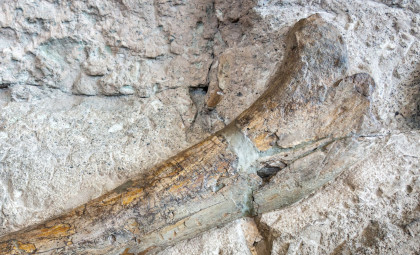
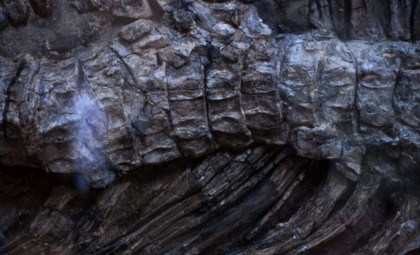
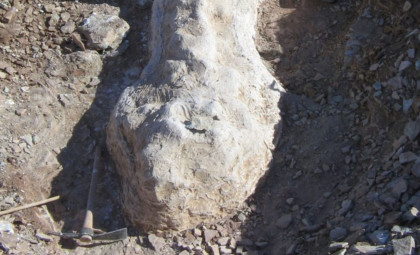
The identification was based on a single anterior dorsal vertebra retrieved from the Phu Kradung rock formation, as detailed in a recent paper published in Scientific Reports. Although the material is limited, the vertebra itself holds critical information for classifying the species.

A Remarkable Discovery Beyond China’s Borders
Mamenchisaurid fossils, dating back to the Middle and Late Jurassic periods, have been predominantly linked to China’s Sichuan Basin. The family’s first recognized member, Mamenchisaurus constructus, was discovered in 1952 at a construction site, with numerous related species identified in the area since then.
While mamenchisaurids are mostly associated with China, some vertebrae found in Tanzania—previously attributed to the Late Jurassic sauropod Janenschia robusta—have been reinterpreted as mamenchisaurids, implying a wider geographic distribution that included parts of Africa.

Uragasaurus kalasinensis represents the first officially named mamenchisaurid from northeastern Thailand. Its genus name is derived from the Sanskrit term “Uraga,” meaning “snake” or “serpent,” combined with a reference to Kalasin province where the fossil originated. According to Komsorn Lauprasert, paleontology professor at Mahasarakham University in Thailand:
“Combined with other material from the Phu Kradung Formation, it reveals that Southeast Asia was an important center of mamenchisaurid diversity, filling a critical gap in understanding the biogeographic distribution and evolutionary radiation of this sauropod group across the Asian continent during the Jurassic period.”
Insights from CT Imaging of the Vertebra
The defining Y-shaped contour of the vertebra is a key characteristic of this species; however, researchers went further by employing CT scans to explore the bone’s internal makeup. This revealed elongated, teardrop-shaped indentations called fossae and a pneumatic design featuring air-filled chambers rather than being fully solid bone.
Pneumaticity is common in sauropod vertebrae, including mamenchisaurids. A 2025 study in Cretaceous Research showed that these hollow vertebral systems supported extensive air sacs similar to those found in modern birds, helping to reduce bone mass and mechanical strain on the neck.

Explaining Variations in Neck Length Among Dinosaurs
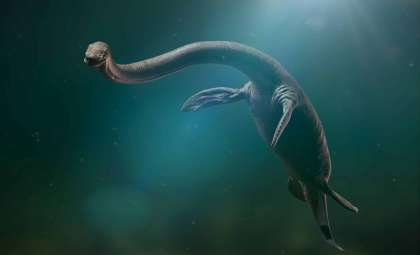
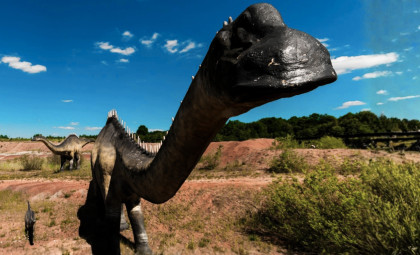
Although pneumatic vertebrae also existed in theropods and pterosaurs, neither group approached the extraordinary neck lengths seen in sauropods. As reported by PeerJ, theropod necks typically measured between 6 and 8 feet, while some pterosaurs had necks up to 9 feet long. Sauropods, on the other hand, occasionally possessed necks extending beyond 50 feet.
Many modern birds still exhibit pneumatic vertebrae inherited from dinosaur ancestors. In contrast, giraffes—the tallest animals with long necks today—lack such air-sac systems and pneumatic bone structures, relying entirely on different anatomical strategies to achieve their height.

Compared to well-studied sites in China, the Jurassic sediments of the Phu Kradung Formation and elsewhere in Thailand have seen limited paleontological exploration. As Lauprasert remarked:
“Given Thailand’s extensive Jurassic sedimentary deposits and limited paleontological exploration compared to China, future excavations will likely uncover more mamenchisaurid specimens, potentially revealing new species.”
- Categories:
- Science

0 comments
Sign in to Comment