

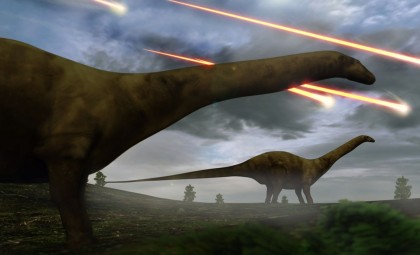
The asteroid responsible for ending the age of dinosaurs was no typical celestial object. Recent studies indicate that the Chicxulub impactor originated from a rare class of ancient meteorites called CO chondrites, demonstrating that this life-altering impactor came from an uncommon region of our solar system.
Expert analysis focused on the nickel isotopes found in the thin global layer of debris deposited after the collision that occurred 66 million years ago. This enormous space rock struck near the present-day Yucatán Peninsula in Mexico, forming the Chicxulub crater and precipitating the catastrophic event that extinguished non-avian dinosaurs. The asteroid’s diameter has been approximated at 10 to 15 kilometers, impacting Earth at an estimated speed of 64,000 km/h.
Identifying details about the impactor has been challenging because the collision pulverized almost the entire asteroid. Only minute fragments survived within the worldwide clay layer formed by the impact, offering scarce clues to its true nature.

An Uncommon Asteroid Hidden in Earth's Geological Layers
Scientists examined the debris layer dispersed globally following the Chicxulub event. Through precise measurements of nickel isotope ratios, they traced the chemical fingerprint of the remnants back to known meteorite categories.

The evidence pointed to the asteroid being a carbonaceous chondrite of the Ornans class, commonly referred to as CO chondrites. These meteorites are exceptionally rare on Earth, comprising only about 5% of all known meteorite finds, with CO chondrites representing a small subset.
“These are definitely not like the typical meteors you find in museum collections,” said Professor Philippe Claeys, a researcher at Vrije Universiteit and the University of British Columbia.
According to Claeys, CO chondrites are among the most primordial materials in the solar system. They contain comparably low levels of volatile substances such as carbon, zinc, water, and notably sulfur, unlike many other meteorite types.
This discovery implies that the dinosaur-killing asteroid was not one of the typical space rocks but belonged to an unusual and ancient class of cosmic material.
Impact Dust Cloud Likely Played Key Role
The research, featured in Science Advances, reaffirms the impact’s connection to major ecosystem collapses at the close of the Cretaceous period.
However, it shifts discussions about the asteroid’s chemical influences. Since CO chondrites have significantly less sulfur, it’s now considered less probable that sulfur from the impactor was the principal cause of the dramatic global environmental changes.
“It doesn’t alter our theory of what caused the extinction event, but it makes it less likely that sulfur contained in the impactor was the smoking gun,” Professor Claeys said.

Researchers instead emphasize the vast quantities of fine particulate matter ejected into Earth’s atmosphere by the impact. This widespread dust and debris are thought to have been the dominant factor driving post-impact environmental shifts.
The study also points out that nearly the entire asteroid vaporized upon collision, leaving only minor traces embedded in the global impact layer for scientists to study.
Tracing the Asteroid’s Origins
While the asteroid’s classification is now clearer, pinpointing its source region remains a challenge. Potential origins include remote, volatile-rich zones in the outer solar system or regions at the outer edges of the asteroid belt near Jupiter.
This extraordinary event was extremely uncommon. A primordial object from a far-reaching section of space journeyed through the solar system before striking Earth and forming today’s crater beneath the Yucatán Peninsula. As Professor Claeys remarked:
“Being impacted by such a rare, distant projectile really underscores how unlucky the dinosaurs were.”

- Categories:
- Science




0 comments
Sign in to Comment