

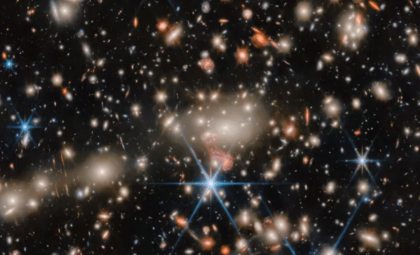
Recent astronomical research suggests that the enigmatic little red dots spotted in the distant cosmos are not lone entities but rather compact galaxies harboring energetic central black holes. Featured in Nature Astronomy, this investigation highlights faint optical emissions around these far-off sources, indicating densely packed regions of star formation within the initial billion years after the Big Bang.
Reevaluating the Origins of the Universe's Tiny Red Spheres
These findings alter previous interpretations of a particular set of remote cosmic objects termed little red dots. Although first detected in deep-field surveys of the early universe, their exact nature has been debated for some time.
Their strong luminosity combined with their distinctive reddish hues have intrigued researchers regarding their light sources. Some ultraviolet studies suggested these might be encompassed by galaxy-like structures.

Obtaining optical data, which better reveals stars and galactic morphology, has been challenging because the bright central sources often overshadow the weak light from nearby galaxies.
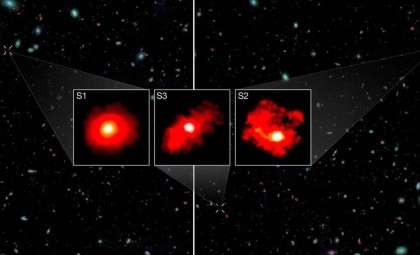
To tackle this, scientists merged data collected by the James Webb Space Telescope. They analyzed a large sample of 217 little red dots to uncover subtle patterns invisible when studying each individually.
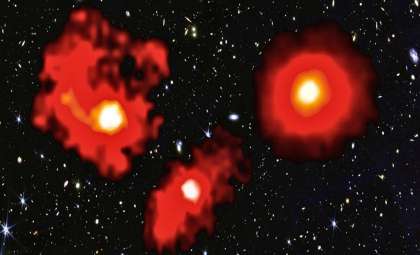
This aggregated approach uncovered a faint extended glow surrounding the dots, which likely originates from compact galaxies instead of isolated light points.
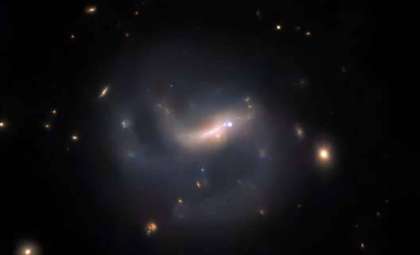
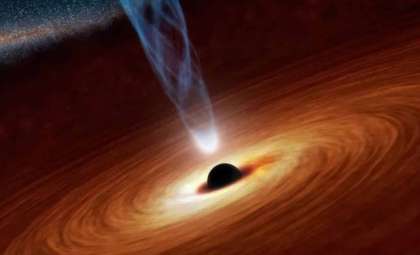
These results imply that many of the little red dots might be active galactic nuclei nestled within small, compact galaxies. Central to these systems are supermassive black holes accreting matter and causing the observed emissions.
Compact Star-Forming Galaxies Disclosed by Webb Observations
The study published in Nature Astronomy finds that the host galaxies possess unusual characteristics compared to typical galaxies from the same epoch.
Measurements show these galaxies generally have a radius close to 210 parsecs, which translates to about 685 light-years, making them approximately 2.5 times denser than similarly massed star-forming galaxies contemporaneously.
With an estimated total mass near 1 billion solar masses, these compact galaxies contain sufficient material to sustain robust star formation despite their small scale.
Their concentrated structure might explain the intense and peculiar brightness of the little red dots. The combination of dense stars, gas, and central black holes could generate the unique signals observed.
The research also highlights the advantages of combining multiple observations rather than depending on isolated images. The extended emissions were too weak to detect clearly in individual cases, but the composite data revealed recurring patterns.
Scientists characterize these findings as representative average traits for the group, acknowledging individual differences and emphasizing the need for further study to assess the prevalence of these compact galactic hosts.
Exploring the Universe's Initial Billion Years
Little red dots provide a valuable glimpse into the early coexistence of galaxies and black holes during the universe's formative billion years. Their presence challenges existing theoretical models of cosmic development.
The new evidence points to a scenario where black holes and galaxies evolved together in highly compact environments. Such primordial structures may be crucial stepping stones toward the formation of the larger galaxies we observe in the current universe.
Understanding the interaction between these central sources and their galactic surroundings continues to be a critical research focus. Scientists aim to clarify the pace of formation and their impact on the early cosmos.
While the detected faint optical emissions add an important clue, the full nature of these objects remains elusive without precise spectroscopic follow-up.
Detailed light analysis will allow astronomers to confirm distances and unravel the physical conditions that shaped these ancient cosmic inhabitants.
- Categories:
- Astronomy


0 comments
Sign in to Comment