

Recent analysis of nine nearby galaxies unveils that actively accreting supermassive black holes might play a role in encouraging star formation, challenging the longstanding view that they only suppress it. Published in The Astrophysical Journal, the findings highlight how energetic galactic nuclei are linked to star-forming regions, energized gas patterns, and potent shock fronts coursing through their host galaxies.
Supermassive Black Holes Exhibit a Multifaceted Influence on Galaxy Development
For many years, astronomers have examined active galactic nuclei (AGN) as central engines that control how galaxies evolve. As matter spirals toward a galaxy’s core black hole, it emits tremendous energy, generating intense radiation and massive outflows. This so-called AGN feedback has usually been thought to inhibit star birth by heating or stripping away gas.
However, this new research presents a nuanced perspective. Scientists discovered that black holes in active feeding phases often coexist with star-forming areas, hinting that some black hole activity may actually help establish conditions favorable to new stars. The study published in The Astrophysical Journal focused on galaxies whose central black holes are engulfing nearby matter, enabling detailed observation of how these high-energy zones influence their environments.


Utilizing the VLT/MUSE instrument, the team mapped three-dimensional gas dynamics and energy input sources across the galaxies. This enabled scientists to distinguish among effects created by radiation from black holes, ongoing star formation, and shocks triggered by high-speed gas flows.
“Detecting these distinct components revealed that black holes not only draw in material, but also expel it,” explained Peixin Zhu, a graduate student and astronomer at the Center for Astrophysics | Harvard & Smithsonian. “There is a close relationship between consumption and ejection processes.”
Star-Forming Rings and Intense Shock Waves Encircling Energetic Galactic Centers
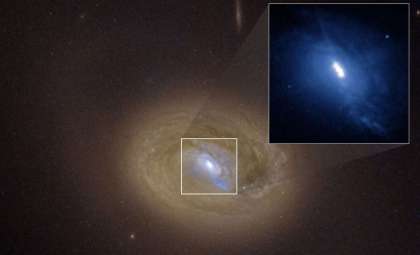
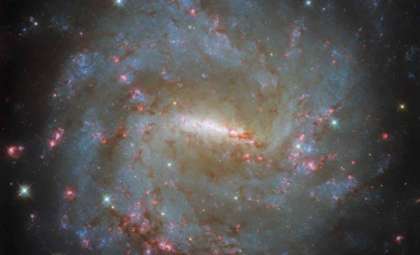
The nine galaxies surveyed all displayed recurrent traits illustrating how black hole activity impacts the surrounding interstellar gas. Rings and arc-shaped areas of star formation were found at distances between roughly 0.8 and 6 kiloparsecs from the galactic core, forming active stellar nurseries.
The observations also highlighted cone-shaped zones of ionized gas radiating outward from the galactic disks, tracing the path of radiation escaping from the active black holes and showing how energy propagates through these galaxies.
Additionally, astronomers identified rapid shock waves generated where these energetic outflows strike interstellar gas. Notably, these shocks occurred in directions perpendicular to the primary black hole-driven outflows, creating a striking and consistent geometric feature across all studied galaxies.
“The most interesting phenomenon about shocks is that they always go perpendicular to where the black hole’s injected outflows go,” Zhu said. “It is very common, and we see it consistently appearing across all nine galaxies.”
Researchers propose these shocks stem from interactions between AGN jets and their galactic surroundings. In galaxies with less prominent jets, black hole-driven winds may also be responsible for producing these shocks.
Advanced Models Shed Light on Black Hole Impact within Galaxies
To interpret these findings, scientists integrated precise observational data with complex theoretical models created by Zhu along with fellow astrophysicists Lisa Kewley at the Center for Astrophysics | Harvard & Smithsonian and Ralph Sutherland from the Australian National University.
These frameworks allowed the comparison between observed energy sources and simulated scenarios including black hole radiation, young stars, and shock phenomena. Complementary Chandra X-ray observatory data further corroborated their interpretations.
The conclusions challenge the idea of black hole feedback as merely a destructive force; instead, it appears to be a dynamic cycle involving gas accretion, energy release, and continuous interplay with the galaxy's environment.
“Our work reveals that black holes do more than just consume matter at galactic centers — they actively modify their surroundings,” stated Lisa Kewley, director of the Center for Astrophysics | Harvard & Smithsonian and Zhu's mentor. “Understanding this intricate feedback loop is key to grasping galaxy evolution.”

Revisiting the Black Hole-Stellar Birth Relationship
This research provides a fresh outlook on a fundamental cosmic puzzle: how galaxies maintain balanced growth over billions of years. Although supermassive black holes make up a tiny fraction of galactic mass, their influence spans thousands of light-years through radiation, winds, and jets.
By isolating the effects of active black holes, scientists unraveled clearer links between these cosmic engines and star formation. The new findings imply certain black holes might help foster environments conducive to star creation, rather than only evacuating the building blocks for stars.
Examining this small galaxy sample marks progress toward determining the prevalence of such processes across the universe. Future explorations with more advanced telescopes promise deeper insights into whether these patterns hold on cosmological scales, refining models of galaxy evolution.
- Categories:
- News


0 comments
Sign in to Comment