

The European Space Agency’s innovative Proba-3 mission has successfully documented an uncommon series of three solar prominence eruptions occurring within the sun’s inner corona. This achievement is possible due to two spacecraft working together to produce a man-made eclipse in space, unveiling regions typically hidden from view.
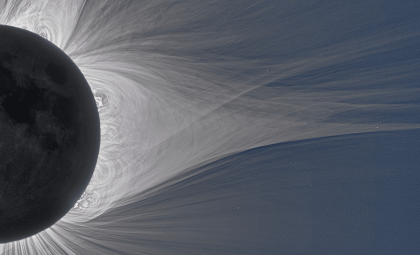
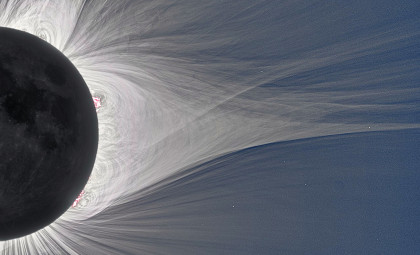
By flying in close coordination, the Proba-3 duo blocks the brilliant solar disk, exposing the subtle features surrounding it. This approach enables researchers to investigate the inner corona, the sun’s hottest atmospheric layer, where critical solar phenomena develop.
These events were captured on September 21, 2025, during a phase of heightened solar activity. Using the mission’s ASPIICS coronagraph, images were taken at five-minute intervals, recording three eruptions over a span of five hours.

Rare Triple Eruption Observed in the Solar Corona
The newly created animation merges imagery from ASPIICS with data from NASA’s Solar Dynamics Observatory (SDO) and its Atmospheric Imaging Assembly (AIA). The dark orange solar disk contrasts with the delicate yellow haze illustrating the inner corona.
Visible in the footage are prominences, which are large, cooler plasma formations suspended close to the sun. These stand out because the surrounding corona reaches temperatures near one million degrees, whereas the prominences are nearer 10,000 degrees.
Such prominences can extend outward before erupting and releasing plasma in multiple directions. Andrei Zhukov from the Royal Observatory of Belgium, leading the ASPIICS project, clarified that these cooler features are occasionally detected near the sun despite the extreme heat nearby.
“Seeing so many prominence eruptions in such a short timeframe is rare, so I’m very happy we managed to capture them so clearly during our observation window,” Zhukov said.

Zhukov expressed satisfaction that their team caught these events with such clarity. This sequence offers scientists a closer examination of the behavior of these cooler plasma structures amid the scorching corona.
Helium Emissions Illuminate Solar Atmosphere Processes
The ASPIICS coronagraph analyzes the corona using various filters that detect distinct spectral lines, with each line representing light from particular elements present in the solar atmosphere.
The prominence eruptions recorded by Proba-3 utilize a spectral line emitted by helium atoms. Observing at this wavelength reveals the solar atmosphere similar to the human eye’s perspective during a total solar eclipse viewed through a yellow filter.
The European Space Agency notes that the gentle yellow illumination encircling the sun in these images results from visible light from the solar surface scattered by electrons within the corona.

By combining data from ASPIICS and AIA, scientists gain complementary perspectives on identical solar activities. While both detect helium emissions, ASPIICS emphasizes the subtle features near the sun’s edge.
A Revolutionary Method for Monitoring the Sun’s Hidden Corona
Proba-3 relies on precision positioning to maintain alignment between its two spacecraft, producing artificial eclipses in orbit—one spacecraft blocks the sun while its partner observes the surrounding corona.
“The corona is extremely hot, about 200 times hotter than the sun’s surface,” explained Zhukov.
This approach grants scientists clearer, consistent views of the inner corona, a section traditionally obscured by the sun’s intense brightness. ESA describes Proba-3 as filling a vital gap in continuous solar monitoring by making this atmospheric layer accessible.
These recent images underscore how artificial eclipses revolutionize solar observation. By recording the dynamics of prominence eruptions, Proba-3 enables detailed tracking of solar events previously difficult to follow.
- Categories:
- Science







0 comments
Sign in to Comment