

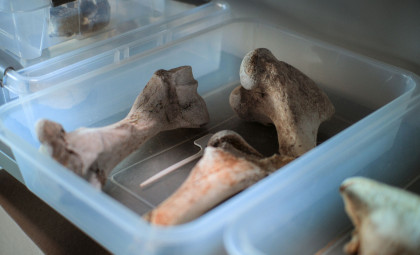
After nearly eight decades in storage, a fossil unearthed in 1948 at Ghost Ranch in northern New Mexico has been recognized as a new species related to crocodiles, dating back 210 million years. This ancient specimen, preserved at Yale University's Peabody Museum of Natural History, had remained unclassified until recent examinations.
Documented in the Proceedings of the Royal Society B, the research introduces Eosphorosuchus lacrimosa as a previously unrecognized genus and species. Notably, it coexisted with the early crocodilian relative Hesperosuchus agilis, despite distinct anatomical differences between the two.
Unique Carnivorous Figure Among Early Croc Kin
Ghost Ranch’s fossil assemblage captures a snapshot of Late Triassic biodiversity, depicting lush river ecosystems that supported various reptiles. Approximately 210 million years ago, Hesperosuchus agilis was adapted for speed, featuring an elongated snout, strong hind legs, and a lightweight frame suitable for pursuit predation.

In contrast, Eosphorosuchus lacrimosa had a shorter snout, a reinforced skull structure, and larger jaw muscles. These traits suggest it was built for delivering powerful bites rather than relying on agility like Hesperosuchus. Both species were discovered together in a single deposit, likely the result of a shared catastrophic burial event.

Bhart-Anjan Bhullar, associate professor of Earth and planetary sciences at Yale University and lead researcher, highlighted in a press announcement that:
“During this period, the late Triassic, there were two reptile dynasties vying for dominance: the line that would produce crocodiles and alligators on one side, and that which would produce birds, which of course are dinosaurs, on the other,” he said.
Unveiling Concealed Details Through CT Scanning
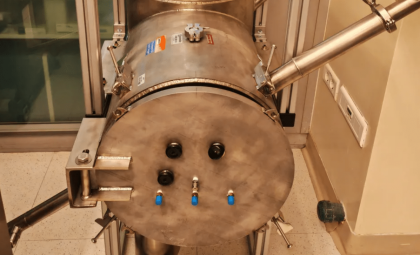
Researchers used computed tomography (CT) scanning to examine hidden fossil parts still encased within rock. Miranda Margulis-Ohnuma, a Yale Ph.D. student and first author, conducted detailed analyses from scans produced at the Yale Chemical and Biophysical Imaging Center, enabling digital separation and in-depth study of the fossil's structure.

The published analysis highlighted distinguishing features from Hesperosuchus, particularly in the skull and facial bones, confirming that the fossil represents a previously unidentified species.
The new genus name Eosphorosuchus merges the Greek term Eosphorus, meaning “dawn,” with soukhos, the word for crocodile, reflecting its place in early crocodilian evolution.
“Eosphorosuchus is one of only a handful of well-preserved early crocodile relatives, and its coexistence with Hesperosuchus represents the ‘dawn’ of functional diversification in the lineage that would give rise to modern crocodiles,” Margulis-Ohnuma explained.
Insights from Ghost Ranch’s Rich Fossil Heritage
The Ghost Ranch Bone Bed has served as a pivotal Late Triassic window for nearly 100 years, revealing fossils ranging from early croc relatives to fish, lizard ancestors, and the dinosaur Coelophysis bauri.
The fossil containing both Eosphorosuchus and Hesperosuchus is curated in Yale’s Peabody Museum of Natural History, stored in two large rock slabs about the size of a car. This newly characterized species highlights the diversity present in ancient crocodilian forms before the group evolved into today’s species.
“It’s a time-slice of a single moment 210 million years ago,” Bhullar said. “These two individuals had to compete and interact with each other. They were quite possibly looking at each other when they died.”

- Categories:
- Science


0 comments
Sign in to Comment