

An unrecognized galaxy distorted by gravitational lensing has been uncovered within archival data from the James Webb Space Telescope focusing on the galaxy cluster MACS J0308.9+2645. This finding highlights that valuable discoveries can still be hidden within publicly available datasets. Initial analysis suggested the galaxy was among the universe’s earliest, but after revised calculations, its redshift is now estimated at around z ≈ 1.4. This shift emphasizes the need for careful photometric assessment when examining extended celestial sources.
Discovering a Peculiar Arc in Webb’s Public Data
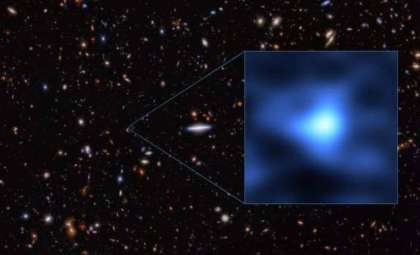
Astrophysicist Homer Dávila Gutierrez found the object, named A1, while exploring public observations from Webb’s Near-Infrared Camera (NIRCam) obtained through General Observer program GO-5293. The surveyed dataset encompassed 54 JWST/NIRCam fields, including 1,591 potential candidates. Among them, A1 stood out as a convincing gravitational lensing feature due to its shape and brightness.
A1 appears highly elongated, with an axis ratio near 6.5, and its longest axis aligns tangentially to the cluster’s core—typical of how gravity from mass concentrations stretches background light. Though distorted, its brightness allowed detailed follow-up. Strikingly, it was missing from all known astronomical catalogs and lensing records.

Gutierrez commented,
“Second, its brightness: it is the brightest of the highly elongated sources at that radius, which made it measurable. And third, its absence from every catalog: it does not appear in the published strong-lensing inventory of this cluster, nor in SIMBAD, NED, or VizieR.” That absence led him to check directly with the observing team. “When I contacted the GO-5293 team, they confirmed it did not overlap with the systems they were analyzing. A real, bright, uncataloged arc-like source in a massive Planck–selected cluster—that is what made it worth pursuing.”

Revised Distance Alters Understanding
The findings, available on the arXiv preprint server, underscore that deriving a galaxy's distance is just an early step in astrophysical study. An initial photometric redshift estimate using EAZY indicated a high redshift near z ≈ 4.4, which would position the galaxy within the universe's first billion years, capturing significant early cosmic history.
However, A1’s extended, distorted shape complicated automated photometric measurements, as standard catalog apertures missed some light, skewing its measured colors and biasing the redshift estimate. Once the photometry was adjusted to better include the galaxy’s full structure, its redshift estimate dropped. Gutierrez explained the update:
“With the corrected photometry, A1 is a galaxy at z ≈ 1.4—we see it as it was roughly 9 billion years ago—lying behind the cluster MACS J0308.9+2645 (z = 0.356), one of the most massive clusters known. Its light passed close to the cluster on its way to us, and the working interpretation, shared by the program team’s lensing experts, is that it is a singly lensed image: stretched and modestly magnified by the cluster’s gravity, but not multiply imaged.”
This update significantly changes the cosmic narrative for A1. It is no longer considered a very early universe object but remains an important example of how gravitational lensing by massive clusters can reveal distant galaxies.
Galaxy Clusters Acting as Cosmic Amplifiers
The striking form of A1 results from a fundamental aspect of Einstein’s general relativity: gravity warps spacetime and bends light paths. Massive galaxy clusters, containing galaxies, hot gas, and dark matter, produce intense gravitational fields capable of magnifying and distorting light from background galaxies. When such distant galaxies lie along the Earth's line of sight behind a cluster like MACS J0308.9+2645 at z = 0.356, the cluster can act as a natural telescope.
A1 is located about 51 arcseconds from the cluster’s X-ray center, and its tangential elongation supports gravitational lensing as the cause of its appearance. Current assessment suggests A1 is a single lensed image, meaning the cluster’s gravity stretched and brightened its light but didn’t produce multiple observable copies. More refined gravitational lens models are required to confirm this interpretation.
“Its projected position, about 51 arcseconds from the cluster’s X-ray center, and its tangential elongation are consistent with that picture. The definitive test—an updated lens model of the cluster built from the new JWST data—is in progress.”
Such models will determine if the galaxy’s position, shape, and magnification agree quantitatively with the cluster’s mass distribution.

A Second, Dimmer Arc Presents Further Uncertainty
The search also revealed another source, called A2, which shares some morphological features with A1 but is fainter and smaller, complicating its interpretation. Although A2 lies at a similar projected distance from the cluster core and is even more elongated, its photometric data are less reliable.
The same photometric aperture issues affecting A1’s initial distance estimate have an even stronger impact on faint, extended objects like A2, making robust redshift determinations difficult. Gutierrez is cautious about claiming a definitive redshift until improved corrections are applied to A2's photometric measurements.
“And that matters: the photometric issue that affected A1’s original redshift estimate—catalog aperture magnitudes that capture only a small fraction of an extended source’s light—applies even more strongly to a faint source like A2. So I treat its nature and redshift as open questions pending the same corrected reanalysis I applied to A1,” Gutierrez said.
Thus, A2 remains a candidate galaxy influenced by lensing, illustrating that morphology alone doesn’t confirm an object’s distance or identity.
The Growing Role of Webb’s Data Archive in Uncovering Cosmic Objects
A1’s significance extends beyond the galaxy itself to where it was discovered. Since beginning science operations in 2022, JWST has amassed a vast public archive of observations from various research programs. Once the proprietary period expires, these datasets provide rich opportunities for independent researchers.
This reuse of archival images allows new discoveries unrelated to the original purpose of observations. A1 exemplifies how archival data can reveal previously unrecognized objects while demonstrating the importance of rigorous analysis before declaring unusual findings.
The ultimate value here was the reassessment of A1’s distance, underscoring the careful evaluation needed when cataloging faint, extended sources in large surveys generated by Webb.
Upcoming Studies Will Clarify A1’s True Nature
The key question now is whether new mass models of MACS J0308.9+2645 can recreate the lensing setup that explains A1’s shape and location. This involves simulating the mass distribution of the cluster’s visible matter and dark matter and calculating the resulting gravitational effects on background galaxies.
If modeled predictions match A1’s observed lensing features, it will confirm the galaxy is a singly lensed, gravitationally amplified system at about z ≈ 1.4. Conversely, discrepancies might require rethinking its classification. This collaboration between archival scientists and the original observation team illustrates how teamwork maximizes the potential of Webb’s public data. Gutierrez remarked,
“The most rewarding part of this process has been exactly that: the GO-5293 team responded generously, confirmed the object was uncataloged, and we are now working with their updated lens model to establish A1’s nature definitively. Independent researchers and program teams collaborating over public data—that is Webb’s archive working exactly as intended.”
With Webb generating vast deep-infrared datasets, repeated reexaminations of its archives could uncover surprises. Future landmark discoveries may already reside unnoticed within images taken months or even years ago.
- Categories:
- News



0 comments
Sign in to Comment