

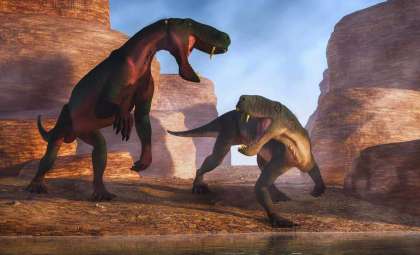
About 300 million years ago during the Early Permian period, Dimetrodon was the dominant carnivore, preying on large amphibians and other creatures. Although it resembled a reptile with its distinctive sail, this ancient predator was not part of the dinosaur lineage but belonged to the synapsid group, which eventually led to the evolution of mammals.
This classification corrects a long-standing misunderstanding rooted in early fossil finds. Initially, Dimetrodon was confused with dinosaurs, but further investigation positioned it firmly on the mammal-related branch of the vertebrate tree.
Scientists remain intrigued by many aspects of this creature, particularly the function of its pronounced dorsal sail. Meanwhile, research on its teeth has shed light on its feeding habits. “These predators had a very broad diet,” explained Kirstin Brink, a paleontologist from the University of Manitoba.

From Misclassified Dinosaur to Synapsid Spotlight
The journey of Dimetrodon's classification started in 1845, when a fragment of an upper jaw was discovered on Prince Edward Island. Originally named Bathygnathus borealis, it was mistakenly thought to be one of the earliest dinosaurs. Later studies disproved this, showing that dinosaurs, birds, and modern reptiles belong to the sauropsid group, whereas Dimetrodon is a synapsid. Brink and her team played a key role in revising the fossil’s taxonomy.
“We are actually closer related to Dimetrodon than any other reptile is,” Brink said, although Dimetrodon was probably not a direct ancestor of mammals.
The team proposed renaming the fossil Dimetrodon borealis in a 2015 article in the Canadian Journal of Earth Sciences. This approach preserved the widely recognized Dimetrodon name through an uncommon taxonomic reversal. Today, at least 14 species are known, but as Brink notes, their classification remains somewhat complicated, with some specimens possibly representing juvenile forms of other species.
The Enigmatic Sail: More Than Heat Regulation?
The sail running from neck to tail base is perhaps Dimetrodon’s most iconic trait but also one of its biggest mysteries. Unlike flexible sails of modern reptiles like basilisk lizards, these structures were rigid. One leading idea suggests the sail helped regulate body temperature by capturing sunlight during basking.

However, anatomical investigations challenge this explanation. Fossilized sail cross sections showed a lack of sufficient blood vessel channels necessary for effective heat exchange. Brink also highlighted that the closely related synapsid Sphenacodon had a similar body shape but lacked any sail.
“It maybe suggests that they weren’t using it just for thermoregulation,” she said.
Alternative theories propose that the sail was used for visual display purposes such as camouflage, attracting mates, or intimidating rivals. Unfortunately, no pigment data has been preserved to confirm these ideas. As Brink summarized:
“The sail was definitely confusing, and I think it still is confusing.”
Insights into Feeding from Tooth Anatomy
Dimetrodon could reach impressive sizes, with species like Dimetrodon grandis growing longer than 2 meters. All species were meat-eaters, though smaller individuals may have consumed insects.
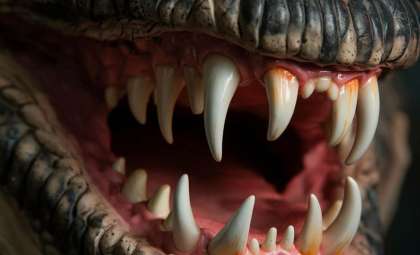
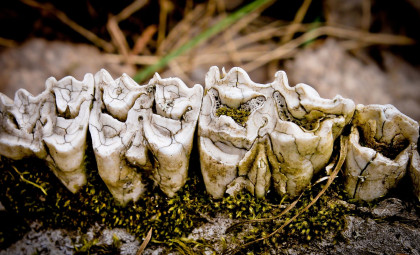
Its teeth offer vital clues regarding diet. A study led by Brink and published in Nature Communications revealed mostly blade-shaped teeth, with later fossils showing teeth extending deeper into the gums and featuring serrated edges. Early Dimetrodons hunted other predators, including amphibians like Diplocaulus and Eryops. As herbivores appeared during the Permian, these became additional prey options.

Dimetrodon’s reign concluded by the end of the Cisuralian epoch during the Permian. It had vanished well before the end-Permian mass extinction 252 million years ago, an event considered the most extensive species loss recorded on Earth, according to Britannica.

- Categories:
- Science

0 comments
Sign in to Comment