

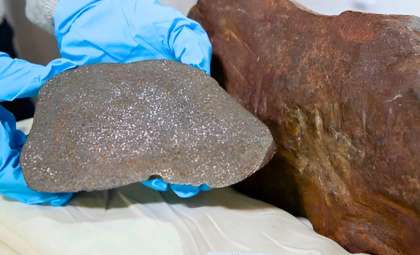
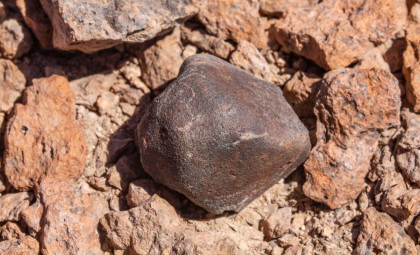
Researchers have uncovered a new kind of rock within a meteorite from Mars that hosts andradite garnet, a mineral typically known as a gemstone on Earth. This finding points to the possibility that the garnet formed within the Martian interior. The rock was identified inside the NWA 8171 meteorite, which was recovered from the Sahara Desert in 2013.
Detailed examination revealed a garnet-rich section, a feature previously unconfirmed in Martian crustal rocks. Despite decades of exploration by orbiters, landers, and rovers, meteorites sourced from Mars continue to provide unique insights by enabling direct laboratory study rather than relying solely on remote observations.
The scientists emphasize that minerals like garnet preserve valuable records of a planet’s evolution. This newly identified garnet-bearing rock offers important evidence to better understand the geological processes that influenced Mars throughout its 4.5-billion-year existence.

A Hidden Gemstone Within an Unconventional Martian Sample
On our planet, garnet is prized as a colorful gemstone and recognized as the traditional birthstone for January. Beyond its aesthetic value, its chemical makeup helps geologists deduce the conditions present during its formation. The andradite garnet found in NWA 8171 is often yellow-green and can also appear as demantoid, a valuable gem form. Garnet comes in various types including almandine, pyrope, and grossular.
On Earth, andradite typically crystallizes in skarn environments, formed through heat and fluid interactions that metamorphose existing rocks. These settings are commonly linked to dynamic plate tectonics, where crustal movements generate high temperatures and pressures.

Since Mars lacks active plate tectonics, this discovery challenges existing models and fuels questions about the extent of geological activity beneath its crust.
The team, publishing their work in Geochemical Perspectives Letters, propose that this garnet-rich portion could represent a newly identified kind of Martian metamorphism. Alternatively, it might stem from a rare volcanic rock formed through ancient magma processes.
A Martian Fragment Unveiling Planetary Secrets
The garnet-containing meteorite is classified as NWA 8171, a member of the Martian polymict regolith breccia meteorite group. These meteorites are composed of various fragments fused together after early impacts on Mars.
Several analytical lines confirm the rock’s Martian roots. Trapped noble gases inside align with Mars’ atmospheric composition, while its mineralogy and oxygen isotope patterns correspond with known Martian characteristics.
Oxygen isotopes serve as distinct planetary signatures, aiding scientists in tracing a rock's origin. NWA 8171 is linked to 18 related fragments, including the well-documented NWA 7034, nicknamed Black Beauty.
The meteorite's complex makeup complicates interpretations since components were blended by impacts, requiring meticulous study of individual fragments to unravel their histories.
The Enigma of the Martian Garnet-Containing Rock
Strong evidence points to the garnet-rich fragment's Martian origin. Associated pyroxene crystals share chemical traits with other Martian minerals, and its texture resembles that of other pieces within NWA 8171.
The researchers emphasize that embedding this fragment within a confirmed Martian meteorite provides a compelling link, yet remain cautious because regolith breccia meteorites may include components with distinct origins.

Given the breccia’s composite nature, some fragments might theoretically derive from other sources within the Solar System.
A definitive test involving detailed oxygen isotope analysis would offer stronger proof, though it requires sampling the meteorite. For now, the team opts to continue investigations before performing this destructive method.
- Categories:
- Science







0 comments
Sign in to Comment