

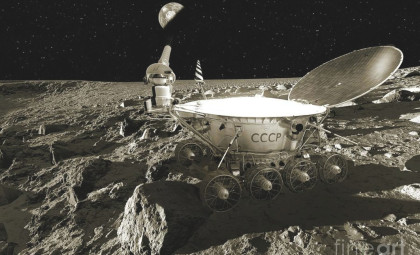
A diminutive mirror left behind on the Moon by the Soviet space program was considered lost for many years. However, in 2010, researchers pinpointed the location of the Lunokhod 1 rover and successfully reactivated its neglected laser reflector. The saga began in November 1970 when the Luna 17 spacecraft delivered Lunokhod 1 to the Mare Imbrium. The rover traversed the lunar landscape for approximately eleven months until its heater malfunctioned, causing it to cease communication in 1971.
Positioned at the rover's front was a compact yet ingenious device: a French-engineered laser retroreflector composed of fourteen glass prisms. Its purpose was straightforward yet highly accurate: to reflect laser beams sent from Earth directly back to scientists on the ground. Although the reflector remained intact on the Moon, its exact location was unknown.
For nearly four decades, this mirror remained effectively missing. That changed when NASA’s Lunar Reconnaissance Orbiter captured images that unveiled the rover's whereabouts, enabling scientists to target the reflector once again.

NASA’s Lunar Imaging Reveals the Lost Rover
The difficulty with Lunokhod 1 wasn’t just identifying the rover but obtaining coordinates precise enough to utilize its laser reflector. Lunar laser ranging demands pinpoint accuracy because researchers aim to strike a small target more than 384,000 kilometers away.
As detailed by the Science Blog, the Soviets recorded some initial positioning data after deployment, but the specifics needed for contemporary research weren’t readily accessible. As years passed, efforts to relocate the reflector dwindled.

This changed when NASA’s Lunar Reconnaissance Orbiter began high-resolution lunar mapping in 2009. The orbiter’s camera revealed both the rover and its path, allowing a team led by Mark Robinson at Arizona State University to determine its location with an accuracy of about 100 meters.
With updated coordinates in hand, the APOLLO laser ranging group at Apache Point Observatory in New Mexico resumed attempts. Directed by Tom Murphy from the University of California San Diego, they focused a 3.5-meter telescope toward the rover’s position.
“It turns out we were searching around a position miles from the rover,” said Murphy, as quoted by Science Daily. “We could only search one football-field-sized region at a time. The recent images from LRO, together with laser altimetry of the surface, provided coordinates within 100 meters, and then we were in business and only had to wait for time on the telescope in good observing conditions.”
On April 22, 2010, scientists fired the first laser pulse at the long-unseen reflector. The signal bounced back, demonstrating that the tiny device was still functional after years on the Moon.
Remarkable Performance from a Decades-Old Soviet Mirror
The strength of the returned signals astonished researchers. Not only was the reflector operational, but its efficiency exceeded expectations after so many years exposed to the harsh lunar environment. Comparisons were made with the reflector from Lunokhod 2, another Soviet rover. Initial readings from Lunokhod 1 returned about 2,000 photons per session, whereas Lunokhod 2 delivered signals of roughly 750 photons.
Further analysis of the APOLLO data revealed that the Lunokhod 1 reflector returned signals roughly four to five times stronger than the Lunokhod 2 mirror. Scientists attributed this to better preservation due to less lunar dust accumulation and milder temperature variations at Lunokhod 1’s higher latitude location compared to Lunokhod 2.

Following its rediscovery, the reflector was reintegrated into the ongoing lunar laser ranging program, joining reflectors left by the Apollo missions and the Lunokhod 2 device.
A Cold War Era Mission Continues to Support Scientific Advancement
Recovery of the reflector was driven by more than historical interest. Lunar laser ranging enables precise measurement of the Earth-Moon distance by timing laser pulses’ roundtrip duration. These measurements have revealed the Moon’s gradual recession from Earth at about 3.8 centimeters per year due to tidal forces.
This technique also offers ways to scrutinize Einstein’s theory of general relativity, shed light on lunar interior properties, and refine our understanding of Earth’s rotation and precision timekeeping. According to a NASA report, the five functional reflectors on the Moon serve as crucial fixed points for these experiments: three installed during Apollo 11, Apollo 14, and Apollo 15, and two left by Soviet Lunokhod missions.

The journey of Lunokhod 1 is extraordinary—a Cold War-era rover equipped with a French instrument, now aiding scientific inquiry over fifty years post-landing.
“Not only now do we know that Lunokhod 1 is there, we also know that it is parked perfectly so that its reflector faces earth,” explained Murphy. “In fact, the signal is so surprisingly strong that the rover could not be in anything but a level parking spot with its last commanded roll on the lunar surface deliberately oriented toward the earth.”
- Categories:
- Space



0 comments
Sign in to Comment