

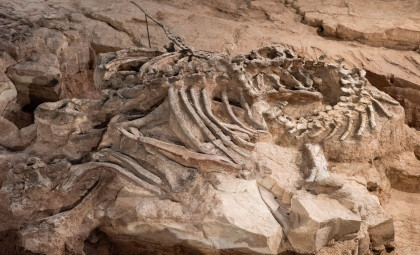
Typically, dinosaur fossils offer only skeletal remains, leaving scientists to infer details about skin texture, body shape, coloration, and armor coverage from limited clues. Soft tissues and skin are rarely conserved through the ages.
However, in northern Alberta, a dinosaur specimen was found with an extraordinary level of preservation, revealing body contours, individual scales, and armor that remained in place around its neck, shoulders, and back.
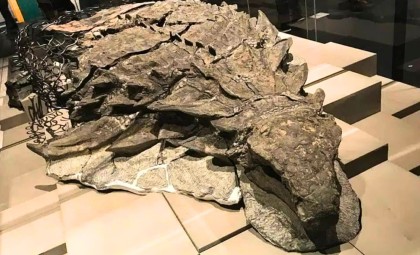
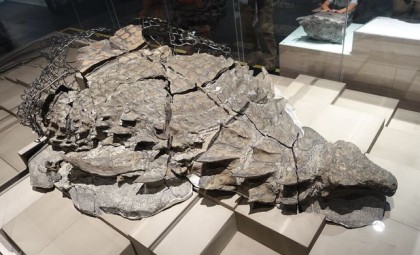
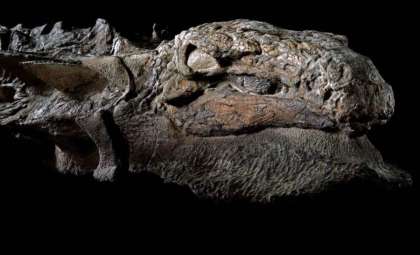
This dinosaur, identified as Borealopelta markmitchelli, is an armored herbivore, fossilized in three dimensions with extensive skin and protective coverings still affixed to the skeletal framework. A study published in Current Biology details the preservation of scales, bony armor plates, keratinous sheaths, and organic material used to reconstruct the living appearance of this ancient creature.

Exceptional Preservation Beyond Bones
Calling the specimen a “mummy” can be misleading since internal organs were not preserved intact. The unique aspect of this fossil lies in the survival of skin and soft tissues, including epidermal scales and horny coverings enveloping much of the armor.
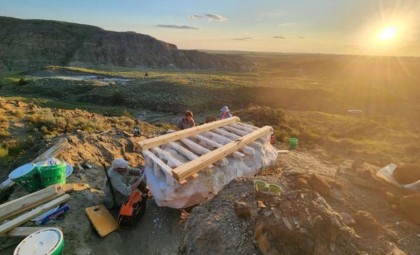
Dating back approximately 110 million years to the Early Cretaceous period, the dinosaur roamed what is today Alberta. It was unearthed in March 2011 at the Suncor Millennium Mine near Fort McMurray when operator Shawn Funk noticed atypical material embedded in the rock.

While Borealopelta was a terrestrial animal, its remains were discovered in marine sediment, suggesting the body drifted into an ancient sea and settled on the seafloor. The swift burial helped shield it from decay and disturbance.
At the Royal Tyrrell Museum of Palaeontology, curator Donald Henderson contributed to the fossil's extraction and analysis. His research employs computer simulations to study extinct creatures’ locomotion, weight distribution, and ecological interactions.
Patient Preparation Over Thousands of Hours
Despite its remarkable state, extracting the fossil proved difficult. Per The Atlantic, the massive rock containing the fossil weighed roughly 15,000 pounds and fractured during removal.
Over more than five years, technician Mark Mitchell dedicated upwards of 7,000 hours meticulously removing the encasing stone. In honor of his effort, the species name markmitchelli was bestowed.
The final display differs greatly from typical flat fossils, preserving much of the dinosaur’s original shape, individual scales, and armor configurations across key body regions.
Simply put, this allowed paleontologists to rely less on speculation.

The team could examine the precise alignment of scales over the bony armor and inspect the keratinous coverings atop larger defensive features. The fossil also retains prominent shoulder spines, illustrating how the armor integrated with the living animal rather than existing as separate bones after death.
This external preservation also revealed another layer of information.
Insights into Dinosaur Coloration and Camouflage
Chemical analyses suggest the dinosaur exhibited reddish-brown coloration, with a distinct pattern known as countershading—a darker back and lighter underside.
In modern animals, countershading functions to reduce shadowing and flatten appearance, aiding concealment. This finding is intriguing because Borealopelta was heavily armored.
Estimated to weigh over 1,300 kilograms (approximately 2,900 pounds), the dinosaur likely faced predation threats. The researchers propose that camouflage complemented its physical defenses, as armor alone might not have sufficed.
Caleb Brown, a researcher at the Royal Tyrrell Museum who studied the camouflage evidence, told The Atlantic that while many assumed armored dinosaurs were well-protected, the presence of camouflage patterns implies they also benefited from reduced visibility.
Some skepticism remains about the color analysis. Alison Moyer, an expert in ancient molecules, told The Atlantic that marine burial environments and decomposition prior to fossilization could have altered the chemical signatures.
Reconstructing fossil pigmentation is challenging because scientists must differentiate original coloration signals from chemical changes accumulated over millions of years. In this case, the specimen spent around 110 million years encased in sediments on what was once an ancient seabed.
Detailed Record of Armored Dinosaur Physiology
Even without complete certainty about all color aspects, Borealopelta offers unprecedented insights into the anatomy of armored dinosaurs. Skin scales remained linked to the underlying bone plates, and major defensive structures still show traces of their keratinous coverings.
The Current Biology study also suggests some armor elements might have exhibited distinct pigmentation patterns, indicating possible visual signaling functions beyond defense.
The arrangement of armor and skin structures across the dinosaur’s neck, shoulders, and back can still be observed—details lost in most fossils before fossilization completes.
Borealopelta remains understood as a whole organism, not simply a skeletoned reconstruction.
- Categories:
- Science



0 comments
Sign in to Comment