

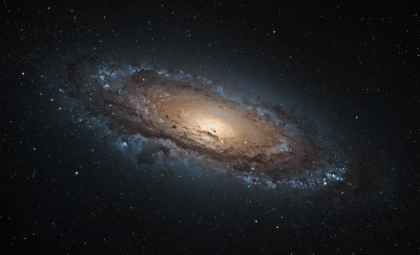
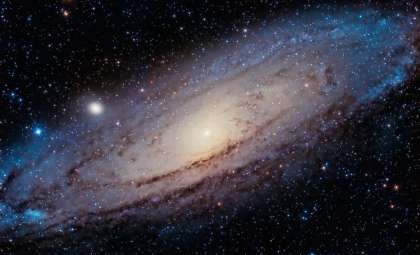
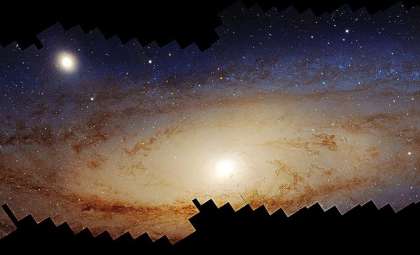
The Andromeda galaxy has been showing a gradual decrease in star creation over the past 500 million years, with a more pronounced drop during the last 40 million years, according to new findings from NASA’s Hubble Space Telescope.
Situated about 2.5 million light-years away from Earth, Andromeda’s proximity allows astronomers to study its individual stars across the galactic disk. This makes it an exceptional case for examining how stellar populations evolve and how galaxies undergo slow transformations.
Published in The Astrophysical Journal, this study integrates data from two significant Hubble surveys: the Panchromatic Hubble Andromeda Treasury and the Panchromatic Hubble Andromeda Southern Treasury. These datasets enabled scientists to chart nearly two-thirds of Andromeda’s disk and investigate the histories of around 200 million stars.

The investigation capitalized on the principle that stars hold clues to their galaxy’s past activity. Young blue stars suggest recent star formation, whereas older red stars indicate regions where new star births have slowed down.
Hubble Reveals Evolution of Andromeda's Star Population
To trace Andromeda's evolving dynamics, the team segmented its disk into thousands of areas roughly 300 light-years square. Each segment's star formation history was assessed in detail.
As outlined by NASA, the researchers compared the presence of younger blue stars with older red stars. Sections rich in blue stars pointed to more recent activity, while regions dominated by redder stars reflected a decline in star formation.
This method afforded an unprecedentedly detailed glimpse into the galaxy’s development. Ben Williams, astronomer at the University of Washington and study co-author, remarked:
“We need to measure the individual stars because they are the fossil record of the galaxy’s formation,” Williams said. He added that: “Hubble is the only telescope that can give you high enough spatial resolution over a large enough area to be able to do that in Andromeda.”

Previous investigations revealed that Andromeda underwent an intense starburst about 2 billion years ago, probably triggered by a merger or interaction with another galaxy. The new study delves into the subsequent gradual slowdown in star-making.
Decline in Star Creation Following Andromeda’s Peak
The scientists estimated that approximately 500 million years ago, Andromeda was forming stars at a pace close to one solar mass annually. By about 40 million years ago, this rate had decreased to nearly half that. Today, its star formation has slowed further, down to roughly one-fifth of a solar mass per year. The team evaluated if this decline was global across the disk or localized to particular zones.
Results indicated that star formation has mainly been confined to a star-forming ring roughly 32,000 light-years from the galactic center. The reduced activity within this ring explains much of the overall downturn.

The study found no evidence suggesting the star formation drop resulted from a sudden depletion of star-making material. Instead, it appears to be a gradual fade following a more intense past era.
“It’s just like after running a marathon, sometimes you’ve got to take a bit of a breather,” said Tobin Wainer, lead author of the study from the University of Washington, describing the galaxy’s reduced activity.
Exploring M32’s Role in Andromeda’s Star Formation Drop
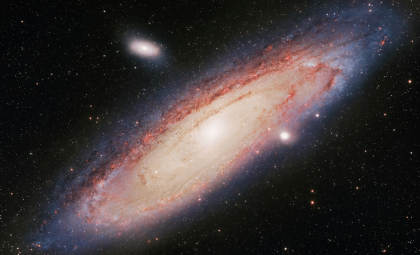
The team also investigated whether M32 (Messier 32), a nearby dwarf companion galaxy, might be linked to the recent decline in Andromeda’s star formation. M32 lies about 16,000 light-years away in the sky’s plane, though its actual three-dimensional position remains uncertain, making it unclear if or when it interacted with Andromeda.
Using data from the Panchromatic Hubble Andromeda Southern Treasury, researchers examined Andromeda’s regions near M32, noting a reduction in star-forming activity that contrasted with other areas of the galaxy.

The onset of this decline, estimated around 60 million years ago, may clarify whether Andromeda’s disk was influenced by M32’s passage.
“One of the major motivations for this program was to probe potential interactions between M32 and Andromeda’s disk,” said Zhuo Chen, co-author of the study at the University of Washington.
While the evidence does not conclusively prove that M32 caused the reduction in star formation, it remains a leading candidate. “It’s right there, and it’s definitely the most likely suspect,” Wainer remarked.
The researchers plan to continue scrutinizing the extensive Hubble archive alongside observations from ground-based telescopes. NASA’s forthcoming Nancy Grace Roman Space Telescope is also set to explore Andromeda’s disk and its encompassing halo.
“There’s a strong scientific value to this archival data. Andromeda is important because it’s a neighbor that is close enough that we can see it in great detail while also getting a global perspective,” the study’s co-author, Raja GuhaThakurta of the University of California Santa Cruz, explained.
- Categories:
- Astronomy




0 comments
Sign in to Comment