

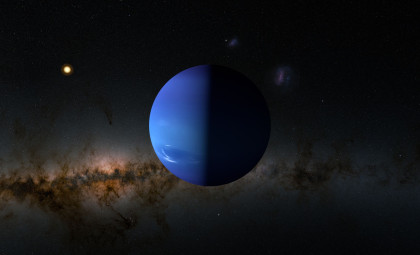
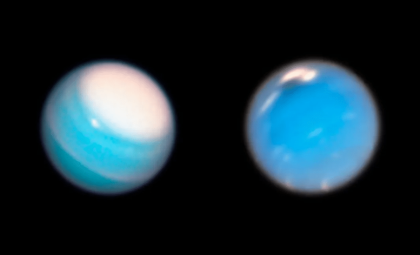
Researchers have managed to produce an extraordinary form of ice that remains solid at temperatures exceeding 2,000°C by subjecting water to extreme pressures. This breakthrough may provide insight into the conditions inside the ice giants Uranus and Neptune, where such exotic water phases could exist.
By trapping a tiny droplet of water between two diamonds and applying intense pressure—millions of times greater than Earth’s atmospheric pressure—and then heating it with lasers, the team found that the water did not vaporize as expected.
This peculiar state, known as superionic ice, differs from conventional ice because its oxygen atoms form a rigid lattice while hydrogen ions flow freely within it. This dynamic atomic arrangement allows the substance to conduct electricity.

Understanding superionic ice has been a focus for scientists for years, given its potential role in explaining phenomena observed in the outer planets of our solar system.
Water Adopts a Unique Structural Phase
The study demonstrated that water can hold a solid form even under conditions that would typically melt ordinary ice. Pressures reached up to 219 gigapascals with temperatures around 2,630 kelvins (~2,357°C).
Under these intense conditions, water transformed into hexagonal close-packed (hcp) ice, which became the preferred structural phase as heat and pressure increased, according to findings published in Physical Review Letters.
The key difference lies in the atomic arrangement: oxygen atoms remain fixed in a crystalline matrix while hydrogen ions move fluidly through this framework. This fluidity contributes to the ice’s electrical conductivity.
Although the concept of superionic water was proposed over three decades ago, solid experimental proof began to emerge in 2018, followed by 2019 experiments that directly revealed its atomic structure.

Investigating Water at Unprecedented Pressures
Under the leadership of Alexis Forestier from the French Alternative Energies and Atomic Energy Commission, scientists employed a diamond-anvil cell to confine microscopic water samples between two diamonds.
The samples were heated using lasers, with boron-doped diamonds absorbing energy, and analyzed via X-ray beams at the European Synchrotron Radiation Facility. At peak pressure, the sample measured about 12 micrometers across. Increasing pressure gradually reorganized the atomic structure, with the hexagonal close-packed phase becoming increasingly dominant.
The transformation reflected a rearrangement of oxygen atoms into a new pattern rather than a change in the chemical identity of the water. This subtle shift impacted hydrogen ion mobility and overall material behavior.
Researchers observed that this phase transition happened progressively as atomic layers shifted incrementally rather than abruptly.
Clues to the Magnetic Fields of Uranus and Neptune
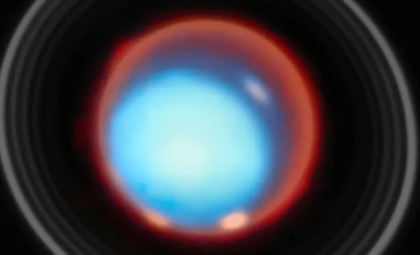
The unusual properties of superionic ice may offer explanations for the magnetic field peculiarities seen on Uranus and Neptune. These distant planets display magnetic fields unlike Earth's, characterized by significant tilts and complex geometries. Scientists propose that conductive layers deep within these planets contribute to their magnetism. Since superionic ice conducts electricity, it stands as a strong candidate for the source of these layers.
The new discovery of hcp superionic ice is poised to influence future models of water inside giant planets. Prior studies had identified various superionic phases, including both fcc and hcp forms, existing at pressures above roughly 150 gigapascals and temperatures near 2,500 kelvins.
The researchers also identified unusual expansion around 1,700 kelvins (~1,427°C), linked to superionic phases. Much of the expansion occurred anisotropically, suggesting hydrogen ions migrate more easily along specific channels within the crystal lattice.

Critical questions remain about where exactly this form of ice may exist inside planetary interiors and its detailed properties. Nevertheless, this experiment reveals that water under extreme conditions can become an exotic substance unlike anything typically encountered on Earth.
- Categories:
- Astronomy




0 comments
Sign in to Comment