

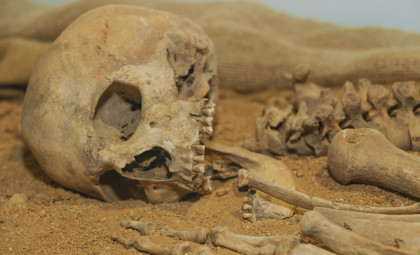
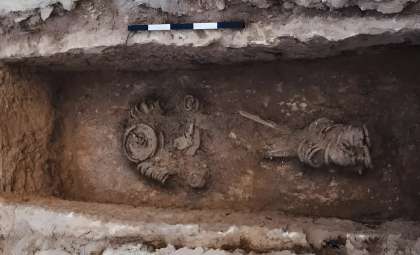
Archaeologists uncovered a young woman’s burial featuring a sickle placed over her neck and a triangular wooden padlock fastened to her left big toe. These unique burial artifacts were found in 2022 at a mass grave site in Pień, Poland. The cemetery itself remains unmarked, but has been under investigation by Nicolaus Copernicus University since 2005.
At the time of death, the woman, nicknamed Zosia, was estimated to be between 18 and 20 years old. Although sensationalized in the press as a “vampire grave,” Dariusz Poliński, head of the excavation, prefers to interpret the burial customs as traditional anti-vampirism practices designed to safeguard the living from the dead.
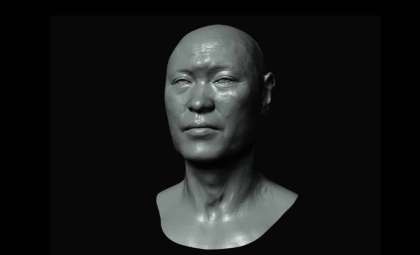
Nearly four centuries after her death, Swedish forensic artist and archaeologist Oscar Nilsson crafted a facial reconstruction based on a 3D-printed replica of her skull, using anatomical data and evidence from her remains. This reconstruction gives a glimpse into the appearance of the woman who has sparked significant media attention related to Polish vampire folklore.


According to Reuters, Nilsson highlighted the contrast between the burial conditions and his facial portrayal. “We have strived to bring her back to life as accurately as possible,” he explained.
Breathing Life Into a 17th-Century Face
The process began with a 3D-printed replica of Zosia’s skull. Nilsson attached markers denoting tissue thickness, sculpted facial muscles from clay, placed eyeballs, and layered additional material to form skin and other soft tissues. The painstaking reconstruction can require 200 to 400 hours, according to Nicolaus Copernicus University.
Some facial features remain difficult to pinpoint—especially the ears and nose tip—while skin, eye, and hair colors are often speculative when DNA tests don’t provide conclusive information.
In Zosia’s case, DNA testing was unable to determine pigmentation traits. Live Science reported that genetic and isotope analyses suggest her origins extend to southern Scandinavia, possibly Sweden. Nilsson chose to depict her with pale skin, blue eyes, and dark blond hair. Bone studies indicate she stood approximately 162 centimeters (5 feet 4 inches) tall.
The remains also revealed additional health insights.

Signs of a painful but non-fatal cancer were present in her sternum. Her cervical vertebrae displayed Kimmerle’s anomaly, a condition linked to severe headaches or sudden fainting episodes. Additionally, Harris lines found in her shin bones may indicate episodes of childhood malnutrition or physiological distress, though these interpretations are debated.
Poliński hypothesizes that physical or mental health issues might have led to Zosia’s ostracization. Nilsson also associates her unusual burial with these health struggles.
What her community knew about her health remains unclear, as the available evidence does not definitively explain her treatment in life or death.
Symbols of Status Found in Burial
Despite the unusual burial, Zosia’s grave contained indications of wealth. Fragments of a silk bonnet alongside remnants of a gold brocade ribbon were uncovered.
Nilsson told Live Science that the luxurious fabric suggests affiliation with an affluent or possibly noble family. Textile expert Maria Cybulska, who specializes in historic textiles at Lodz University of Technology, identified the ribbon’s style as characteristic of the 17th century.
For the final portrait, Anna Silwerulv, a researcher at Stockholm’s Vasa Museum, bespoke clothing that reflects Zosia’s suggested high social standing.

Zosia’s was not the only distinctive grave at the Pień site. Around a third of nearly 100 graves displayed “deviant” burial practices—where individuals were interred differently from the norm. Items like stones and padlocks in graves have been interpreted as methods to stop the dead from rising.
Another peculiar detail emerged from Zosia’s remains.
The green staining found on her palate suggests a small piece of copper had been placed in her mouth. The sickle crossed her neck, while the padlock was fastened around her toe.
Speaking to Live Science regarding Zosia’s story, Nilsson remarked that although she was in need of medical assistance, she was instead feared and treated as “something dangerous and vicious.”
To inject personality into the reconstruction, Nilsson chose to portray Zosia glancing back over her shoulder, a detail unseen in skeletal remains but evocative of her enduring story.
- Categories:
- Science






0 comments
Sign in to Comment