

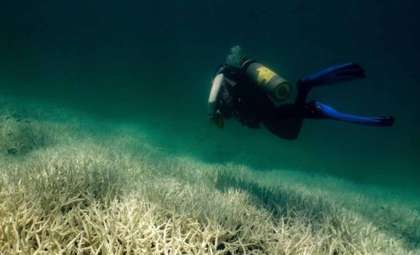
Hidden more than 50 meters beneath the ocean surface near the coast of Benin, a coral reef once thought lost has been brought back into the spotlight. This vibrant ecosystem, situated in the Gulf of Guinea, represents a living example of a mesophotic coral ecosystem, surprising marine biologists focused on deep-water habitats.
The reef’s history dates back to the 1960s when early fishing expeditions hinted at the presence of coral growth in West African waters. Due to limited technology at the time, scientists concluded that the reef was likely inactive or dead.
Now, more than five decades later, Gérard Zinzindohoué and his team from the Benin Fisheries and Oceanological Research Institute revisited the site with advanced tools. Utilizing detailed sonar imaging, remotely operated underwater vehicles, and the National Geographic Exploration Technology Lab’s Deep Sea Camera System, researchers explored an environment that had remained largely unexplored for years.

A recent publication in Frontiers in Marine Science dated July 19 marks this as the first confirmed discovery of a living mesophotic coral ecosystem on the continental shelf in the Gulf of Guinea.
Sonar Technology Reveals a Long-Forgotten Reef
Initial scans from the expedition appeared unremarkable, with seafloor images dominated by sand and sediment. However, the sonar soon detected rugged rocky formations suggesting something more significant beneath the waves.
“The first thing that gave us hope was our first deployment of the sonar. We were seeing nothing but sand and sediment, and suddenly we could see some rocky structure,” Zinzindohoué said.

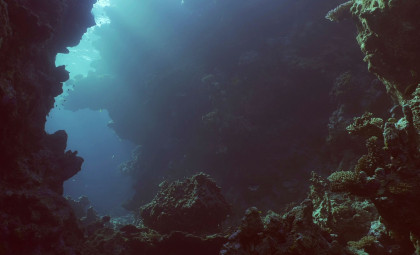
These sonar signals directed researchers toward what appeared to be coral formations. Subsequent inspections with underwater cameras showed that the structures were alive, revealing a thriving ecosystem bustling with diverse coral species and marine organisms. Unlike the expansive, continuous reefs typical in shallow waters, this reef consists of dispersed coral clusters attached to rocky seabeds.
Coral Communities Thriving in Low-Light Depths
The rediscovered reef forms part of mesophotic coral ecosystems, which inhabit the ocean’s dimly lit “twilight zone,” where sunlight is scarce. Such reefs typically spread out in patches instead of forming a single large structure, differing notably from the shallow, unified reefs seen elsewhere.
The published research explains that mesophotic coral formations grow in areas with much less light than common shallow reefs. This matches observations of the Benin reef, where coral colonies are scattered over rocky outcrops rather than creating a continuous ridge. The finding emphasizes that coral ecosystems can survive in hard-to-reach, understudied parts of the ocean.

Images captured during the research reveal that this reef system remains alive and active, overturning past assumptions that it had vanished long ago.
New Discoveries Raise Future Questions
While this discovery answers some questions, it also opens new avenues for investigation. It remains unclear whether the reef has remained continuously healthy since the initial 1960s observations or if it has experienced cycles of damage and recovery.
Forthcoming expeditions will gather coral samples and map additional seabed areas along the West African coast. These efforts aim to ascertain the reef’s full extent and understand its historical development. Zinzindohoué notes that marine research in Benin is limited, partly due to the prioritization of other pressing social and economic challenges.
“We hope that, through this result, people will start to look at the ocean differently, and that it might inspire others to do more ocean research and focus on the protection and conservation of marine ecosystems.”

- Categories:
- Science





0 comments
Sign in to Comment