

Groundbreaking solar observations have exposed an unexpected layer of turbulent activity, as researchers identified numerous swirling structures called Kelvin-Helmholtz instabilities scattered widely across the Sun’s magnetized surface. Published in Nature, these insights reveal that these dynamic vortices are far more prevalent than previously assumed.
Exceptional Imagery Unveils Unseen Solar Dynamics
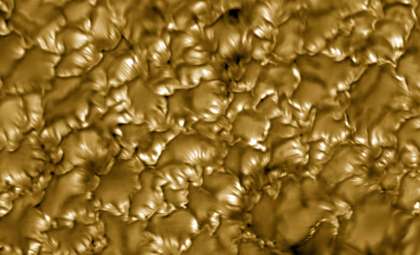
This breakthrough arises from some of the highest-resolution images ever captured of the solar surface, enabling scientists to scrutinize minute magnetic formations with extraordinary detail. This advanced visualization of the Sun uncovers vibrant motions within zones that were once too intricate to analyze fully.
At the core of the investigation were Kelvin-Helmholtz instabilities (KHI), which resemble wave patterns that emerge when layers of plasma or fluid slide past each other at differing velocities. Analogous phenomena occur in terrestrial clouds or ocean surfaces, but on the Sun, these structures develop through interactions between fluid plasma and shifting magnetic fields.


Combining data from cutting-edge solar observatories with sophisticated computer modeling, the team verified these swirling patterns as authentic physical events rather than artifacts of observation. Their analysis showed that KHI occurrences are common and not confined to rare solar phenomena.
Friedrich Wöger, a solar physicist at the National Solar Observatory, discussed the difficulties in validating these findings.
“Providing the evidence that ‘what looks, walks, and quacks like a duck actually is a duck’ is much more difficult, and could only be achieved with the highest spatial resolution data of the solar surface ever acquired, and the most complete and detailed numerical computer simulations ever performed (just for this purpose),” he told ScienceAlert.
Magnetic Boundaries Host Widespread Vortex Activity
Analysis indicates that these vortex formations consistently appear at the interfaces of magnetic regions, signifying that KHI is a ubiquitous feature within solar dynamics. The frequency of these phenomena surprised the research team.
“We were truly amazed by the incredible amount of small-scale detail and dynamic activity visible in the high-resolution images,” solar physicist David Kuridze of the US National Solar Observatory told ScienceAlert.
Contrary to initial expectations that KHI would arise only under uncommon conditions, evidence showed that the delicate equilibrium needed for their formation regularly exists within the star’s magnetic environment.

“The real surprise was seeing just how ubiquitous KHI actually is all across the surface,” Kuridze said.
“To generate it in a real physical system, you need a remarkably delicate balance between competing physical forces. So discovering that these strict requirements are satisfied practically everywhere at the boundaries of magnetic elements is simply astonishing.”
Reported in Nature , these findings offer fresh insights into how energy transfers through the solar atmosphere. Grasping such micro-scale activity provides critical context for refining models that simulate solar phenomena and the star’s outer atmospheric layers.
Implications for Future Solar Research
Finding numerous KHI events challenges previous assumptions about the Sun’s magnetically active surface. These small-scale currents are likely critical contributors to the transport of energy and matter across the solar atmosphere, thereby affecting broader solar dynamics.
Scientists emphasized that this breakthrough was enabled by advances in observational instruments, allowing unprecedented scrutiny of the Sun’s surface details.
“We were truly amazed by the incredible amount of small-scale detail and dynamic activity visible in the high-resolution images,” Kuridze said, highlighting the impact of the improved observations.
Wöger reflected on the significance of this discovery, calling it a pivotal moment in solar physics. “It was a very exciting time because the implications could be so far-reaching.”
The team anticipates that further advances in solar imaging will continue to uncover the Sun’s hidden processes. “Each landmark discovery adds another essential piece to the vast solar puzzle since the Sun still holds countless secrets,” Wöger added.

Opening New Doors to Solar Mysteries
The identification of widespread magnetic vortices underlines how much remains undiscovered about our nearest star. Despite decades of study, the Sun still surprises scientists when observed with the latest technology.
This work highlights the significance of small-scale activity in shaping solar behavior. Through enhanced examination of these vortices, researchers aim to better decipher the interactions between magnetic fields, plasma flow, and atmospheric variations.
These observations represent a vital step toward a deeper understanding of solar mechanics. As solar telescopes and imaging continue to evolve, the veil on the Sun's concealed dynamics is expected to lift even further.
- Categories:
- News







0 comments
Sign in to Comment