

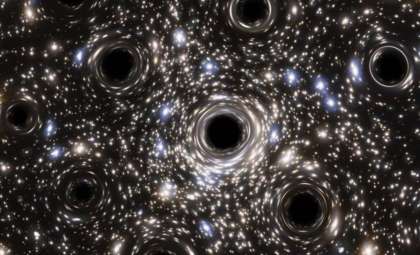
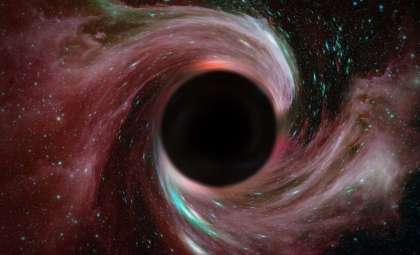
Recent computational models propose that more than 90% of stellar-mass black holes within the Milky Way exist independently, forming a concealed group largely inaccessible to astronomers. These insights, shared on the arXiv preprint server, imply that the black holes detected until now represent only a minor portion of the galaxy's actual black hole community.
Nearly all known stellar-mass black holes have been discovered through their interactions with companion objects, typically a nearby star. In such pairs, the black hole’s gravity draws material from the star, generating radiation observable by telescopes.
However, this research points out that such binary systems are just the tip of the iceberg. A far larger population may travel quietly through the galaxy, unattached to stars and lacking significant detectable matter.

The team, led by Wagg at New York’s Flatiron Institute, utilized robust Milky Way evolution simulations to predict the current number of black holes, their positions, and their trajectories through space.
Simulations highlight a vast hidden black hole cohort
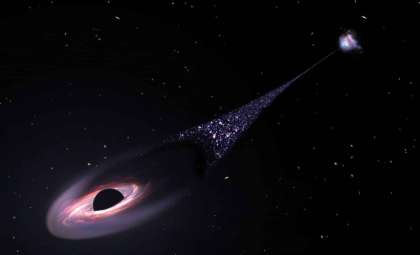
By modeling the lifecycle of stars over billions of years—from birth through death—the scientists charted the formation of stellar-mass black holes that arise when massive stars collapse. The simulation also incorporated the effects of supernova explosions, which impart powerful gravitational kicks to newborn black holes, altering their speeds and locations, sometimes propelling them beyond the Milky Way’s bounds.
Findings show that approximately 91% of the galaxy’s stellar-mass black holes exist in isolation. Without a nearby star to feed on, these black holes emit almost no signals, making them invisible to traditional detection methods.
Published on arXiv, the study further estimates that nearly 3% of these black holes have escaped the galaxy due to their high birth velocities.
The remaining black holes include the binary systems that astronomers have observed—rare examples that may not reflect the common conditions around most black holes, but rather a small subset primed for detection.

Challenges in spotting solitary black holes
Black holes are invisible by nature, trapping not only matter but also light, which prevents direct observation by electromagnetic means. Scientists instead detect their presence by observing the effects of their gravity on nearby objects.
In binary systems, a black hole can attract gas from a companion star, heating it to emit X-rays and other radiation measurable by telescopes.
Isolated black holes lack companion stars and surrounding material to disturb, so they drift through space without producing bright emissions traditionally used to pinpoint them.
This detection gap limits our knowledge about black hole formation, the impacts of stellar explosions on their motions, and their distribution across galaxies.
By predicting probable locations of these hidden black holes, the new simulations offer a roadmap for astronomers to strategically focus future searches instead of relying on chance discoveries.
Next-generation observatories may reveal the unseen black hole majority
Upcoming instruments like the Roman Space Telescope, extended data from Gaia, and cutting-edge spectroscopic programs might enable astronomers to uncover these elusive black holes by analyzing gravitational effects rather than electromagnetic signals.
One exciting approach involves gravitational microlensing, where a black hole’s gravity bends and intensifies the light of a more distant star, producing noticeable temporary brightening that exposes the otherwise hidden object.
The models developed by Wagg and colleagues can guide researchers in pinpointing promising search areas. Confirming these predictions with observations would offer a more complete understanding of black hole numbers throughout and beyond the Milky Way.
This discovery highlights a fundamental issue in astronomy: the most observable objects may not be the most prevalent, with invisible populations significantly influencing galaxy development and stellar evolution while remaining largely undetected.
Combining advanced simulations with imminent observational data promises to turn these theoretical cosmic denizens into concrete components of our galaxy’s census.
- Categories:
- News






0 comments
Sign in to Comment