

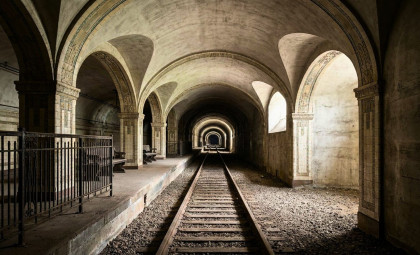
In the early 1960s, British government scientists quietly conducted experiments on the London Underground, releasing packages containing harmless biological simulants from moving trains to study their dispersal and persistence, according to a 2002 parliamentary report.
These tests, carried out by the former Microbiological Research Establishment at Porton Down, aimed to assess Britain’s exposure risk to biological attacks. The government stated these operations occurred with the approval of ministers, London Underground authorities, and the Biological Research Advisory Board.
The subway experiments were a component of a broader programme, where Porton Down released microorganisms and other substances in public areas to understand how biological agents might spread. A Guardian article from 2002 detailed an official history covering British biological-warfare trials from 1940 through 1979, revealing over 100 secret experiments.

Bacterial Simulants Moved Up to 10 Miles Underground
A Guardian investigation in 2001 described one test on the Northern line where two government researchers boarded a train at Colliers Wood and released spores mimicking anthrax during the journey toward Tooting Broadway.
Follow-up samples taken days and weeks afterwards revealed these spores had travelled through the tunnels as far away as Camden Town, around 10 miles from the release point. The spores were non-pathogenic and intended solely to simulate biological agent dispersion.

The media report also noted that these Subway experiments were officially described as “ventilation trials”. An official source deemed the research essential but expressed concerns about potential political fallout if the details became public.
Details about the timeline of the Northern line test vary between reports: the 2001 investigation places it in 1963, the parliamentary record cites two trials in 1963 and 1964, while a 2002 Guardian account dates a similar release between Colliers Wood and Tooting Broadway to 1956.
Porton Down Conducted Related Tests in Government and Railway Sites
Before the Underground studies, other experiments measured vulnerabilities in transport and government buildings. In 1955, non-harmful organisms were spread in tunnels beneath central London, causing, according to Guardian records, significant contamination in three government offices and also affecting tunnels under Whitehall.
Railway trials happened further back in 1953 and 1954 on the route between Exeter and Salisbury. These involved releasing microorganisms within tunnels and on trains to observe their movement among passengers and equipment.

The parliamentary account noted that since the Biology Department’s inception in 1940, Porton Down carried out numerous studies on bacterial spore transmission in various settings including labs, test ranges, maritime environments, and outdoor sites. No comprehensive list of all experiments over the years exists.
Over One Million People Exposed in Coastal Microbial Releases
The subway tests were just one element of the broader programme. According to the 2002 Guardian report, between 1961 and 1968, releases of E. coli and Bacillus globigii—a harmless anthrax surrogate—exposed more than a million residents along England’s southern coast, stretching from Torquay to the New Forest. These microorganisms were dispersed from the military ship Icewhale near Dorset.
The million-person figure pertains to these coastal tests and does not detail how many subway users encountered the released organisms. The parliamentary records do not specify the number of passengers exposed in the Underground trials.

The 2002 Guardian article mentioned that two scientists commissioned by Porton Down reviewed the historical tests’ safety. Both concluded these releases did not pose health risks, though one indicated vulnerable groups like the elderly or respiratory patients might face serious effects if exposed to large amounts. Some nearby residents questioned official safety assurances and demanded a public inquiry.
In a parliamentary reply from March 2002, the UK government stated that reports on the 1963 and 1964 London Underground experiments have been available at the Public Record Office for several years.
- Categories:
- News





0 comments
Sign in to Comment