

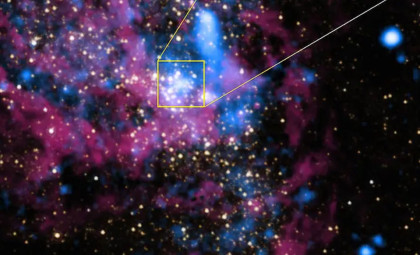
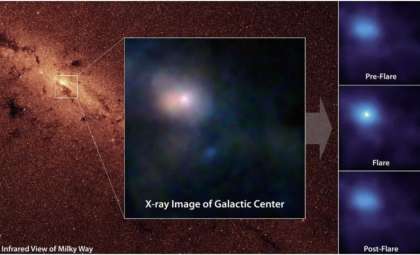
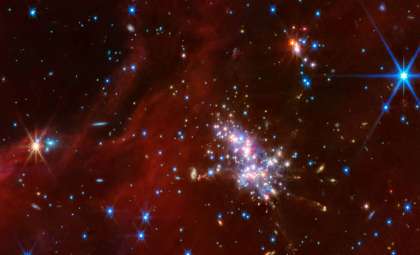
A recent simulation of a galaxy resembling the Milky Way has demonstrated that nuclear star clusters and nuclear stellar disks originate together from the same inflowing material near galactic centers. These core zones in galaxies are among the most intricate regions in the cosmos.
Characteristic features such as densely packed nuclear star clusters and flattened nuclear stellar disks have been detected in our Milky Way and other galaxies, yet their formation processes have long remained a mystery.
Until now, scientists believed these two formations arose through distinct mechanisms. Observational data showed no obvious correlation between their sizes and masses, making it tough to conclude whether they shared a unified development path.

However, a new investigation by the SMUGGLE-Ring project, led by the Leibniz Institute for Astrophysics Potsdam (AIP), provides fresh insights. The team developed an advanced high-resolution hydrodynamical simulation of a barred galaxy analogous to the Milky Way, capturing the natural emergence and development of nuclear star clusters and stellar disks over four billion years.
Stellar Bar as a Catalyst for Central Structures
The simulation reveals that the galaxy’s stellar bar acts as the key agent driving the formation of both the nuclear star cluster and the nuclear stellar disk. This rotating feature funnels gas from the outskirts inward, supplying the raw material for star formation in the core.
The researchers describe the bar as a “cosmic conveyor belt,” continuously channeling gas into the center and fueling the simultaneous growth of both star cluster and disk. As gas accumulates, feedback from dying stars generates shocks, triggering successive bursts of star formation.

Over billions of years, the simulated galaxy accumulates hundreds of millions of solar masses worth of stars at its center. Unlike static snapshots from telescopes, this dynamic model allows continuous tracking of the galaxy’s evolutionary journey.
The research team follows the growth of the stellar bar, gas inflow, episodic star formation, and the expansion of the nuclear stellar disk, revealing that these features evolve in tandem rather than independently.
Uncovering the Evolving Link Between Core Features
This model sheds light on why astronomers have struggled to identify a straightforward connection between nuclear star clusters and stellar disks. Observable differences stem from the phase of the galaxy’s development at the time of view.
“The apparent disconnection does not mean that the stars themselves differ fundamentally in age, chemical composition, or motion,” notes the study’s co-author Dr. Cristina Chiappini.

The simulation indicates that the relationship between these two structures evolves over time, with their relative mass and dimension diverging during phases of continuous growth. Consequently, galaxies observed at various periods can display diverse central morphologies, even if formed through similar processes.
This evolutionary perspective offers an explanation for the inconsistent correlations seen in earlier astronomical surveys, suggesting these differences arise from where a galaxy stands along its long-term transformation.
Dynamic Interactions in the Galactic Heart
The model incorporates a sophisticated representation of dark matter, enabling detailed analysis of the interplay among stars, the stellar bar, and the dark matter halo. Unlike prior simulations using fixed backgrounds, this approach lets all components evolve interactively. The study highlights this dynamic treatment as a critical strength. Dr. Ivan Minchev elaborates:
“Previous studies rely on fixed background potentials for the galactic bar and dark matter halo, but the realistic dynamical treatment of stars and the dark matter halo using live particles in our model allows us to form a realistic bar that evolves over time and then naturally forms nuclear structures.”
The simulation also reproduces a “dark gap” near the bar, a feature found in many galaxies that results from the interaction between stars and dark matter influenced by the bar’s rotation.

The model captures an important event where a massive star cluster, holding about 30 million solar masses, migrates to the galaxy’s core and merges with the existing nuclear star cluster. Researchers draw parallels to observations of NGC 1365, where giant star clusters are found within the bar.
These inward-moving clusters are likely to integrate with central star clusters, impacting their size and mass over relatively short timescales.
- Categories:
- Space



0 comments
Sign in to Comment