

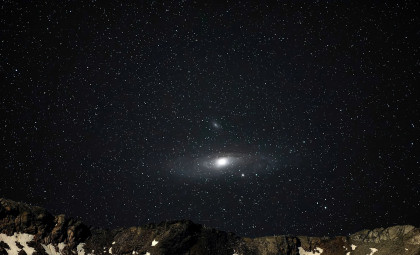
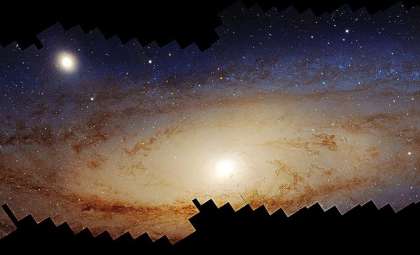
The Andromeda galaxy has seen a significant drop in its star-forming activities over the past several million years, with astronomers pointing to M32, a nearby dwarf galaxy, as a prime factor behind this shift. Observations from the Hubble Space Telescope indicate that the slowdown is most evident in the sector of Andromeda facing M32.
These insights offer a fresh perspective on the recent evolutionary stages of M31, Andromeda's official designation. Situated roughly 2.5 million light-years from Earth, Andromeda’s proximity allows detailed study of individual stars, helping scientists to piece together its evolutionary story.
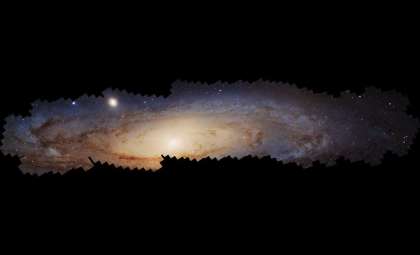
It was already known that Andromeda underwent a notable star formation spike about 2 billion years ago, likely triggered by a past galactic encounter. The latest research shifts focus to subsequent epochs, revealing how swiftly the rate of star production tapered off. Utilizing data from two extensive Hubble surveys cataloging nearly 200 million stars spread over about two-thirds of Andromeda’s disk, scientists could analyze star formation patterns in different galaxy regions over recent times, according to NASA.

Hubble Maps Andromeda’s Waning Star Formation
The NASA researchers segmented Andromeda’s disk into blocks approximately 300 light-years wide, assessing stellar colors within each. Since younger stars are brighter and bluer compared to older, dimmer, and redder stars, the mix of colors reveals when recent star formation happened. Blue-rich areas correspond to active star birth, while redder zones indicate older star populations with diminished recent activity.
Results point out that around 500 million years ago, Andromeda was forming stars at a pace of roughly one solar mass annually. This pace steadily declined, reaching about half a solar mass per year by 40 million years ago.

The downward trend has continued, with Andromeda’s current star formation rate about one-fifth of the Sun’s mass per year. This research refines the timeline of this decline and highlights its uneven impact across the galaxy.
M32’s Role in Andromeda’s Star Formation Shift
Astronomers discovered that the deceleration in star formation is especially pronounced on the side closest to M32, a compact galaxy just about 16,000 light-years from Andromeda. Known for its peculiar structure, M32 might be the stripped core of a spiral galaxy that lost its outer layers following interaction with Andromeda.
As NASA notes, M32 has long been suspected of influencing Andromeda’s recent changes due to its position and form, potentially pointing to a historic collision between the two. However, researchers remain cautious and stop short of directly blaming M32 for the star formation decline.
“We can’t explicitly say that we are seeing a decrease in star formation because of M32,” said Tobin Wainer, a graduate student at the University of Washington and one of the astronomers involved in the research. “But it’s right there, and it’s definitely the most likely suspect.”

Upcoming Telescope Missions May Unlock More Andromeda Secrets
The possible interaction between Andromeda and M32 continues to be a focus of research, shedding light on galaxy evolution following gravitational encounters. This study deepens knowledge about one of the Milky Way’s closest major neighbors. Soon, the Nancy Grace Roman Space Telescope will expand the scope of Andromeda studies well beyond previous efforts.
“Roman’s gigantic field of view can cover at least 100 times as much area as Hubble at near-infrared wavelengths in a single observation. A newly approved Roman observing program will image the entirety of Andromeda’s disk and areas of its surrounding halo,” stated NASA.

The upcoming Roman telescope will provide fresh insights into Andromeda’s stellar populations, helping clarify the patterns uncovered by Hubble. For now, M32 remains the leading explanation for the dramatic slowdown in star formation witnessed in Andromeda’s recent history.
- Categories:
- Space




0 comments
Sign in to Comment