

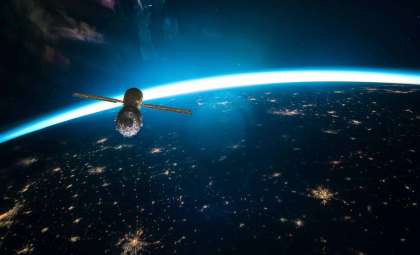
SpaceX aims to deploy a staggering fleet of up to one million AI-powered satellites in Earth’s orbit, prompting experts to express concern over the potential atmospheric impacts of such an extensive space operation. The activity involved in launching and eventually deorbiting these satellites could inject significant quantities of soot and metallic particles into fragile atmospheric layers that scientists still struggle to understand.
The concept of orbital data centers is designed to shift the growing energy needs of AI computing away from terrestrial sites. Leading aerospace companies like SpaceX, Amazon, and Blue Origin propose that satellites operating on solar power in space could overcome many of the energy consumption and cooling limitations faced by ground-based data hubs.
These three corporations have collectively sought approval from the Federal Communications Commission to deploy over a million space-based data centers in the coming decade. SpaceX, spearheaded by Elon Musk, has revealed intentions to create an AI satellite network on an unprecedented scale.

The unprecedented volume of planned launches raises alarms among atmospheric scientists. The intensified rocket activity and satellite returns would introduce additional anthropogenic substances into upper atmospheric regions where the long-term environmental consequences remain poorly characterized.
The Impact of Increased Rocket Launches on Earth’s Upper Atmosphere
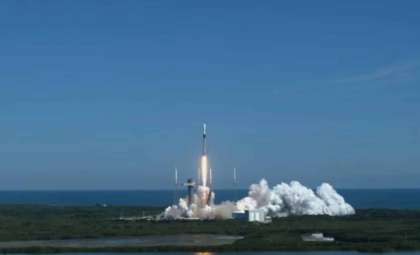
SpaceX is expected to rely heavily on its Starship for deploying this vast constellation. This heavy-lift rocket employs methane and liquid oxygen propellants, a cleaner alternative to the kerosene fuel used by SpaceX’s Falcon 9. Nevertheless, experts caution that the vehicle’s sheer size could have considerable environmental effects.
“Starship is a bigger rocket burning more propellant,” Eloise Marais, a professor of atmospheric chemistry at University College London, told Space.com. She also explained that the cleaner fuel choice could be offset by the much larger amount of propellant required.
A report referenced by the same article, authored by space sustainability expert Andrew Wilson, estimates a single Starship launch emits roughly 76,000 metric tons of CO2-equivalent gases — a footprint comparable to the yearly emissions from approximately 17,727 gasoline cars.

According to Ars Technica, deploying a constellation of one million satellites might require as many as 77,000 Starship launches. This is a stark contrast to the current annual count of 324 orbital launches worldwide in 2025.
The topic of black carbon emissions, a form of rocket-produced soot, is a particular focus. Unlike pollutants closer to Earth’s surface, particulates deposited in the upper atmosphere can linger for extended periods — potentially around three years.
The Atmospheric Consequences of Vast Satellite Networks
The environmental considerations extend beyond launches alone. Massive satellite systems necessitate ongoing replacements, as aging satellites eventually reenter and burn in Earth’s atmosphere. Presently, the European Space Agency monitors about 19,000 active and inactive satellites orbiting Earth. The widely deployed SpaceX Starlink V2 Mini satellites weigh around 800 kilograms (1,760 pounds), while the forthcoming AI satellites are expected to be substantially heavier.
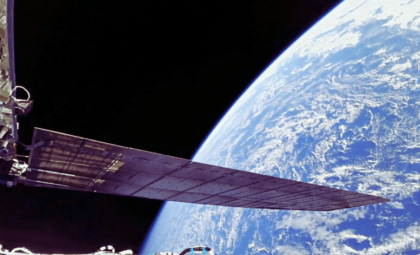
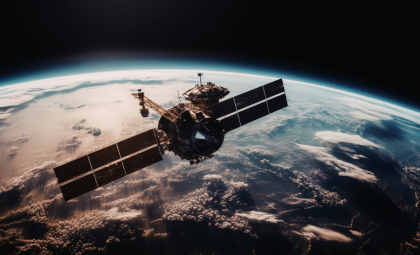
Reports from Space.com estimate that each orbital data-center satellite could weigh up to 7.5 metric tons and feature solar arrays extending approximately 75 meters (246 feet) in length.
During atmospheric reentry, satellites vaporize and fragment into particles, including aluminum that forms aluminum oxide. This compound is known to impact the ozone layer, but the broader implications of frequent satellite reentries at scale are still under investigation.
“But if you have hundreds of thousands or millions of satellites in space at any one time, you are essentially going to create a rain of man-made materials, electronic equipment and metals that otherwise wouldn’t be coming into the atmosphere,” he warned.

Scientists Seek Clarity Before Deployment Begins
Currently, knowledge gaps persist around how rocket exhaust and spacecraft debris chemically interact within the high-altitude atmospheric environment.
“Launches and the reentries are really the only things that humans do that deposit material directly into the upper atmosphere,” Aaron Boley, an astronomy and space sustainability scholar at the University of British Columbia, stated.
Pollutants are removed far more slowly from the upper atmosphere compared to lower layers, as Marais points out. While surface contaminants are cleared by precipitation and wind within weeks, materials at higher altitudes rely on considerably slower atmospheric cleansing processes.
Researchers emphasize the urgency for extensive observational studies to assess the environmental impacts of deploying enormous satellite fleets. Marais highlights the need for “much more data and time” before drawing conclusions. Boley adds that such comprehensive analysis must precede large-scale satellite launches.
“We absolutely have to understand,” he said, “and we have to understand that before we actually launch a million satellites. Not that we launch them and wait [to see] what happens.”
- Categories:
- Space






0 comments
Sign in to Comment