

An extraordinary alignment between comet 10P/Tempel 2 and the venerable globular cluster Messier 30 has produced a captivating astronomical image captured by contemporary observatories. Featured by NASA, this scene portrays two celestial bodies that seem linked in space, despite being separated by vast cosmic distances. This event beautifully demonstrates how perspective shapes our view of the night sky into a canvas of surprising cosmic interactions.
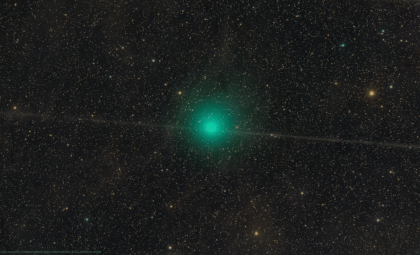
Captured on July 29, the comet appeared to pass near Messier 30 from our vantage point on Earth. The comet’s subtle greenish coma and slender dust tail seem to intersect the star cluster, crafting the illusion of a cosmic encounter. In truth, these objects exist in entirely different regions of the universe, serving as a reminder of how a three-dimensional universe is projected onto a two-dimensional image.
An Uncommon Celestial Conjunction of Comet Tempel 2 and Messier 30
The photo showcases 10P/Tempel 2, a well-known recurring comet, positioned near Messier 30, a globular cluster comprising ancient stars within our Milky Way. The comet manifests as a faint greenish diffuse glow on the left, while the star cluster glimmers as a dense assembly of distant stars.

NASA explains this capture represents a fleeting moment when the comet and cluster appeared close in the sky due to the comet’s orbit and Earth's changing observation angle.
The comet’s dust tail seems to reach toward the globular cluster, creating the dramatic visual of comet debris extending into a vast stellar collection. This striking view highlights the contrasting nature of these celestial entities.
While the comet is a small, icy traveler within our solar neighborhood, the globular cluster harbors hundreds of thousands of stars, located far beyond the confines of our planetary system.

Tracing The Legacy of Messier’s Renowned Catalog
This observation also ties today’s astronomy to Charles Messier, the 18th-century astronomer whose catalog assigned names like Messier 30. Messier’s goal was to exclude objects mistaken for comets.
As he searched for comets—which exhibit noticeable movement—he documented numerous faint, static fuzzy objects against the star background. These were not comets, but distant nebulae and star clusters.
The Messier Catalogue remains one of astronomy’s most famous compilations, featuring galaxies, nebulae, and clusters beloved by both amateur and expert stargazers.
The contemporary depiction of Tempel 2 near M30 evokes this history, as both bodies would have appeared as blurred spots through Messier’s telescopes centuries ago.
Vast Distances Separate These Astronomical Neighbors
Although the image suggests proximity, the actual distances of the comet and cluster reveal an immense scale gap. At the time of photography, the comet lay roughly 3.5 light-minutes from Earth.
Meanwhile, Messier 30 resides about 28,000 light-years away, situated in the Milky Way’s outer halo and consisting of stars formed billions of years in the past.
This contrast illustrates how telescopic images can simultaneously capture objects nearby and those extraordinarily distant within the same frame.
Thus, the apparent conjunction of Tempel 2 and M30 is purely a visual coincidence, not a physical interaction. The comet journeys within our solar system, whereas the cluster remains far beyond the local galactic environment.
- Categories:
- News


0 comments
Sign in to Comment