

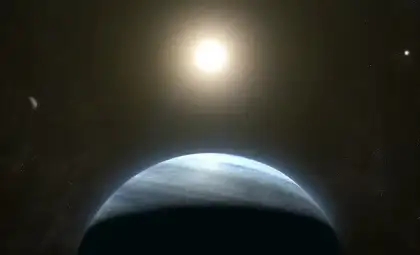
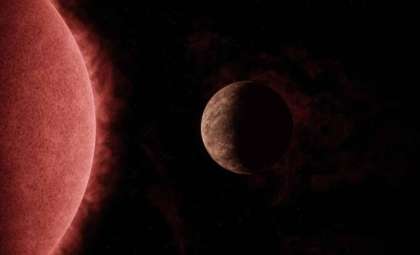
A team of astronomers has detailed a seldom-seen 48-Jupiter-mass brown dwarf transiting an exceptionally large, aged star, offering a unique opportunity to explore the origins of objects bridging planets and stars. This system, designated HIP 61637 b, was discovered using data from NASA's Transiting Exoplanet Survey Satellite (TESS) and examined in a study published on arXiv. Its distinctive mass, orbital characteristics, host star, and precisely constrained age provide critical insights for evaluating competing models of brown dwarf formation.
Unveiling a Scarce Brown Dwarf in a Star-Companion Desert
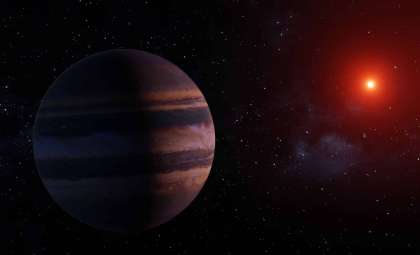
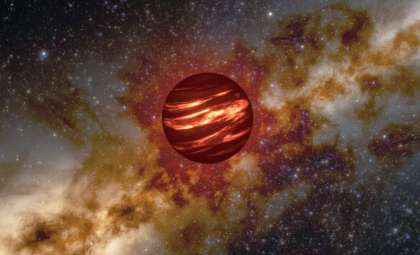
Brown dwarfs sit awkwardly between planets and stars—they’re too large to be planets but lack the stable hydrogen fusion defining stars.
HIP 61637 b pushes these boundaries with a mass near 48 times that of Jupiter. Though well within the brown dwarf category by mass, its formation history remains uncertain.
This object also falls within the so-called brown dwarf desert, an area around stars where brown dwarfs are rarely observed in close orbits. Such rare finds are invaluable for testing formation theories and understanding orbital dynamics.
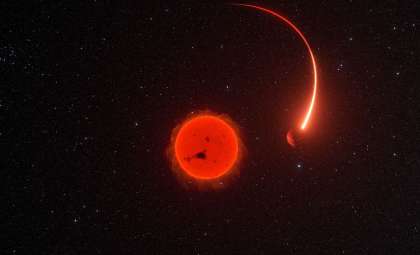
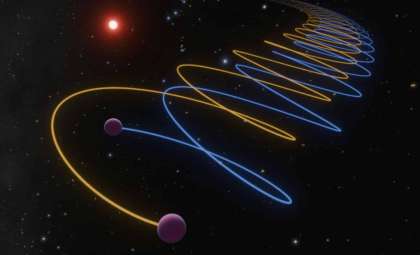
Leading the research, Nino Ephremidze from Harvard University combined TESS transit data with comprehensive spectroscopic analysis. TESS identifies transits by capturing subtle, periodic dimming as orbiting objects pass in front of stars from Earth’s viewpoint.
This method reveals orbital details and physical dimensions when paired with stellar information. Spectroscopy measures the star’s reflex motion caused by the companion’s gravity, allowing precise mass estimates. These combined observations enabled an unusually accurate characterization of HIP 61637 b, a notable achievement for such a rare category of objects.


The Uncommon Host Star Adds to the Significance
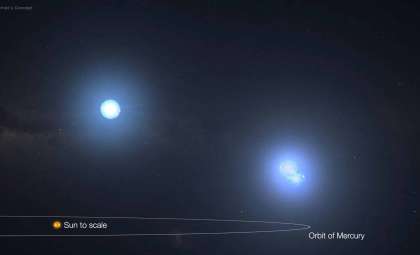
The brown dwarf companion is only part of what makes this system remarkable. Its star is an aging A-type giant with nearly three times the Sun’s mass. Researchers highlight it as the brightest and heaviest star discovered with a transiting brown dwarf companion, creating an exceptional environment for study.
A-type stars evolve quicker than solar-mass stars since they burn fuel at a higher rate. This star is nearing the end of its hydrogen-burning phase despite being younger than the 4.6-billion-year-old Sun.
Its evolutionary state enabled the team to estimate the system’s age at roughly 396 million years.
Such precise dating is essential, as determining ages for isolated brown dwarfs is typically challenging.
Brown dwarfs cool and shrink over time, so their temperature and size depend heavily on age. Without independent age data, various combinations of mass and age yield similar observable traits.
When a brown dwarf accompanies a star with a known age, it fixes a pivotal benchmark in evolutionary models. This makes HIP 61637 b only the seventh brown dwarf with a reliably measured age, serving as an important reference for theorists.
Two Distinct Formation Routes Hint at Different Origins
The fundamental question raised by HIP 61637 b is whether all brown dwarfs arise via the same formation path. While brown dwarfs are often categorized by mass, they may originate from fundamentally different processes.
One scenario is akin to star formation: collapsing clouds of gas and dust form an object that never attains the mass needed for sustained hydrogen fusion.
The other resembles planet formation, where a body grows within a circumstellar disk of gas and debris around a young star.
Each pathway leaves distinct imprints on the resulting system.
Forming via gravitational collapse often results in companions with eccentric, elongated orbits, reflecting turbulent early dynamics.
Conversely, disk-origin objects tend to have well-ordered, circular orbits aligned with the disk plane. However, long-term orbital evolution can mask these original patterns.
Close brown dwarf companions may undergo tidal forces that gradually circularize initially elongated orbits, meaning a circular orbit today doesn’t guarantee a planet-like birth.
Conflicting Clues from Mass and Size Challenge Formation Scenarios
A compelling aspect of HIP 61637 b lies in the interplay among its size, age, and the massive host star.
These factors indicate the brown dwarf could have formed inside a circumstellar disk, hinting at a planetary-like growth process.
This notion could redefine how far planet formation mechanisms extend into the brown dwarf mass realm.
However, a major puzzle remains: HIP 61637 b weighs about 48 times Jupiter’s mass.
Traditionally, disk accretion models predict difficulties forming objects this massive since disk depletion or feedback effects generally limit mass accumulation.
Alternatively, formation via cloud collapse can more easily explain such large masses, but it must also align with observed system properties.
Thus, the findings do not decisively prove one formation path over the other.
Instead, they reveal a complex boundary where the line between star-like and planet-like formation blurs.
This research, accessible on arXiv, positions this system as a valuable point for future studies rather than conclusive evidence.
Continued modeling of massive disks and discoveries of similar-age systems may clarify whether large companions near 50 Jupiter masses can commonly form in planet-like disks.
- Categories:
- News


0 comments
Sign in to Comment