

While strolling along a gravel trail in Israel, three-year-old Ziv Nitzan noticed an intriguing stone. She picked it up, wiped away the dust, and showed it to her sister Omer. What seemed like an ordinary family walk soon revealed a rare artifact dating back thousands of years, hidden near an ancient settlement.
"Among thousands of stones scattered around, she selected this particular one," Omer recounted in a translated clip released by the Israel Antiquities Authority. "After clearing off the sand, she realized it was something special." According to a Live Science feature on the finding, the family soon recognized the "beautiful stone" as an ancient relic and alerted archaeologists.

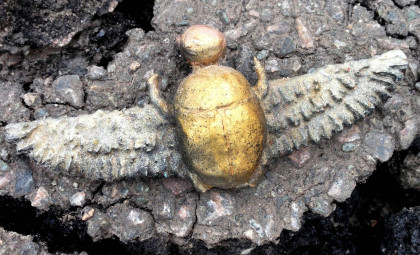
Experts identified the item as a 3,800-year-old scarab amulet from the Middle Bronze Age. This beetle-shaped piece bore Canaanite origins, designed in the style of ancient Egyptian artifacts common across the eastern Mediterranean. Discovered at Tel Azekah, it complements a rich collection of Egyptian and Canaanite antiquities recovered from this key Bronze Age hub in the Judean Lowlands.

An Ancient Relic from a Fortified Bronze Age Settlement
Ziv uncovered the scarab during a March visit to the archaeological site, located roughly 45 kilometers from Tel Aviv and 30 kilometers from Jerusalem. The mound overlooks the Shephelah region, also called the Judean Lowlands, historically a crossroads connecting Mediterranean trade routes with the hills of Judah, linking cities like Beth Shemesh and Lachish.
According to the Lautenschläger Azekah Expedition’s detailed site history, Azekah flourished as a heavily defended city during the Middle Bronze Age (circa 2000 to 1550 BCE). It persisted into the Late Bronze Age before facing destruction and abandonment. Subsequent settlements from the Iron Age through the Byzantine era have also left their marks on the hill.

Years of excavation at Azekah have uncovered fortifications, architectural remains, pottery, and amulets, illuminating its long history of occupancy. Oded Lipschits, the Tel Aviv University archaeologist leading the digs, noted that this latest find fits within a well-established array of Egyptian and Canaanite artifacts found at the location. Its discovery along a hiking path enriches an archaeological landscape known for diverse ancient cultural materials.
Scarab Amulets: Symbolism and Usage in Antiquity
The amulet is fashioned after the holy scarab beetle, specifically the dung beetle. Ancient Egyptians linked these insects’ habit of rolling dung balls to the sun’s journey across the sky, associating the scarab with concepts of creation, renewal, and the sun god Khepri.
As one of the most iconic Egyptian symbols, small scarab amulets were widely used—worn as jewelry, carried for protection, placed in tombs, or kept in homes. Their curved tops depicted the beetle, while the flat undersides often showcased inscriptions, symbols, or figures.

Some scarabs operated as stamp seals, imprinting clay to authenticate or secure belongings. Daphna Ben-Tor, a specialist from the Israel Museum focusing on ancient amulets and seals, explained their combined role: “Scarabs were used in this period as seals and as amulets.” Her research on Egyptian and Canaanite scarabs explores how these small objects migrated between cultures and evolved over time.
The Israel Museum’s scarab collection houses examples crafted from materials like glazed steatite and faience. Steatite is a soft stone carved then given a hard glazed finish, while faience is a manufactured mixture mainly composed of ground quartz, featuring a glossy surface. Both materials enabled artisans to create small, durable objects with precise detail.
Egyptian Influence Blends with Canaanite Craftsmanship
While scarab shapes originated in Egypt, many found in Canaan were locally produced. Canaanite artisans adapted Egyptian forms and iconography to craft scarabs tailored for Levantine communities. Scholars analyze their shape, materials, carving techniques, and inscriptions to trace their origins and timelines.
Excavations at Azekah have unearthed numerous Egypt-connected items, including scarabs and amulets. The expedition’s site overview situates these finds within the settlement’s broader Bronze Age narrative. Despite being found on a surface trail rather than a sealed context, Ziv’s scarab added to this archaeological record.

Due to its surface discovery, the scarab’s age was determined through typological dating, comparing its design and craftsmanship to securely dated parallels. Reports confirm the artifact as a Canaanite piece roughly 3,800 years old.
The scarab belongs to an era when fortified Canaanite cities maintained close interactions with Egypt through commerce, travel, artistic expression, and administration. Scarabs were widespread as both protective amulets and functional seals. At Tel Azekah, this find enriches a collection of Egyptian and Canaanite relics uncovered at the site.
Tel Azekah’s Multi-Layered Historical Significance
This landmark hill is tied to the biblical tale of David and Goliath, where opposing forces clashed nearby. However, the scarab predates that episode by centuries, belonging instead to the earlier Bronze Age world of Canaanite city-states, long before Azekah became a Judean fortress.
Later historical accounts cite Azekah in military campaigns against Judah, with continuous habitation through numerous successive periods. This long occupation means artifacts from different eras can be intermingled across the site. Detailed excavations help archaeologists separate these layers by carefully documenting soil strata, building features, and adjacent finds.
Ziv’s family entrusted the priceless Bronze Age amulet to the Israel Antiquities Authority for proper preservation and recording. The relic is slated to join other Egyptian and Canaanite treasures on display at the National Campus for the Archaeology of Israel in Jerusalem.
- Categories:
- Science








0 comments
Sign in to Comment