

Astronomers have uncovered an exceptional system containing three active supermassive black holes inside J0148-4214, a galaxy observed less than 1.3 billion years after the Big Bang. Utilizing data from the James Webb Space Telescope, this rare finding offers vital clues on the early formation and growth of massive black holes in the young cosmos.
The light from the galaxy has journeyed about 12.5 billion years to reach Earth. With a redshift of 5.0167, J0148-4214 provides insights into a cosmic era when enormous black holes already existed despite the short timespan available for their development.
This discovery is notable because the three black holes coexist within the same galaxy but exhibit varying masses and spatial separations. Two lie near the galactic core, separated by roughly 620 light-years, while the third is situated about 5,500 light-years away. Whether these three will ultimately merge remains an open question.

Tracking Black Holes via Rapid Gas Movements Detected by Webb
While the black holes themselves are not directly imaged by the James Webb Space Telescope, astronomers detected them by analyzing the behavior of ionized hydrogen gas using the telescope’s Near Infrared Spectrograph (NIRSpec), which revealed gas moving at high velocities around each black hole.
“This is the first evidence of three active black holes in a single galaxy in the distant universe,” study leader Hannah Übler, an astronomer at the Max Planck Institute for Extraterrestrial Physics, said in a statement.

The largest black hole has a mass estimated at around 80 million times that of the Sun. Nearby, just 620 light-years away, lies a much smaller black hole with about 600,000 solar masses. Despite its smaller size, this minor black hole is accreting gas at a rate surpassing the Eddington limit, where radiation pressure begins to counteract material inflow. Such intense feeding likely cannot be sustained for long.
The third black hole has a mass of approximately two million solar masses, roughly half the mass of Sagittarius A*, the supermassive black hole at the center of our Milky Way.
Galaxy Mergers Could Drive Their Swift Growth
As detailed in Astronomy & Astrophysics, the team investigated both the host galaxy and its black holes. Giovanni Mazzolari from the Max Planck Institute for Extraterrestrial Physics noted that J0148-4214 contains a stellar mass totaling roughly 1.3 billion solar masses.
“The JWST data allowed us not only to identify the three black holes, but also to estimate their masses, accretion rates and the stellar mass of the galaxy,” Mazzolari said. He added that the black holes represent a significant fraction of its stellar mass.
Scientists suggest the third and possibly the smaller central black hole were introduced into J0148-4214 through galactic mergers. This mechanism offers additional evidence for how black holes could rapidly accumulate mass early in the universe’s history. Roberto Maiolino from the University of Cambridge, a research collaborator, described the findings as indicating a cosmic collision as “an alternative, accelerated path for black hole growth in the early universe.”

Übler highlighted that this discovery also relates to the early cosmic processes capable of bringing massive black holes together, potentially triggering the kinds of mergers detectable by next-generation gravitational wave observatories.
Potential Ejection of One Black Hole
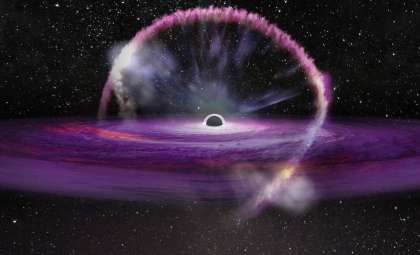
One intriguing aspect remains unresolved: the third black hole might not be gravitationally bound to the other two. It could be moving away from J0148-4214, possibly due to the three-body problem involving the interaction of all three black holes. The two smaller black holes may have initially formed a pair before encountering the massive 80-million-solar-mass black hole. This interaction might have resulted in the capture of the smaller one and the ejection of the two-million-solar-mass black hole.
A comparable phenomenon occurs with stars in the Milky Way. According to Space.com, when two stars approach Sagittarius A*, one can be captured while the other is flung away at immense velocity, known as a hypervelocity star. Currently, astronomers cannot determine the trajectory of the third black hole in J0148-4214, leaving it uncertain whether it will eventually converge with the others or escape its host galaxy.

The coalescence of such massive bodies emits long-wavelength gravitational waves, which current observatories like LIGO, Virgo, and KAGRA cannot detect. The upcoming LISA mission will, however, observe these signals from space using a trio of spacecraft positioned in a triangle, separated by 1.55 million miles (2.5 million kilometers).
- Categories:
- Space




0 comments
Sign in to Comment