

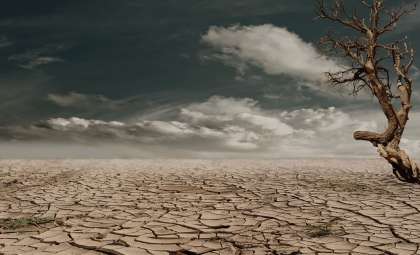
The United Nations has declared that the global water situation has surpassed a simple crisis—it has escalated into a long-lasting, severe depletion of freshwater resources.
A comprehensive report from the UN University Institute for Water, Environment and Health reveals that numerous rivers, lakes, and underground aquifers worldwide have been drained beyond sustainable levels, a state termed “water bankruptcy.” Unlike a temporary water shortage, this condition signals a permanent shift in Earth's hydrological balance that cannot be undone.
Currently, approximately 75 percent of humanity lives in countries experiencing significant water stress. Over half of the planet’s largest lakes are vanishing, nearly 70 percent of major groundwater reserves are in decline, and about two billion individuals inhabit regions where the land is sinking due to excessive groundwater extraction.

Why 'Water Crisis' No Longer Captures the Reality
Kaveh Madani, the report’s lead author from the UN University Institute for Water, Environment and Health, suggests that labeling the situation a “crisis” is misleading. A crisis typically implies a short-term disturbance followed by recovery, but today’s water scarcity patterns represent irreversible change.
Using a financial metaphor, Madani explains that surface water—including rivers, wetlands, and reservoirs—functions like a checking account replenished seasonally, while groundwater serves as a long-term savings account. When human consumption consistently exceeds natural replenishment, intensified by climate change, resources are depleted beyond recovery.
Madani highlights that unlike financial bankruptcy, where recovery is possible, water bankruptcy causes irreversible damage. Collapsed lands, compressed aquifers, disappearing glaciers, lost wetlands, and extinct species are permanent consequences that cannot be reversed by policy changes alone.
Tehran and Las Vegas: Two Cities on the Brink
The report focuses on two areas exemplifying water bankruptcy’s tangible impacts.
Iran is identified as deeply afflicted. Its driest autumn in half a century exacerbated decades of dam construction and groundwater depletion, leading to near-total drying of Lake Urmia, once the Middle East’s largest lake.
Officials considered relocating Tehran and tried cloud seeding to stimulate rain. Madani, having served as former deputy head of Iran’s Department of Environment, linked water shortages to recent protests, noting that societal collapse follows infrastructure failure.
In the US West, the Colorado River shows parallel decline. Its flow has decreased by 20 percent over 20 years due to reduced snowfall, increased evaporation, and major agricultural water use, including irrigation for cattle feed. The river’s main reservoirs have dipped to about 30 percent capacity.

Bradley Udall, a researcher at Colorado State University, warns the river system could hit “dead pool”—when dam water levels are too low for flow—as soon as 2027. Efforts to negotiate water use cuts across states collapsed last year, underscoring the challenges of allocation among competing interests.
Efficiency Alone Is Not Enough
The report also reveals an unexpected insight about irrigation: modernizing to drip or sprinkler systems may inadvertently increase total water consumption because less water returns to downstream systems. True water savings require both technological improvements and overall reductions in water use.
Agriculture accounts for roughly 70 percent of freshwater withdrawals worldwide. Reducing water use in farming threatens food production and the livelihoods of over a billion people, many from developing countries that export food globally. Discussions about water savings often overlook these critical human dimensions.
Even Water-Abundant Nations Face Challenges
Water-rich countries aren’t immune to pressures. Growing needs from data centers, along with pollution from industry, sewage, fertilizers, and runoff, degrade water quality, making it unusable in many areas.
Loss of wetlands—covering an area nearly the size of the EU—has removed vital ecosystem services valued at an estimated $5.1 trillion, including flood protection, food provision, and carbon storage.

Bangladesh exemplifies how water abundance and scarcity can coexist. Sea level rise and saltwater intrusion have contaminated half the nation’s groundwater with arsenic, while chemical pollutants from the fast-fashion sector severely impact rivers in Dhaka. Sonia Hoque from the University of Oxford notes local awareness of pollution sources but highlights political hurdles for implementing stricter standards due to economic concerns.
Adopting ‘Bankruptcy Management’ for Water
The report calls for a fundamental paradigm shift: moving beyond crisis response toward proactive "bankruptcy management." This strategy demands transparent water accounting, enforceable usage limits, and conservation of natural water systems such as aquifers, wetlands, rivers, and glaciers.
Starting with accurate measurement is crucial, as many regions lack systems to track water extraction effectively. Investing in solutions like cloud seeding is pointless without understanding existing supply and demand.
Acknowledging that some watersheds and cities are already water-bankrupt requires policies focused on reducing demand and redistributing resources. Protecting remaining water reserves as strategic assets, and abandoning reliance on hope for recovery via infrastructure or rainfall, is essential for sustainable water management.
- Categories:
- News











0 comments
Sign in to Comment