

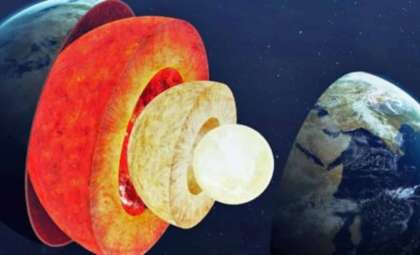
Recent research reveals that Earth’s inner core might harbor a unique form of hydrogen, displaying properties unlike any hydrogen found on the planet’s surface. Termed superionic hydrogen, this substance can simultaneously flow like a liquid while retaining a solid framework and conducting electricity under extreme conditions.
Far beneath the surface, Earth’s core experiences intense pressure and heat, creating a realm beyond human reach, where common elements assume extraordinary forms.
For decades, scientists have sought to understand this inaccessible zone, particularly how lighter elements integrate with the core’s primary element, iron. Hydrogen has emerged as a key focus due to its potential impact on the core’s makeup and internal dynamics.

In a paper featured in Proceedings of the National Academy of Sciences, researchers propose that superionic hydrogen exists within Earth’s depths—an exotic state unseen anywhere else naturally on the planet. Through advanced computer modeling, they explored hydrogen’s behavior when alloyed with iron under the immense pressures and scorching temperatures found in the core.
Exploring an Unseen Hydrogen Phase in Earth’s Core
The team examined various iron-hydrogen alloy configurations to determine hydrogen’s stable forms inside the inner core. Instead of segregating, hydrogen atoms appear to permeate the iron’s crystalline lattice, generating a compound with unusual traits.
The models focused on two crystal arrangements: the hexagonal close-packed (HCP) structure and the body-centered cubic (BCC) structure. These denote different spatial arrangements of iron atoms, influencing how hydrogen atoms navigate the lattice.
Findings indicated that the BCC arrangement is less stable due to higher free energy and greater reactivity, whereas the HCP structure better matches the inner core’s conditions.

The researchers noted the BCC form might achieve stability at temperatures exceeding 6,400 kelvin and hydrogen amounts over 20 percent under pressures near 3.6 million atmospheres. Still, melting under these extreme conditions likely limits BCC’s dominance.
“Our calculations show that hydrogen can stabilize a superionic BCC phase at sufficiently high temperature and hydrogen content,” the researchers wrote. “However, this stability field is superseded by melting, so only the superionic HCP phase coexists with the liquid in the Fe–H system.”
Potential Hydrogen Movement Between Earth’s Inner and Outer Core
The investigation also suggests hydrogen distribution within the inner core isn’t uniform. Modeling revealed a gradient in hydrogen concentration, higher near the core’s outer edges and tapering toward its center.
This disparity could encourage superionic hydrogen migration toward the boundary separating the inner core from the outer core. Upon crossing this interface, hydrogen may lose its superionic phase and blend into the surrounding liquid outer core.

The study further clarifies that this exchange isn’t solely driven by the slow solidification of the inner core. It highlights ongoing hydrogen flow between core layers as the inner core expands at roughly 1 millimeter per year. This growth correlates with the movement of light elements like hydrogen through Earth’s deep interior.
Insights into Earth’s Magnetic Field Generation
The circulation of hydrogen and other light elements may explain why portions of the core vary in composition. The authors propose this dynamic can create chemical buoyancy, providing power for the geodynamo that sustains Earth’s magnetic field.
The study highlights that temperature primarily governs hydrogen’s phase distribution inside the core, more so than pressure. Although pressure remains extreme throughout, subtle temperature differences dictate which hydrogen forms are favored.

Additionally, the researchers note this behavior might extend to other light elements such as oxygen and carbon. They concluded that:
“Our results, therefore, demonstrate that the nonuniform distribution of superionic hydrogen in the [inner core] is a direct consequence of equilibrium thermodynamics. This mechanism may also apply to the distribution of other light elements, influencing [the] core’s composition, dynamics, and evolution.”
- Categories:
- Science









0 comments
Sign in to Comment