

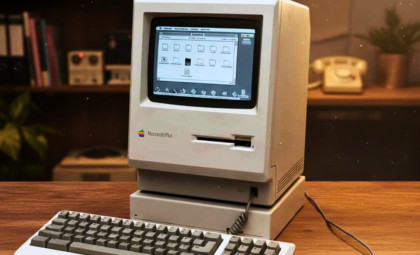
Before Photoshop became a household name, Thomas Knoll was simply addressing a modest challenge. As a graduate student focused on computer vision, he owned a Macintosh that could only render images in black and white. In 1987, he started creating image-processing tools that used pixel patterns to mimic grayscale on the screen.
This collection of utilities was named Display. It wasn’t designed as a professional-grade graphics program — Thomas’s primary goal was to develop software supporting his PhD research, not tools for photographers or designers.
His brother, John Knoll, soon began experimenting with these utilities. What unfolded next transformed these separate tools into the commercial software now known as Adobe Photoshop, launched on February 19, 1990.

John Knoll’s Vision: Consolidate All Tools into One Program
Thomas’s journey toward image processing software had roots going back decades. In 1971, when he was just 11, his father introduced him to photography by gifting him an Argus Rangefinder camera and teaching him film development in their basement darkroom. By about 1975, at age 15, Thomas was self-learning BASIC programming on teletype terminals connected to his high school’s timesharing computer.
For years, his passions for photography and coding remained separate. But during graduate school, they converged through computer vision research, where image processing helped machines recognize features like edges.
John approached the world of digital images differently. Employed at Industrial Light and Magic, he worked with analog image composition as ILM explored early digital image processing. The studio had technology to scan individual movie frames, digitally alter them, and output back to film.

Recognizing that digital film editing could revolutionize the process, John taught himself computer graphics in his free time.
Thomas’s software already contained many essential functions John could leverage. Sharing Thomas’s image-processing tools freed John to focus on rendering without juggling separate programs for display and file management.
However, there was a significant issue: the tools existed as fragmented, standalone programs.
John proposed a solution: “It would be great if all of these features were combined into one application so I wouldn’t have to switch constantly.”
Thomas accepted the challenge.
This practical request was the turning point that transformed individual utilities into a unified image-processing application.
A Digital Parallel to Darkroom Techniques
Integrating the tools introduced new technical hurdles. Different computers John used had varying gamma settings, causing images to appear inconsistent between displays.
This problem reminded Thomas of his earlier darkroom experiences.

Years before, in the basement darkroom, Thomas had mastered how chemical processing, photographic paper choices, and equipment controls could alter brightness and contrast of photos.
He now needed a digital equivalent for those adjustments.
Inspired by traditional darkroom workflows, Thomas created the Levels dialog — the first major image adjustment feature that would become central to Photoshop.
The software soon took on the name Photoshop.
Thomas recounted these early design steps in a 2015 interview by Adobe.
Rejections Followed by a Partnership with Adobe
Having built the software was only half the battle. The Knoll brothers needed a publisher willing to distribute it.
Throughout the late ’80s, multiple companies declined their pitches. Some had their own image-editing projects and avoided competition, while others felt Photoshop didn’t align with their products.
That changed when they showed it to Adobe.
Thomas recalled that Adobe immediately grasped Photoshop’s potential and how it complemented their existing product lineup.
Photoshop launched commercially on February 19, 1990. But initial versions were not yet optimized for photography workflows. Hardware limitations hindered seamless use in photographic production.

At the time, high-quality digital cameras compatible with Photoshop workflows did not exist, nor were there printers capable of producing photographic-grade prints. To get photographic output, users had to generate four-color separations on film and send those to commercial presses.
Such processes were costly. Thomas estimated first photographic prints could cost roughly $2,000, while producing a 35-mm film roll print might run between $35,000 and $40,000.
Photoshop 1.0 was therefore primarily targeted at publishing and graphic design professionals rather than photographers.
Hardware Catches Up, Changing Photoshop's Role
As the 1990s progressed and the web grew, Photoshop found a new audience among website developers needing tools to resize, compress, and optimize images for online display.
The emergence of inkjet printers revolutionized photo printing.
For photographers, these printers replaced the costly film-to-press process. Now, film could be scanned, edited in Photoshop, and printed directly via inkjet technology.
Digital cameras further streamlined the workflow by allowing photographs to be transferred directly into Photoshop without film scanning.

The software originated because Thomas needed image-processing software for his Macintosh's limited black-and-white display, and John required integrated tools to avoid toggling between separate programs.
By 2015, Thomas noted in an Adobe interview that increasing power in mobile devices was shifting where people performed digital editing, prompting efforts to adapt Photoshop for mobile platforms.
He also expressed delight in seeing artists creatively combine Photoshop’s foundational features in novel ways he had never anticipated.
Even 25 years post-launch, Photoshop’s roots remain traced to a graduate student coding simple image utilities for a black-and-white Mac display.
- Categories:
- News








0 comments
Sign in to Comment