

In 2010, a vast section of molten iron located beneath the equatorial Pacific abruptly altered its movement, switching from a faint westward drift to a pronounced eastward flow. The origins of this event remain unclear, and current models indicate that the eastward current has been diminishing since 2020.
This discovery stems from an extensive evaluation of ground-based magnetic data alongside satellite readings spanning 1997 to 2025. The peer-reviewed article detailing these findings was published on May 6, 2026, in the Journal of Studies of Earth’s Deep Interior, authored by Frederik Dahl Madsen, Isobel Howard, William Brown, and Kathryn Whaler.
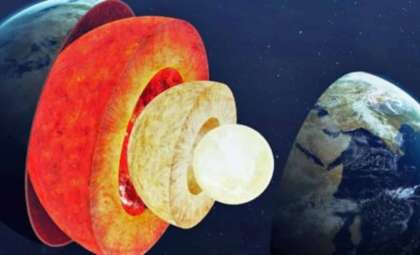
The molten outer core of our planet, situated roughly 2,200 kilometres beneath the surface, consists of electrically conductive liquid iron swirling around the solid inner core. This dynamic generates Earth’s magnetic field. Variations in this geomagnetic field allow scientists to infer the movement of material near the top layer of the outer core, even though direct observation from the surface is impossible.

Shift Toward Eastward Flow in Equatorial Pacific Region
Typically, the outer core flow at the surface tends to move westward. This flow pattern is linked to a large planetary-scale westward gyre offset from Earth’s axis of rotation. The equatorial Pacific lies beyond the grasp of this gyre, offering a unique zone where flow can behave independently.

A marked change occurred in 2010, when the data revealed that a substantial iron-rich fluid zone beneath the equatorial Pacific transitioned from a mild westward direction to a vigorous eastward motion. ESA characterizes this flip as unexplained and notes it challenges the notion of long-term stability in large-scale outer-core circulation.
The study clarifies that the 2010 change was not a total reversal of the entire outer core flow but a localized alteration beneath the Pacific, set against a broader context of predominately westward flow. This key distinction frames the interpretation of the event.
The researchers constructed their flow models based on secular variation—the gradual change of Earth’s magnetic field over time. By assuming negligible magnetic diffusion on timescales under 100 years, they inverted magnetic field measurements into representations of fluid movements near the outer core’s boundary.

The dataset integrates ground-based magnetometer records with satellite data from ESA’s Swarm and CryoSat missions, Germany’s CHAMP mission, and the Ørsted satellite. This comprehensive record enabled an examination of core-surface flow developments across nearly 30 years.
Tracking Post-Reversal Changes with Swarm Satellites
ESA deployed the Swarm satellite trio in 2013, three years following the Pacific core flow switch. Equipped with precision magnetometers and flying in coordinated orbits, the satellites effectively separate magnetic signals from the core, crust, oceans, ionosphere, and magnetosphere.
This ability to isolate sources is crucial because satellite measurements capture overlapping magnetic influences. Swarm's global, long-term data has delivered precise observations post-reversal and assisted in reconstructing variations of the flow near the core-mantle boundary.

Beyond revealing the broad eastward shift, the satellite data uncovered wave-like accelerations and swiftly altering flow patterns that might have been missed in less detailed datasets. ESA correlates these observations with sudden changes tied to the Pacific reversal and a geomagnetic jerk that occurred in 2017.
These findings are significant because Earth’s geodynamo is dynamic, with continuous fluid motions reshaping the magnetic field. While many large-scale flow patterns seem stable over decades, the rapid regional shift beneath the Pacific stands out in the dataset.
Investigating Potential Links to Inner-Core Dynamics
The underlying cause of the Pacific flow alteration is yet to be determined, but its timing suggests a possible connection to changes in the inner core identified through geodesy and seismology.
Madsen and collaborators propose that shifts within Earth's deep interior could have triggered the outer-core flow rearrangement beneath the Pacific. However, this remains a hypothesis rather than a definitive explanation, as the temporal correlation alone is not conclusive.
The proposed model introduces complexity by showing that the vigorous eastward flow has been diminishing since 2020. This opens several interpretations: the shift might be a short-lived anomaly, part of cyclical oscillations, or indicative of a more lasting transformation in core circulation.
Madsen emphasized that ongoing monitoring is critical: “Continued observation will be crucial to understand how these flow patterns evolve over time.”
Magnetic Data Sheds Light on Earth’s Deep Interior Dynamics
These deep Earth processes happen thousands of kilometres below the surface and have no direct impact on human safety or climate conditions. Their importance lies in understanding how motions in the outer core sustain Earth’s protective magnetic field.
As the core flow varies, so does the magnetic field. ESA highlights that fluctuations affect navigation technology, satellite operations, and space weather models. Additionally, the magnetic field shields the planet from charged solar particles.
The Pacific flow shift provides a tangible case demonstrating how swiftly regional patterns in the core’s liquid iron can change. The study encompasses observations through 2025, offering a detailed timeline that goes beyond the initial 2010 event into the period when the eastward flow began its observed decline.
- Categories:
- Science










0 comments
Sign in to Comment