

Hidden underneath the farmland near Waxahachie, Texas lies 22.5 kilometers of tunnel constructed for an ambitious American particle accelerator project that was never realized. The Superconducting Super Collider was abruptly halted by Congress in October 1993, leaving its subterranean passageways, access shafts, and surface facilities dormant.
The accelerator was intended to be a massive 87.1-kilometer ring beneath Ellis County, situated roughly 48 kilometers south of Dallas. Within this structure, two streams of protons would have raced in opposite directions before colliding with a total energy of 40 tera-electron volts (TeV).
By the time federal funding was cut, about 20% of the construction had been completed. This included the excavation of tunnels, installation of 17 access shafts, and erection of over 18,600 square meters of buildings, as detailed in a Scientific American overview. The project had already consumed more than $2 billion.

Probing the Basics of Matter
A particle collider uses intense magnetic fields to steer beams of particles through evacuated tubes. When these particles collide, detectors capture the byproducts and energy released, giving scientists a glimpse into the fundamental constituents of matter.
The Texas design aimed to accelerate each proton beam up to 20 TeV. This collision energy would have dwarfed that of any collider active or planned at the time the project was greenlit.
Approximately 10,000 superconducting magnets were planned to navigate the beams. These magnets operate near absolute zero, conducting electricity without resistance to generate the strong fields necessary for steering high-energy particles.
The experimental agenda included hunting for the Higgs boson and undiscovered particles. John Gunion, a physicist, told Scientific American that despite having lower beam luminosity than CERN’s later collider, the SSC would still have yielded sufficient Higgs events for detection. Luminosity here refers to the collision rate of particles inside the machine.
Higher collision energies would also expand the search beyond the Higgs, targeting possible supersymmetric particles and constituents of dark matter.
Years of Preparation Led to Construction
Concepts for a multi-TeV collider in the U.S. developed through the late 1970s and early 1980s. The Department of Energy embarked on formal design work in 1983, with President Ronald Reagan endorsing the initiative in 1987.
Reagan’s science advisor urged the team to be “bold and greedy,” as reported by Scientific American, and Reagan encouraged physicists to “throw deep,” reflecting the ambitious scale.
The Department of Energy chose Ellis County for the site in November 1988, with groundwork beginning by 1989, according to the American Institute of Physics.
The accelerator’s underground ring was to encircle Waxahachie, with shafts and surface buildings providing entry for the collider’s components such as cooling systems, electrical infrastructure, experiment halls, and detectors.
By 1993, workers had dug nearly 24 kilometers of tunnel. However, only the basic civil structures were completed; the magnet arrays, beam pipes, detectors, and other apparatus were never installed.
Funding Issues and Project Management Challenges
Initial cost projections were about $4.4 billion, but these soared to $8.25 billion by 1992, and estimates ballooned beyond $11 billion by late 1993.
Early budgets overlooked major expenditures, including roughly $500 million for detectors, $400 million for operations before completion, $60 million for land acquisition, and $118 million for federal oversight, as later Department of Energy reviews revealed.
Revisions to the magnet design further increased expenses. Enlarging the magnet apertures, prompted by calculations showing greater particle losses, added roughly $2 billion to costs, reported Scientific American.
Moreover, the project lacked robust cost and timeline controls. Historian Michael Riordan noted that the Department of Energy doubted that the particle physics community could provide the necessary management strength.
“They did not trust they could get that from the high-energy physics community, and I think they were partially correct in that,” Riordan told Scientific American.
Management conflicts also hindered progress. The Department of Energy introduced managers with defense backgrounds, contrasting with physicists accustomed to research lab cultures. This difference led to audits, conflicts, and leadership changes that undermined trust.
International Support Fell Short
Project plans anticipated about $2.6 billion in contributions from Texas and foreign partners. Texas committed $900 million, disbursing nearly $400 million by cancellation.
Foreign backing was minimal. India pledged $50 million, but several other approached countries declined funding. Europe was heavily invested in CERN, and negotiations with Japan were complicated by political and trade tensions.
Additionally, the project’s framing stirred controversy. A statement cited by Scientific American described it as “an American project [with] American leadership,” even while seeking substantial foreign funds.
Burton Richter, Nobel laureate and former SLAC director, later criticized the poor timing of international funding talks. “It was a very bad mistake to seek funding only after the design parameters of the project were determined,” he remarked.
The collider also competed with other expensive federal projects amid an economic downturn and calls for spending restraint. Congress was already funding the International Space Station, and the SSC’s ballooning costs became increasingly problematic.
Funding ceased in October 1993, with about 2,000 people employed at the site and in Dallas, including around 200 scientists. A 1994 study cited by Scientific American found half of the project’s scientists left physics afterward.
CERN’s Large Hadron Collider Achieves the Higgs Discovery
Years later, CERN’s Large Hadron Collider became operational in Europe. In July 2012, its ATLAS and CMS experiments announced the discovery of a particle matching the Higgs boson.
This achievement realized a key scientific goal originally set for the Texas collider. Though CERN’s collision energies were lower, its higher collision rates enabled the breakthrough.
The SSC’s cancellation did not end U.S. involvement in particle physics. American scientists continued at national labs and on international projects, including CERN’s experiments. The American Institute of Physics views the project’s termination as marking the shift of high-energy physics leadership to Europe.
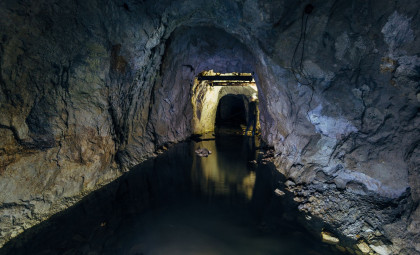
The tunnels in Texas never housed an active accelerator. Scientific American noted in 2013 that the access shafts had been sealed and the tunnels collected rainwater, standing as a silent relic of what might have been.
- Categories:
- Science









0 comments
Sign in to Comment