

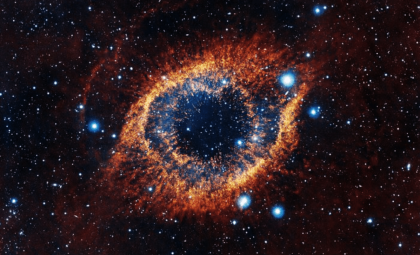
The latest image of the Helix Nebula presents one of the most detailed depictions yet of this nearby celestial marvel. Released in celebration of Astronomy Day, it showcases an intricate web of gas filaments encircling the remains of a star nearing the end of its life, with unprecedented clarity.
This stunning composite merges data from NASA’s Hubble Space Telescope and wide-angle captures from the Mosaic Camera attached to the National Science Foundation’s 0.9-meter telescope at Kitt Peak National Observatory in Arizona. The fusion results in a vast cosmic mosaic that brings into focus the nebula’s intricate forms and vibrant colors, making it one of the closest planetary nebulae to Earth vividly visible.
Approximately 650 light-years distant, the Helix Nebula has captivated astronomers for its unique and striking look. Although it often appears to Earth-bound observers as a radiant eye or a massive bubble, research indicates its authentic shape resembles a gas cylinder aligned nearly directly towards our planet.

According to NASA, experts at the Space Telescope Science Institute meticulously combined the finely detailed sections captured by Hubble before integrating them with the Mosaic Camera’s broader shot.
Crafting an Expansive Cosmic Image From Diverse Observations
The expansive apparent size of the Helix Nebula posed challenges, requiring multiple observations to capture its entirety. Its visible span approaches half the diameter of the full Moon, rendering a single Hubble exposure insufficient to encompass the whole nebula.
Sections of the nebula were photographed using Hubble’s Advanced Camera for Surveys, and these were later stitched together alongside the wide-frame image from the Mosaic Camera, producing a seamless and extremely detailed portrayal of the nebula’s full structure.
During the Leonid meteor shower in November 2002, Hubble utilized downtime while shielding its mirror by orienting the spacecraft away from the meteor stream for nearly 12 hours. NASA reports that the telescope then dedicated nine orbits to imaging the Helix Nebula, which was optimally situated opposite the direction of the meteor debris.

The final image reveals a complex arrangement of filamentary gas strands encircling a colorful ring. The blue tones correspond to emitting oxygen, while reds indicate emissions from hydrogen and nitrogen atoms.
The Nebula’s Peculiar Filaments Born From a Fading Star
At its core, the Helix Nebula shelters the remnants of a star resembling our Sun, which shed layers of gas and dust during its twilight years. This expelled material forms the glowing shell enveloping the central white dwarf — a small, intensely hot stellar relic.
Among the nebula’s standout traits are thousands of comet-like filaments oriented inward toward this central star. These features are thought to result from a hot stellar wind pushing against colder gas and dust expelled previously by the star.

While ground telescopes had detected these filament structures for years, Hubble’s observations expose their complexity in remarkable detail. Scientists propose the filaments may form part of a disk encircling the white dwarf, creating a distinctive collar around the star.
A Beloved Nearby Nebula for Astronomical Study
Thanks to its proximity to Earth, astronomers can examine the Helix Nebula’s structure more thoroughly than many distant nebulae. Located within the constellation Aquarius, it spans almost 3 light-years across, forming an expansive glowing ring in space.
For stargazers, the nebula serves as a favorite sight. To the naked eye through binoculars, it appears as a dim greenish haze, while more powerful amateur telescopes reveal its circular silhouette. Only the most advanced ground telescopes can detect the characteristic radial streaks threading through the nebula’s ring.

Detailed analysis confirms the Helix Nebula is a glowing cylindrical formation oriented nearly straight at Earth, which accounts for its distinctive visual appearance in the sky.
- Categories:
- Space




0 comments
Sign in to Comment