

On December 27, 1935, U.S. military planes targeted an active lava flow from Mauna Loa in Hawaiʻi with 40 bombs. This action was intended to disrupt lava streams moving toward Hilo, threatening the town's water supply.
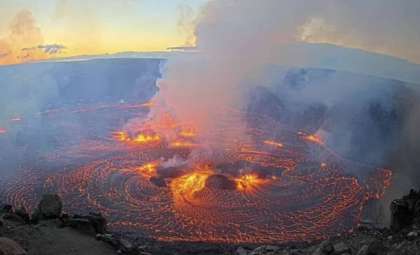
The volcanic eruption began on November 21 inside Mauna Loa’s summit caldera, soon extending down the Northeast Rift Zone. By November 27, an additional vent had opened on the volcano’s northern slope, channeling smooth pāhoehoe lava into a saddle between Mauna Loa and Mauna Kea before it proceeded eastward. According to the U.S. Geological Survey, the lava moved at roughly one mile daily.
Residents and authorities worried that the lava might invade the Wailuku River, Hilo’s key water source. Thomas A. Jaggar, founder of the Hawaiian Volcano Observatory, along with volcanologist Ruy Finch, suggested using explosives to fracture the lava channels feeding the advancing flow.

Understanding the Lava Channels Heading Toward Hilo
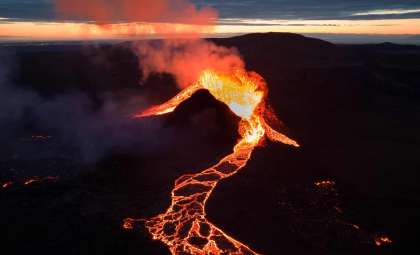
Pāhoehoe lava is a basaltic type characterized by a smooth, often rope-like surface. As the surface cools, the molten lava can continue to flow through hidden channels or insulated tubes beneath, allowing it to travel farther while retaining heat.
The bombing was designed not to stop the eruption but to rupture the lava conduits near the vent. The goal was to disperse the lava across a wider area rather than let it concentrate in a rapidly moving stream directed at Hilo.

The concept of bombing lava flows had been discussed in Hawaiʻi previously. Explosives were considered during eruptions threatening Hilo in 1880 and 1881 but never deployed. The National Park Service identifies the 1935 operation as the first ever aerial bombing of an active lava flow.
The Army mission was commanded by Lieutenant Colonel George S. Patton, who later led U.S. forces in World War II. Aircraft flew from Oʻahu to the Humuʻula lava flow and dropped their bombs near the northern lava channels of Mauna Loa.
Details of the Bombing Operation
The attack involved 20 large demolition bombs and 20 smaller marker bombs. A 1980 study referenced by the National Park Service notes that each MK I demolition bomb weighed 600 pounds and contained 355 pounds of TNT. These bombs featured a short-delay fuse allowing penetration before detonation.
The marker bombs, known as “pointer bombs,” contained small black-powder charges to indicate bomb impact locations for aircrews. According to a Popular Mechanics summary, 16 demolition bombs hit the target zone and 12 struck the intended lava tunnel.

Jaggar observed the bombing from Mauna Kea through a telescope and later called the action “an experiment that could not have been more successful; the results were exactly as anticipated.” Following the bombing, the lava flow slowed and ceased by January 2, 1936.
The National Park Service also records Jaggar’s view that the bombing “helped hasten end of the flow,” noting, “in a natural end, the lava would not cease so abruptly.” Both statements are cited in their account of the 1935 Mauna Loa eruption.
Scientists Debated the Bombing's Impact
USGS geologist Howard Stearns, who flew on the final bombing mission, expressed skepticism. In his 1983 autobiography, he remarked, “I am sure it was a coincidence.” After the explosions, lava continued moving, declined gradually, and didn’t significantly change direction.

The eruption ended six days post-bombing. Since volcanic activity was already winding down, isolating the bombing’s effect from the natural cessation is difficult. The USGS characterizes the effectiveness of using bombs to disrupt lava channels as contentious.
Subsequent investigations concluded that the 1935 bombing and a similar attempt in 1942 produced limited alterations. Nonetheless, this event stands as an early case of lava-flow diversion, a technique aiming to redirect lava instead of halting magma emergence.
- Categories:
- News






0 comments
Sign in to Comment