

August is packed with celestial events for astronomy enthusiasts, highlighted by Venus shining brightly in the evening sky and a notable close encounter between Mercury and Jupiter just before dawn around mid-month. This month also presents excellent viewing opportunities for Saturn, while Mars gradually reemerges into the morning sky.
The shifting alignment of planets throughout August creates a dynamic observing itinerary. Some of these sights are visible to the naked eye, while others benefit from binocular or telescope assistance.
According to Space.com, August’s standout phenomena include Venus reaching its peak eastern elongation, Mercury’s most favorable pre-sunrise appearance, and Jupiter’s steady return from solar glare.

Venus Conquers the Evening Sky as Brightest Object
Venus dominates the evening sky throughout August, shining brighter than any star or planet. Its brilliance intensifies from magnitude -4.2 at the start of the month to -4.5 by August’s end, second only to the Moon in brightness.
On August 15, Venus attains its greatest eastern elongation, positioned about 46 degrees east of the Sun. Despite this wide separation, Venus does not climb very high above the horizon, slowly descending toward the west-southwest as the month advances due to its southern declination relative to the Sun.
Space.com notes that this downward movement is reinforced by the seasonal tilt of the ecliptic, the path traced by the Sun, Moon, and planets. In late summer, this path hugs closer to the western horizon after sunset, causing Venus to sink into the brighter twilight hours during late August and early September.

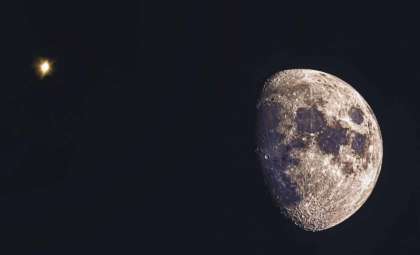
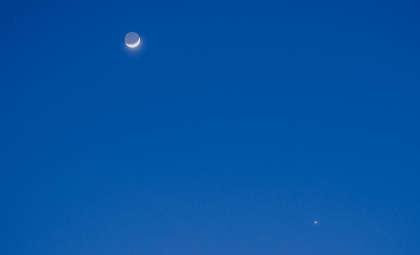
Telescope users will observe Venus nearing a half phase around mid-month, with approximately 48% of its sunlit disk visible. On the evening of August 15, a waxing crescent Moon can be spotted just below and to the right of Venus.
Mercury and Jupiter Form a Stunning Morning Pair
The most captivating pre-dawn event unfolds between August 13 and August 17, as Mercury and Jupiter draw remarkably close above the eastern horizon. Mercury reaches its greatest western elongation on August 2, positioned 19 degrees from the Sun. Roughly 50 minutes before sunrise, it glows at magnitude +0.2 low in the east-northeast. Over the coming days, Mercury nears the horizon and brightens swiftly, peaking at magnitude -1.3 on August 16.
The article points out that on August 9, observers can use Castor and Pollux—the bright twin stars—to guide their gaze to Mercury by following an imaginary line from these stars toward the eastern skyline. On August 11, a delicate crescent Moon with only 2% illumination appears roughly 2 degrees above Mercury.
Jupiter, having passed solar conjunction on July 29, remains hidden during the early part of August but slowly reappears in the dawn glow. By August 12, it becomes visible low in the twilight sky about 5 degrees below Mercury.
The two planets reach their closest separation early on August 15, coming within less than 0.6 degrees of each other. Jupiter outshines Mercury by a factor of two during this rendezvous. They rise roughly 65 minutes before sunrise, standing near 10 degrees altitude in the east-northeast at dawn, making binoculars handy for spotting them amid the increasing light.
Saturn Shines Bright While Mars Gradually Rises
Besides the morning conjunction, Saturn presents the prime telescopic target for August. It ascends a few hours after sunset, positioned close to the boundary between the constellations Cetus and Pisces.
By dawn, Saturn is prominently placed high in the south-southeast sky. Its iconic rings remain well-tilted for clear telescope viewing, although their apparent width is expected to decrease over the next several months.
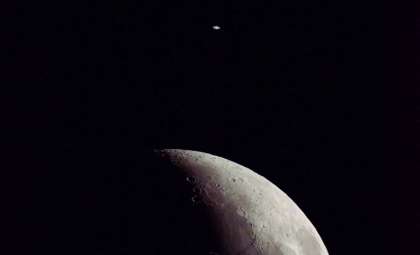
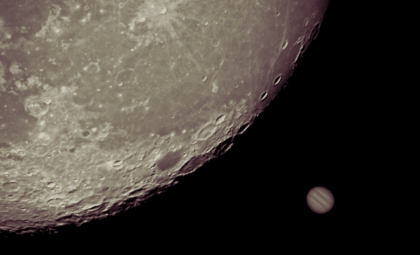
On the night of August 3, a bright gibbous Moon appears slightly below and to the right of Saturn, serving as a convenient marker for finding the planet. Mars rises near 2 a.m. local daylight time throughout August and stands about 20 degrees above the east-northeast horizon at dawn.

As noted by Space.com, Earth closes in on Mars by about 425,800 miles (685,100 kilometers) per day this month. Still, the two planets remain separated by a considerable distance of 172.2 million miles (277.1 million kilometers) by August’s conclusion, resulting in a slow increase in Mars’ brightness.
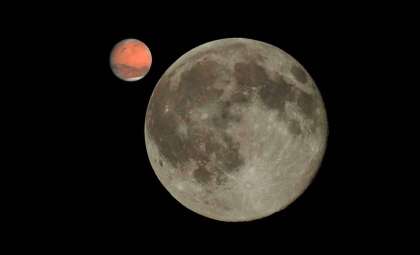
On the morning of August 9, a waning crescent Moon appears roughly 4.5 degrees to the right of Mars, adding another delightful conjunction to August’s lineup of planetary events.
- Categories:
- News



0 comments
Sign in to Comment