

The James Webb Space Telescope (JWST) has identified ammonia in the atmosphere of HATS-6 b, a massive exoplanet approximately 500 light-years away, while also measuring temperatures significantly lower than earlier predictions.
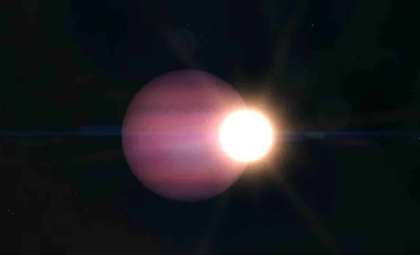
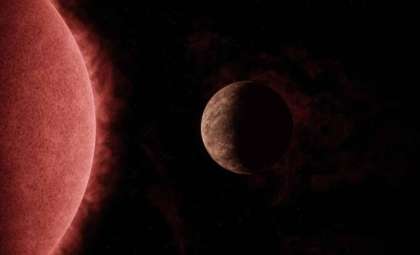
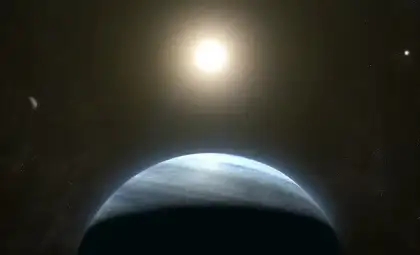
HATS-6 b is a gas giant roughly the size of Jupiter that orbits an M dwarf star, a small and cool type of star, which conventional formation theories suggest should be unlikely to host such a large planet. Its distinct qualities are offering fresh insights into the variety of planetary systems beyond our own solar neighborhood.
These discoveries were made as part of the Giant Exoplanets around M-dwarf Stars (GEMS) initiative, which leverages JWST data to investigate the rare class of gas giants circling small stars. The study, published in The Astronomical Journal, explores both the chemical composition and surprising thermal properties of this planet.

Completing an orbit around its dim host every three days, HATS-6 b’s substantial size is remarkable, given that smaller stars typically provide less material during planet formation. This discovery challenges established views about how large planets like Jupiter can originate around M dwarfs.
Giannina Guzmán Caloca, the lead researcher and a Ph.D. candidate in astronomy at the University of Maryland, highlighted that the limited resources and time available around smaller stars make it difficult to form massive planets like Jupiter or Saturn, marking HATS-6 b as a key object for studying atypical planet formation.
Ammonia Detected on Faraway Giant Planet
The team employed transmission spectroscopy to analyze HATS-6 b by examining the starlight that filters through its atmosphere. This technique helps pinpoint specific molecules based on their unique absorption signatures.
JWST’s observations uncovered four molecules within the planet’s atmosphere: water, methane, ammonia, and carbon dioxide. The ammonia finding is particularly significant due to its rarity in exoplanet atmospheres.
“Carbon, hydrogen and oxygen are all things that have previously been found in atmospheres of giant planets outside our solar system, but ammonia is something almost never detected before,” Guzmán Caloca said.

Ammonia’s detection is important because nitrogen-containing molecules are expected to be more prevalent on cooler giant planets as opposed to the extremely hot types.
Unanticipated Atmospheric Temperatures Observed
JWST’s data also revealed a significant discrepancy between predicted and actual temperatures on HATS-6 b. Earlier models anticipated the planet’s temperature to soar to nearly 800°F (425°C).
These predictions assumed the planet absorbed starlight and distributed the heat evenly across its atmosphere. However, measurements from JWST indicated a much cooler temperature around 250°F (120°C).
Guzmán Caloca suggested that such low temperatures could result from a substantial reflection of stellar light by the planet’s atmosphere before it warms up. The presence of clouds and haze was proposed as a plausible cause for this phenomenon.

These atmospheric elements could drastically influence the energy the planet receives, thereby creating temperature conditions very different from expectations. This temperature discrepancy also highlights the difficulties in studying planets orbiting small, active stars.
Impact on Exoplanetary Science
HATS-6 b is among approximately 40 known gas giants orbiting M dwarf stars and is one of seven worlds examined by the GEMS program. By analyzing these systems, scientists aim to discover if gas giants around small stars form differently compared to those around larger ones.
This discovery adds to the expanding catalog of peculiar exoplanets found throughout our galaxy. Astronomers have now confirmed upwards of 6,000 exoplanets, showcasing a broad diversity in planetary types and atmospheres.

Additional observations are planned to further analyze HATS-6 b’s atmospheric composition and to verify whether clouds or haze are responsible for its surprisingly cool temperature.
- Categories:
- Space






0 comments
Sign in to Comment