

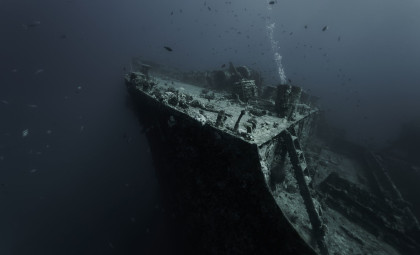
More than seven decades following the Andrea Doria disaster in the North Atlantic, adventurers continue to dive into the decaying Italian ocean liner to examine newly revealed areas and retrieve artifacts before they vanish forever. Tragically, 18 divers have lost their lives attempting to explore this underwater relic.
Resting on its right side some 50 miles south of Nantucket, the 700-foot vessel lies approximately 250 feet underwater, a depth well beyond typical recreational diving limits. Divers face strong currents, poor visibility, icy waters, and decompression challenges on their descent. Inside the wreck, shifting debris, fragile metalwork, and thick silt present additional dangers.
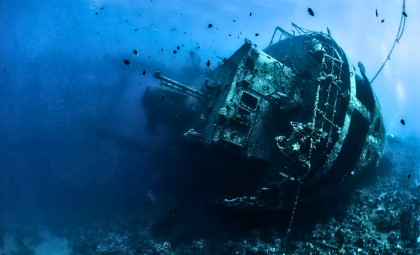
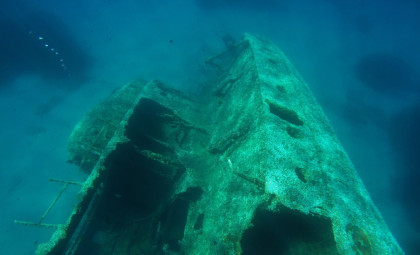
The wreck has dramatically deteriorated over time. Entire decks have collapsed, portions of the bow and stern have broken away, and the ship has lost around 30 feet in vertical height after decades beneath the waves. These structural shifts occasionally reveal previously inaccessible sections and treasures to intrepid divers.

How the Andrea Doria Sank Following the 1956 Collision With the Stockholm
On July 17, 1956, the Andrea Doria departed Genoa, Italy, carrying 1,706 passengers and crew en route to New York. Approaching the conclusion of its 101st transatlantic voyage on July 25, it encountered the outbound M/S Stockholm amid heavy fog.
While the Andrea Doria was engulfed in dense fog, Stockholm traveled under clearer skies. The officers aboard these two vessels made conflicting decisions on how to pass each other after tracking radar signals.
At 11:05 p.m., Andrea Doria's captain Piero Calamai ordered a slight four-degree turn to the port side. Two minutes later, Stockholm’s third officer Johan-Ernst Carstens-Johannsen steered 20 degrees to starboard. At 11:10 p.m., less than a mile apart, the ships finally sighted one another's lights and tried emergency evasive actions.
Within moments, the Stockholm collided with the Andrea Doria’s starboard flank at 18.5 knots. The reinforced bow tore approximately 40 feet into the larger ship, rending seven of its 11 decks behind the bridge.

The disaster claimed the lives of 46 passengers on the Andrea Doria and five crew aboard the Stockholm. Nevertheless, the Andrea Doria remained afloat for nearly 11 hours, enabling rescue ships to save survivors before it sank shortly after 10 a.m. the following day.
Explorers descended almost immediately. A day after the sinking, Peter Gimbel and Joseph Fox dove in wetsuits with basic gear and an underwater camera. Gimbel returned many times, and subsequent expeditions retrieved numerous artifacts from the ship.
A 1964 mission recovered most of a life-sized bronze statue of Admiral Andrea Doria from the first-class lounge. In 1981, Gimbel’s team cut into the hull to retrieve the ship’s hefty three-ton safe. Rumors spoke of diamonds and jewels worth over $1 million inside, but the safe held only a small collection of banknotes and travel checks.
Intense Depth and Crumbling Interiors Make the Wreck Hazardous
The Andrea Doria earned the nickname “Mount Everest of diving” due to the extreme challenge and danger it represents. Eight divers died between 1992 and 1999 attempting to explore the site.
Rising roughly 80 feet off the ocean floor, divers here must contend with six to eight times the atmospheric pressure at sea level, using up air more rapidly while facing risks of narcosis, oxygen poisoning, and decompression sickness.
Inside, explorers navigate sideways staircases, collapsing corridors, corroding metal, and tangled wires. Silt carpets the interior, and disturbing it drastically reduces visibility.

In 1996, Steve Gatto and Tom Packer reached the ship’s engine room for the first time. While filming the instrument panel, Gatto became disoriented and experienced narcosis but managed to find the exit thanks to strobe lights they had placed along their route.
The advent of mixed-gas diving, substituting helium for some nitrogen, helped reduce narcosis and made deep dives somewhat safer. However, divers still needed long decompression stops and had to manage multiple gas mixtures carefully; mistakes could be deadly.
Gatto, with more than 250 dives to the Andrea Doria, observed that some divers relied too heavily on technology rather than experience.
Researchers Recover a Five-Foot Gyrocompass Repeater in 2025
On July 11, 2025, at a depth of about 230 feet, Chris Ogden entered a narrow section of the Andrea Doria and spotted the circular top of a gyrocompass repeater. His diving partner, Joe Mazraani, had discovered the same artifact moments earlier.
This five-foot-tall brass navigational device once stood on the ship’s port bridge wing, indicating the ship’s heading. By 2025, it was entangled beneath debris, cables, fishing nets, and fragments of the corroding hull.
With only four dives left on their expedition, each allowed roughly 40 minutes at the bottom, Ogden and Mazraani cleared nets and spent multiple dives removing pipes, cables, and wreckage. The debris pile they cleared was estimated by Ogden at eight feet high, 10 feet long, and five feet wide.

On the final dive, they tipped the compass onto its side and secured it to a lift bag rated for 500 pounds. Released, the instrument broke free of surrounding wreckage and resurfaced in under a minute.
The gyrocompass repeater remained mostly intact, though its degree-marked face was missing. A rope bound around the device suggested a previous diver had reached it earlier.
Joe Mazraani passed away unexpectedly on July 29, 2025, aged 47, following a medical emergency while diving an unidentified wreck near Georges Bank, about 200 miles off Cape Cod. The Andrea Doria’s foghorn was sounded in his remembrance.
Shortly afterward, filmmaker and diver Al Giddings, who participated in a 1968 Andrea Doria expedition, contacted Jennifer Sellitti of Atlantic Wreck Salvage. Giddings possessed the missing face of the gyrocompass repeater in his home.
Andrea Doria Artifacts Found New Homes in Museums and Private Collections
Since 2010, Atlantic Wreck Salvage has conducted annual expeditions to the Andrea Doria aboard the D/V Tenacious, recovering artifacts like the ship’s foghorn in 2017. They restore and exhibit these treasures for public appreciation.
The ethics of removing items from shipwrecks remain debated. Some advocate preserving artifacts in situ or reserving recovery for archaeologists. However, divers argue that the quickly degrading wreck threatens to bury or destroy objects as collapse and shifting debris accelerate.
Experienced diver John Moyer owns salvage rights alongside Packer and Gatto. In the 1990s, Moyer and Gary Gentile retrieved the feet and base of the bronze Admiral Andrea Doria statue. In 2024, they reunited and restored the statue's remaining parts, acquired from the family of the captain who led the 1964 recovery.
In 2025, Moyer lent pieces from his collection—such as a deck chair, a passenger’s life vest from the collision night, and a 140-pound brass bell—to the Italian American Museum in New York City for an exhibit on the ship’s final journey.
The Andrea Doria continues to evolve after 70 years underwater. As decks collapse and rust spreads across the hull, new areas become accessible for exploration even while the wreck slowly sinks deeper into the Atlantic floor.
- Categories:
- News







0 comments
Sign in to Comment