

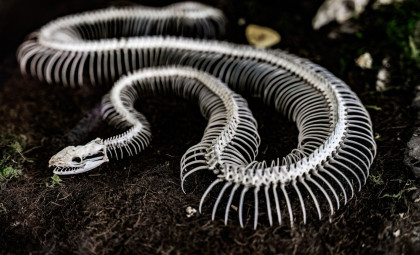
Paleontologists have discovered four snakes preserved side by side in a burrow for 38 million years, providing an unprecedented glimpse into the origins of boas. This newly identified species, Hibernophis breithaupti, was excavated in Wyoming, with exceptional preservation allowing scientists to trace the ancestry of today's rubber boas to a surprising location far from their current habitats.
Snake fossils are typically challenging to analyze due to their fragile, slender bones that often disintegrate before being studied, resulting mostly in isolated fragments. Consequently, finding multiple snakes fossilized together in life-like positioning is exceptionally rare, and discovering four coiled as if in mid-hibernation is extraordinary.
This uniqueness amplifies the importance of the discovery. Living during the Early Oligocene around 38 million years ago in what is now western Wyoming, H. breithaupti provides detailed insights into the physical characteristics and possibly the social habits of early snakes — information rarely preserved in fossils.

An Ancient Ancestor of Today’s Rubber Boas
Led by University of Alberta Michael Caldwell, the research team identifies Hibernophis breithaupti as an early member of the Booidea superfamily, which includes modern boas and pythons. The fossils suggest a direct evolutionary link to rubber boas — small, elusive burrowing snakes still inhabiting certain North American regions today.
“Modern boas are widespread in the Americas, but their early evolution is not well understood,” Caldwell and his colleagues said, noting that: “These new and very complete fossils add important new information, in particular, on the evolution of small, burrowing boas known as rubber boas.”
The team proposes that northern and central North America may have been a key center for boa evolution, challenging the common assumption that boas primarily evolved in warmer environments.
Volcanic Ash Played a Crucial Role in Fossil Preservation
This extraordinary preservation owes much to a violent geological event. Approximately 38 million years ago, the active Southern Basin and Range Volcanic System blanketed the area with thick volcanic ash. This ash, mixed with fine-grained sandy mudstone typical of the White River Formation, encapsulated the snake remains. Caldwell believes that the snakes perished during an unusual flood event, a set of conditions that serendipitously favored the fossils’ survival for millions of years.
“Fossilization is a rough process. You need exactly the right conditions to preserve something,” he said. “Modern garter snakes are famous for gathering by the thousands to hibernate together in dens and burrows.”
The combination of ash, sediment, and flooding created a rare circumstance that securely fossilized multiple snakes together, maintaining their original arrangement over tens of millions of years.
Evidence of Group Hibernation in Ancient Snakes?
Perhaps the most fascinating aspect of this find is behavioral rather than anatomical. Published in the Zoological Journal of the Linnean Society, the study shows all four Hibernophis breithaupti individuals coiled together, suggesting communal hibernation—an enduring behavior found among various modern snake species. For example, contemporary garter snakes regularly cluster in huge numbers in shared dens to conserve heat during colder months.
Caldwell noted the remarkable similarity, emphasizing the significance of this potential social behavior dating back tens of millions of years. If confirmed, this would be one of the earliest documented cases of group hibernation in the fossil record, with the preserved burrow offering an intimate view of how ancient snakes coped with cold climates.
- Categories:
- Science







0 comments
Sign in to Comment