

Imagine a future where humanity doesn’t have to abandon Earth even as the sun nears the end of its life. New research envisions advanced megastructures, artificial illumination, and planetary engineering techniques that could preserve Earth’s livability far beyond the sun’s transformative stages.
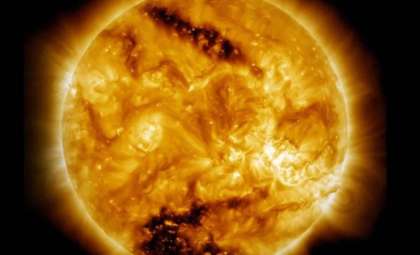
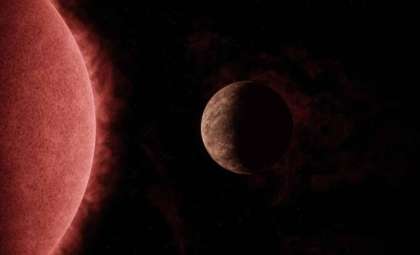
In approximately a billion years, the sun will exhaust its fuel and enter the red giant stage, a process that will render Earth’s current conditions inhospitable. This phase will strip away oceans and atmosphere, potentially swallowing the planet itself.
A study by Gabriel Harry, set to be published in the Journal of the British Interplanetary Society, outlines how an advanced civilization might focus on saving Earth instead of seeking another world. It proposes sweeping engineering efforts utilizing materials from within our solar system.

Massive Sunshade to Shield Earth From Intense Solar Radiation
The primary obstacle is counteracting the intensified solar energy during the sun’s expansion. The study suggests constructing a colossal sunshade positioned at the Lagrange point 1 (L1), a gravitationally stable spot between Earth and the sun.
To effectively block the enlarged sun’s rays, the shield would have to span a significant portion of the sky. Its size could be minimized by using a counterweight linked by an enormous cable, allowing placement closer to Earth, just outside the moon’s orbit.
According to the analysis, the needed materials could be sourced from celestial bodies like Ceres and the moon. Mining about 40% of Ceres would produce enough carbon for a 2-million-kilometer tether, while roughly 0.01% of lunar material could supply aluminum to create a sunshade with a diameter of 350,000 kilometers.

While the sunshade would shield Earth from extreme radiation, it would also block the sunlight crucial for sustaining life and energy. Consequently, an alternative source of illumination would be necessary.
Harnessing Jupiter’s Power to Create Artificial Sunlight
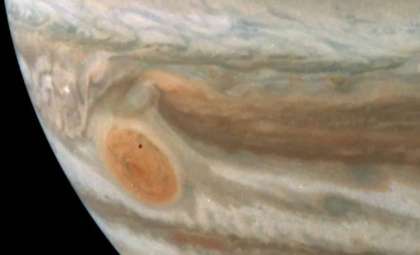
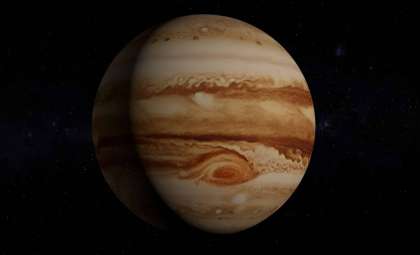
The research proposes tapping gas giants as energy reserves. Jupiter’s abundant hydrogen and helium could fuel fusion reactors in the future.
Based on Gabriel Harry’s work, fusion facilities placed deep within Jupiter’s atmosphere—approximately 6,500 kilometers down—would exploit its natural pressure for reaction containment. The generated energy could then be beamed to Earth.
This energy transfer would involve space-based relay systems and powerful lasers, including a laser roughly 15 kilometers long to send the artificial sunlight directly to Earth’s surface.
The findings suggest Jupiter’s fusion potential could supply artificial sunlight for an astonishing 9.1 quadrillion years. Though this vision demands technological advances far beyond today’s reach, it presents Jupiter as a viable energy provider for a futuristic civilization.
Relocating Earth to Maintain Suitable Conditions
Even with a protective shield and substitute sunlight, Earth would need to avoid being pulled too close to the swelling sun. The study explores gradually shifting Earth’s orbit outward via the gravitational slingshot effect. This could involve continuously directing celestial objects near Earth to impart momentum and increase its orbital radius.
Another method involves propelling oxygen gathered from Jupiter in a continuous particle beam past Earth. The researchers compute this beam’s mass to equal about half of the Amazon River’s flow. Any oxygen reaching Earth’s atmosphere would harmlessly disperse without substantial environmental impact.

The study also looks at ways to sustain Earth’s internal geodynamics. As tectonic activity wanes, nutrient cycling would be compromised. The proposed fix involves injecting antimatter encased in containers and delivered into Earth’s interior via molten iron.
Researchers estimate that producing and injecting about 2 kilograms of antimatter daily could preserve tectonic processes. The study further contemplates the Milky Way–Andromeda collision, suggesting hydrogen beams launched near Jupiter might assist in modulating the solar system’s trajectory.
- Categories:
- Science







0 comments
Sign in to Comment