

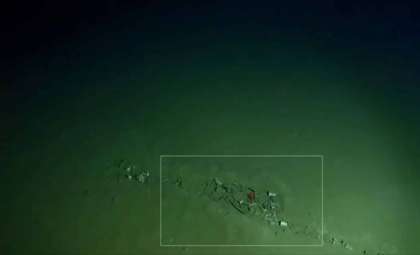
Sonar scans revealed hundreds of ancient storage vessels resting on the Mediterranean seafloor nearly 1.8 kilometers beneath the surface and about 90 kilometers offshore. The discovery was unexpected, as no one was initially searching for a shipwreck in this area.
The offshore energy company Energean was conducting a seafloor survey focused on identifying delicate ecological zones when the amphorae were detected. Footage captured by a remotely operated vehicle (ROV) was promptly shared with the Israel Antiquities Authority.
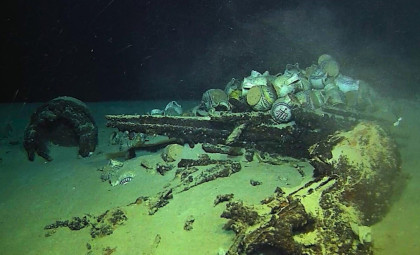
The visuals revealed an extraordinary find: a Canaanite trading vessel dating back to the 13th century BCE, recognized as the oldest deep-water shipwreck ever identified. Importantly, it is the first Bronze Age shipwreck discovered beyond shallow coastal areas.


The find was officially announced by the IAA in June 2024 after recovery efforts aboard the Energean Star. The research vessel traveled six hours from Haifa to the site where a large remotely operated vehicle was deployed, taking an hour to descend to the seafloor.
An Abundance of Bronze Age Amphorae Found Miles Underwater
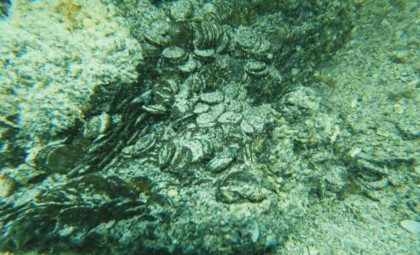
Spanning a roughly 14 by 6 meter area, numerous amphorae emerged from the sediment. Each jar measures about half a meter in length and shares nearly identical shapes.
Careful excavation by the ROV revealed a second amphora layer beneath the surface debris. According to the marine archaeology chief at the IAA, Jacob Sharvit, who monitored the dive firsthand, fragments of the ship’s wooden hull may lie buried underneath the vessels.
"It's surreal," Sharvit remarked as the dark shapes appeared on the monitor. "I couldn't see, only my heartbeat was audible."
The ship likely measured between 12 and 14 meters in length, carrying hundreds of Late Bronze Age Canaanite amphorae used to transport commodities such as olive oil, wine, and other agricultural products throughout the eastern Mediterranean basin.

Archaeologists dated the amphorae to approximately 1400 to 1200 BCE by analyzing characteristic features like the shoulder angles, neck shapes, and pointed bases, which evolved consistently and serve as reliable temporal markers.
The distinctive pointed bases allowed the jars to sway gently with the motion of the ship without tipping over and breaking.
Two vessels were carefully raised from the outer edges of the site with minimal disruption, surfacing for the first time in over 3,000 years. The IAA is conducting petrographic testing to determine the jars’ production origins, along with residue and elemental analyses to identify their former contents.
Early Mariners Ventured Across Open Sea, Far from Shoreline
Prior to this discovery, scholars believed Bronze Age maritime trade mostly followed coastal routes. Known Late Bronze Age cargo ships like the Cape Gelidonya and the Uluburun shipwreck were both found near shallow waters close to land and could be accessed by divers.
In contrast, this wreck lies far from sight of land at 90 kilometers distance from Israel’s coast. The crew must have relied solely on celestial navigation, using the sun and stars for guidance. "It's the first such find located this far from any shoreline," explained Sharvit, emphasizing that it "reshapes our understanding of ancient seafaring skills."

The ship sank during a time when the ancient Mediterranean was highly interconnected. In the 13th century BCE, powerful entities like the Egyptian and Hittite empires controlled a vast trading system spanning Greece, Cyprus, Anatolia, the Levant, and Egypt, exchanging olive oil, wine, metals, timber, and precious gems. "This marks a period when the Mediterranean was truly a globalized region," noted Eric Cline, an archaeologist from George Washington University not involved in the excavation. "Trade, diplomacy, and cultural exchange flourished."
The hundreds of amphorae aboard indicate strong commercial links between where the cargo originated and the Near Eastern ports it was destined for.
The cause of the ship’s sinking remains uncertain, but Sharvit speculates either severe weather or piracy attempts might be responsible.
Preservation Deep Beneath the Waves Offers Unique Glimpse into Bronze Age Maritime Life
The challenging depth has kept the wreck remarkably intact. At 1.8 kilometers below sea level, strong waves and currents do not disturb the site, nor have human activities like fishing or diving impacted it.
Texas A&M nautical archaeologist Shelley Wachsmann described the discovery as "extraordinary," noting that "each shipwreck is essentially a time capsule, capturing a singular moment in history."
The survival of wooden hull elements remains unconfirmed. The vessel seems to have settled on its side, with no hull wood visible during the ROV exploration. Deep-sea excavation efforts are expensive and technically demanding, and Sharvit does not anticipate returning personally. However, ongoing petrographic and residue studies may unlock details about the amphorae’s manufacture and original contents.
- Categories:
- News



0 comments
Sign in to Comment