

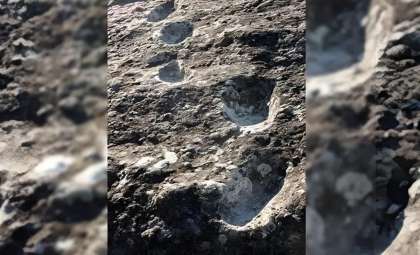
In North Dakota, scientists uncovered a rare set of four footprints dating back 66.5 million years, representing a walking adult Tyrannosaurus rex. Found within the Hell Creek Formation, these tracks enabled researchers to estimate the dinosaur's speed at about 3.5 to 4.5 mph, similar to a fast human walking pace.
Published in the Journal of Vertebrate Paleontology, this finding resulted from collaboration between the Denver Museum of Nature & Science and Liverpool John Moores University in the UK. While single T. rex footprints have been documented before, this is the first detailed description of a continuous trackway attributed to the species.
Unlike fossilized bones, which offer limited insight into an animal’s movement, a trackway preserves a moment of walking behavior, granting scientists a glimpse into the dinosaur’s life millions of years ago.

Uncovering a Remarkable Dinosaur Trail
Stretching roughly 23 feet (7 meters), the trackway includes four distinct three-toed prints, each about 3 feet (0.9 meters) long. The pattern contains two left and two right footprints, with a stride length near 13 feet (4 meters). This site was discovered in 2025 on federal property overseen by the U.S. Forest Service near Marmarth, North Dakota.
Scientists attribute the tracks to T. rex due to their large size and slender toe design, combined with numerous T. rex fossils found in the vicinity.

No other dinosaur from the formation matches the distinctive combination of footprint size and shape. Although erosion has worn the prints somewhat, researchers caution that the speed estimate is approximate.
“Bones tell us an enormous amount about these animals, but footprints capture a moment of behavior,” said Tyler Lyson, senior curator of vertebrate paleontology at the Denver Museum of Nature & Science, who led the fieldwork. “With a trackway, we can actually follow an animal as it moved across the landscape. That is incredibly rare for T. rex.”
Advanced Digital Techniques Enable Detailed Study
The research team utilized high-resolution 3D scanning technology to capture precise images of each footprint and the entire trail. Evan Tamez-Galvan, a museum scientist, performed the scans on site, producing digital models detailed enough for close examination and physical reproduction.

This digital data was crucial, allowing Peter Falkingham, a paleobiologist at Liverpool John Moores University and expert in dinosaur tracks, to serve as lead author without visiting the site in person.
“The technology we’re able to apply in the digital age means my colleagues could scan the tracks in the field and then send the 3D information over to me to visualize on my computer and in VR, enabling me to take as close a look as they did in person,” he said.
A Teacher's Keen Eye Sparks Remarkable Find
This extraordinary discovery stems from an unexpected source—a high school science educator rather than a professional paleontologist. Kent M. Hups, a teacher based at Northglenn High School, noticed the footprints during careful observation of the landscape, later co-authoring the research paper with museum scientists.
“As a teacher, I’m always telling my students that science starts with curiosity, passion and careful observation,” Hups said. “I never imagined that could lead me to a discovery like this.”

Plans are underway to airlift three of the four footprints this fall for display at the Denver Museum of Nature & Science, according to the museum.
- Categories:
- Science








0 comments
Sign in to Comment