

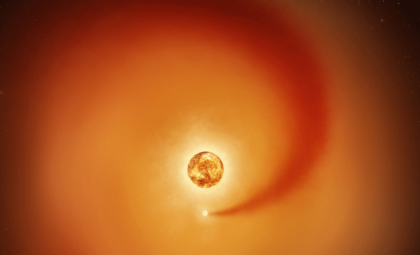
Researchers have potentially identified the elusive star orbiting near Betelgeuse. Leveraging the cutting-edge capabilities of the European Southern Observatory’s Very Large Telescope (ESO’s VLT), scientists have obtained the sharpest imagery to date revealing what could be Betelgeuse B, a faint stellar partner circling the renowned red supergiant. This discovery could finally resolve a decade-long astronomical enigma.
For many years, astronomers suspected that Betelgeuse was accompanied by another star, mainly due to its periodic brightness variations. Nevertheless, numerous attempts failed to visually confirm this companion.
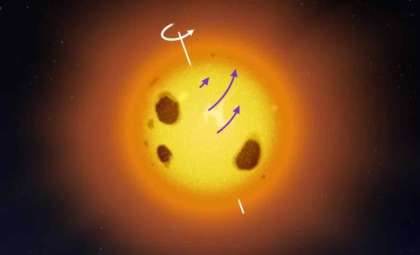
Situated in the Orion constellation and visible to the naked eye, Betelgeuse is a recognized red supergiant, watched over centuries for its notable luminosity changes. It is a mature star expected to culminate its lifecycle in a spectacular supernova explosion.

According to the European Southern Observatory, a research group led by French astronomer Miguel Montargès employed the SPHERE instrument on the VLT to detect the hidden star. Their findings, featured in Astronomy & Astronomy, provide the most compelling evidence yet of Betelgeuse’s binary nature.
Fortunate Timing Enhances Betelgeuse B Detection
The discovery was facilitated by two pivotal studies released in 2024, both predicting the companion would reach its furthest visible separation from Betelgeuse in December 2024, easing its observation. Acting on this, Montargès and his team targeted the star with the VLT in December and processed the images over subsequent months.
Initially unsure if their equipment could detect such a dim object, the team's observations surpassed expectations.
“Honestly, I thought we did not have the sensitivity to detect Betelgeuse B as it was predicted,” Montargès said. “Because it is more massive than predicted, we see it!”

New data imply Betelgeuse B possesses a mass approximately two to three times greater than our Sun, a significant increase over earlier estimates that aligned its mass close to solar levels.
“The fact that we can still discover a nearby companion, more massive and brighter than the Sun, around such a well-studied star is remarkable,” he added in an ESO statement. “These are among the best moments in science: seeing something new, unexpected.
Most Detailed Image Captured So Far of Betelgeuse’s Companion
The significance of this breakthrough lies in directly capturing light emitted from the suspected partner itself, rather than deducing its existence indirectly through Betelgeuse’s behavior. The SPHERE instrument, crafted primarily for exoplanet exploration, also excels in isolating faint bodies near intensely bright stars — proving invaluable since Betelgeuse’s brilliance typically obscures nearby objects.
While prior observations hinted at the companion's presence, such as possible detection with the Gemini North Telescope in Hawaii, this latest VLT data is considered the most definitive evidence yet.

Anthony Boccaletti, an astronomer at the Observatoire de Paris and co-author of the study, emphasized the impressive application of SPHERE’s advanced imaging to a massive evolved star like Betelgeuse. The team plans one final confirmation observation in roughly a year, when the companion should reappear on the opposite side of Betelgeuse. Montargès commented:
“To be certain that the companion is really there, we still need to observe it in one year on the other side of the star, but there is very little space left for doubt.”
New Companion Sparks Further Questions About Betelgeuse
The detection arrives amid ongoing curiosity about Betelgeuse. A few years back, the star unexpectedly dimmed, drawing widespread interest from both scientists and the public with speculation that the supergiant might imminently explode as a supernova.
Subsequent scrutiny via ESO’s VLT revealed a simpler cause: a dust cloud temporarily obscured the star’s glow. Now, astronomers are eager to understand whether Betelgeuse B influences the red supergiant’s development.
“The question is truly open whether this companion is going to have an impact on the evolution of the red supergiant,” Montargès said.
- Categories:
- Space



0 comments
Sign in to Comment