

In December 1935, the U.S. Army Air Corps executed a unique aerial bombing of a flowing lava stream descending a Hawaiian volcano. This mission was led by Lt. Col. George S. Patton, who would later rise to prominence commanding armored divisions in Europe during World War II.
The bombing focused on a lava channel on Mauna Loa's northeast flank, roughly a mile wide and advancing toward Hilo at a rate of about one mile daily, as detailed in the USGS report. To this day, scientists continue debating whether the air raid effectively impeded the lava’s progression.
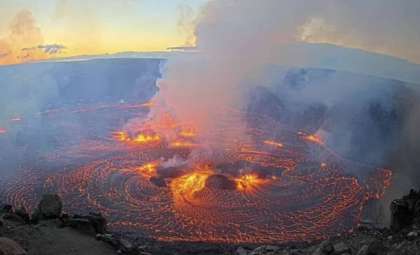
Mauna Loa erupted on November 21 from its summit caldera. Within days, volcanic activity shifted to the northeast rift zone. By November 27, a new vent on the volcano’s northern side released pāhoehoe lava, filling a depression between Mauna Loa and neighboring Mauna Kea.


As the lava moved off Mauna Loa, it continued east toward Hilo at roughly a mile per day. Protection of Hilo’s vital water supply from the Wailuku river was a pressing concern. Dr. T.A. Jaggar, director of the Hawaiian Volcano Observatory, teamed with volcanologist R. Finch to propose disrupting lava channels with explosives near the eruption to divert the molten flow.
The scientists hypothesized that fracturing these conduits might cause the lava to disperse rather than funnel into one path. Explosives had been suggested during a prior eruption in 1880-81, but no action was taken then.
On December 27, Patton’s Unit Dropped 40 Bombs on Lava Pathways
Jaggar enlisted the U.S. Army Air Service, appointing Lt. Col. Patton to oversee the operation. Patton would later become a famed WWII commander.
The December 27 mission deployed aircraft to bomb near the vent, targeting lava channels flowing from Mauna Loa. According to the National Park Service, this was the first-ever aerial bombing of active lava.
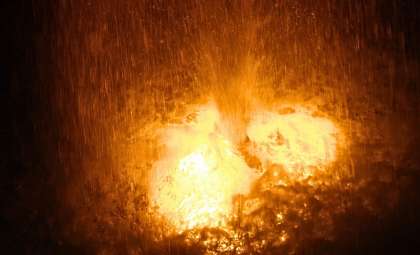
Forty bombs were dropped—20 large demolition bombs and 20 smaller bombs intended for aiming purposes. A 1980 study cited by the National Park Service identified the heavy ordnance as 600-pound MK I demolition bombs with a 355-pound TNT payload and a 0.1-second delay fuse.

The smaller “pointer bombs” carried black powder charges. Of the 20 large bombs, 16 reached the target zone, with 12 striking the lava tunnel meant to be disrupted.
Though lava cools on its surface, molten rock can continue moving beneath through insulated channels. Jaggar aimed to damage these subsurface routes near the vent to encourage lava to spread instead of concentrating in a single advancing stream toward Hilo.
Lava Flow Slowed Post-Bombing, but Cause Remains Debated
Jaggar believed the effort was a success. The National Park Service records his statement that the bombing “helped hasten end of the flow” and that without intervention, the cessation would not have been so sudden.
Using a telescope from Mauna Kea, he observed the bombing and later declared, “The experiment could not have been more successful; the results were exactly as anticipated.”
After the operation, the lava's forward movement decreased from over 5,000 feet per day to around 1,000 feet daily, before halting on January 2, 1936.

However, Howard Stearns, the USGS geologist aboard the final bombing flight, disagreed, later writing in his 1983 memoir that the halt of the lava was “surely a coincidence.”
The National Park Service points out that lava flow weakening occurred gradually over days, with no significant change in direction. Follow-up research found the 1935 and subsequent 1942 bombings had limited impact.
USGS Maintains Uncertainty About Bombing’s Impact
The USGS does not definitively attribute the lava flow’s end to the bombing. It acknowledges Jaggar’s positive view but highlights that the eruption ceased six days afterward, leaving questions around bomb-induced disruption unresolved.
The National Park Service’s assessment echoes this uncertainty: many geologists remain skeptical about the bombing’s effectiveness in halting the lava.
Six days post-bombing, the eruption concluded. Jaggar credited the aerial assault, while Stearns regarded it as mere chance. No subsequent studies have conclusively resolved this debate. The 1942 bombing attempt also yielded inconclusive results.
- Categories:
- News





0 comments
Sign in to Comment