

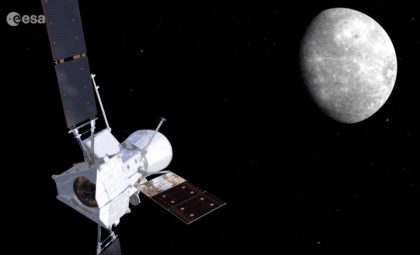
Europe’s BepiColombo spacecraft is nearing a critical stage of its voyage to Mercury, poised to initiate detailed studies of the solar system’s innermost planet, as reported by the European Space Agency (ESA). After navigating a complex path through the inner solar system for several years, the mission is set to embark on scientific operations that will investigate Mercury’s surface, environment, and atmospheric particles like never before.
This moment marks a significant achievement for a mission engineered to withstand the extreme conditions near the Sun. Mercury’s intense temperature fluctuations, powerful solar radiation, and difficult orbital dynamics have compelled engineers to pioneer innovative navigation and durability techniques.
The upcoming orbital insertion will open the door for unprecedented investigation of one of the least understood planets, enhancing knowledge of its makeup, magnetic environment, geological past, and its interaction with solar forces.

A Mission Designed for the Solar System’s Most Extreme Environment
Mercury’s closeness to the Sun subjects it to some of the harshest conditions any spacecraft can encounter. ESA mission lead Santa Martinez highlighted the formidable challenges faced when reaching the planet and maintaining operations there.
“Mercury is a challenging destination. It’s very difficult to reach, it’s very difficult to operate there,” said Santa Martinez, ESA mission manager.
BepiColombo’s systems must tolerate temperature swings from extremely cold to blistering heat under direct sunlight, while also enduring radiation levels significantly greater than those encountered near Earth.
“The main two aspects are really the extreme temperatures that go from -180 to 450°C, and also the solar radiation, which can be up to ten times what we have on Earth.”
These harsh realities have informed every element of the spacecraft’s engineering, including its shielding and operational plans, which have been meticulously developed to ensure survival and functionality close to the Sun.
“There’s a lot of stuff that is going to be new on Thursday that the teams must prepare for,” he said.
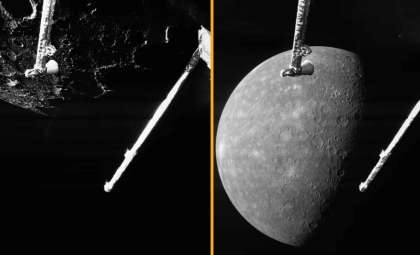
To reach Mercury, BepiColombo followed a complex route involving multiple gravity assists from Earth, Venus, and Mercury itself, slowing the spacecraft down sufficiently for orbital insertion — a task too energy-intensive for a direct trip.

Engineering Complexities at Mercury’s Doorstep
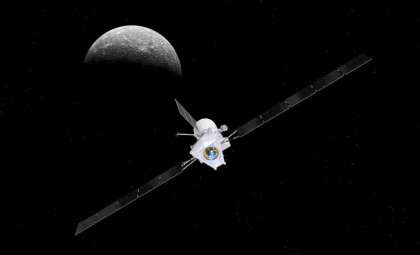
BepiColombo consists of two scientific probes poised to separate and conduct independent investigations around Mercury: Europe’s Mercury Planetary Orbiter and Japan’s Mercury Magnetospheric Orbiter, known as Mio.
During this transitional period, mission operators must carefully monitor a module that cannot be actively controlled. Frank Budnik, ESA’s Flight Dynamics Manager, discussed the challenge posed by this passive component.
“It’s a fully passive module, so you cannot control it, you cannot manoeuvre it,” explains ESA’s Flight Dynamics Manager Frank Budnik.
Anticipating minor deviations from the predicted trajectory, the team remains vigilant, prepared to adapt as unexpected variables emerge during this complex maneuvering phase.
“We know that it’s likely that not everything is going to go according to the nominal plan,” she said. “But we are ready, we are flexible, and we need to be prepared for the unexpected.”
Such adaptability exemplifies the unpredictable nature of deep-space missions, where precision meets the necessity to react swiftly to evolving conditions.
Unlocking Mercury’s Secrets with Advanced Instrumentation
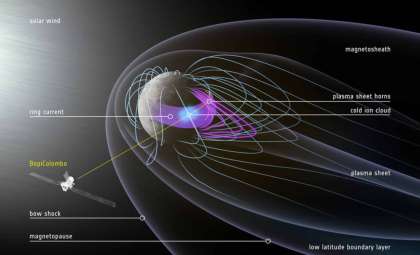
Once fully operational in orbit, BepiColombo will deploy an array of instruments to examine Mercury’s atmosphere, surface, magnetic field, and internal composition.
A focal point is Mercury’s tenuous exosphere — unlike Earth’s thick atmosphere, it is highly influenced by the Sun’s radiation, surface emissions, and solar wind interactions.
Researchers aim to track how gases originate, dissipate, and circulate over time, shedding light on the planet’s surface dynamics and solar influences.
“Both spacecraft will be ‘tasting’ the gases that are surrounding Mercury, being able to tell us what gases are there, whether certain areas of the surface are giving off material and seeing how that changes over time as well,” Geraint Jones explains.
BepiColombo will also map Mercury’s magnetic field and geological features with unprecedented accuracy, complementing past insights from NASA’s Messenger mission but offering fresh perspectives through its unique orbit.
- Categories:
- Space





0 comments
Sign in to Comment