

More than 160 years after a body was recovered from the Arctic ice, its identity has finally been confirmed. Scientists at the University of Waterloo utilized DNA from living relatives to name four previously unidentified sailors from Sir John Franklin’s ill-fated 1845 voyage, including Harry Peglar, whose identity had long baffled experts.
The Franklin expedition is infamous as one of the most tragic episodes in Arctic exploration. Franklin’s ships, HMS Erebus and HMS Terror, embarked in 1845 to traverse the Northwest Passage but became immobilized in ice for nearly two years. By April 1848, the 105 remaining crew members abandoned the ships, attempting a perilous trek across King William Island’s frozen terrain. None survived the journey.
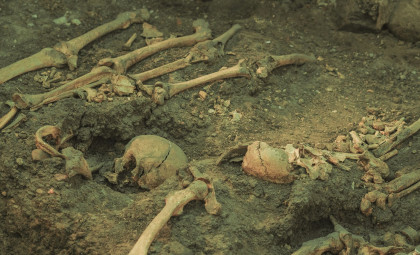
For over a century and a half, the true identities of most crew members remained a mystery, reconstructed only through scattered skeletal remains discovered around King William Island and the adjacent Adelaide Peninsula. The University of Waterloo highlights that this recent surge in DNA technology, linking genetic data from recovered remains to DNA from living descendants, is providing new insights and clarifying the expedition’s final events.

Harry Peglar’s Identity Confirmed
The most remarkable breakthrough centers on a body found in 1859 that carried the “Peglar Papers,” among the rare written documents from the expedition, containing poetry and accounts of hardships endured. Alongside the papers was a seaman’s certificate naming Harry Peglar, the Foretop Captain of HMS Terror. However, the body’s clothing was inconsistent with his rank, leaving his identification uncertain until DNA testing provided definitive proof.
“It was interesting to conclusively identify this sailor because the body was found with almost the only written documents from the expedition ever found,” said Dr. Robert Park, professor of anthropology at Waterloo and co-researcher on the project.

Peglar’s remains were located approximately 130 kilometers from three other sailors newly identified by the team, and he is the sole HMS Terror crew member to have been positively identified through DNA analysis.
Three More Identified from HMS Erebus
In addition to Peglar, researchers named three men: William Orren, an Able Seaman; David Young, a Boy 1st Class; and John Bridgens, a Subordinate Officers’ Steward. All served on HMS Erebus and died at Erebus Bay. Their identifications confirm they endured the prolonged ice entrapment and participated in the 1848 overland escape attempt.
Unlike the remains of Captain James Fitzjames, identified earlier in 2024, which bore signs of cannibalism, these four sailors’ remains show no evidence of such activity. Dr. Douglas Stenton—an adjunct professor of anthropology at Waterloo—reported in his paper that three of the newly identified sailors died together at the same location.
“Three of the sailors we have identified are from HMS Erebus, and they all died at Erebus Bay,” he said.
Tracing Lineages Across Time and Oceans
To verify the identities, Stephen Fratpietro of Lakehead University extracted DNA from archaeological specimens and matched it with mitochondrial and Y-chromosome DNA from living descendants able to trace direct maternal or paternal ancestry to the crew members.
Each of the four matched with a zero genetic distance, strongly indicating direct descent. One compatible descendant was BBC journalist Rich Preston, who discovered a familial connection to John Bridgens.
“It was such a huge surprise to hear from the team that my DNA was a match with one of the sailors on the doomed Franklin expedition,”. Preston said, adding that “I used to work on a genealogy show for the BBC that traced people’s fascinating family stories, and so to discover that there’s such an interesting tale in my own family’s past feels very exciting.”

For Stenton, this genetic investigation holds importance beyond historical insight, providing closure to descendants by revealing not only their ancestors’ identities but also details about their deaths and companions.
“For the living descendants, these findings provide previously unavailable details regarding the circumstances and locations of their relatives’ deaths, as well as the identities of some of the shipmates who died with them.”
Scientists continue to seek more descendants willing to contribute DNA to broaden the research and uncover further identities related to the Franklin expedition.
- Categories:
- Science





0 comments
Sign in to Comment