

Onboard the International Space Station (ISS), astronauts are examining how weightlessness impacts blood flow as they gear up for a spacewalk set for August 18, reports NASA. The Expedition 75 team balanced medical tests, ultrasound imaging, and spacesuit preparations during their active day. Station commander Jessica Meir contributed blood samples for the Venous Flow study, while Jack Hathaway employed the Ultrasound 3 device to scan her internal jugular veins and track her blood pressure. Medical experts on Earth observed the imaging live, searching for indications of irregular blood circulation and possible clotting hazards. Simultaneously, Hathaway, Anil Menon, and Sophie Adenot readied spacesuit systems inside the Quest airlock ahead of their upcoming extravehicular activity.
Exploring Circulatory Dynamics in Microgravity
Commander Jessica Meir initiated the health assessments by collecting blood inside the station’s Columbus module for the Venous Flow experiment. This investigation targets how the circulatory system adapts without gravity’s influence, which ordinarily directs blood distribution on Earth. After sample collection, Meir processed the blood through a centrifuge and inspected it for spaceflight-induced changes.
Following analysis, the samples were stored in a scientific freezer for future study. This procedure contributes to a larger initiative to understand cardiovascular responses during extended space missions. NASA and international partners focus on these investigations as astronaut health preservation becomes critical for longer-duration missions beyond Earth orbit. The ISS offers a unique setting for continuous physiological monitoring while astronauts conduct routine tasks. Data from these studies enhance knowledge of human spaceflight risks and support preparation for journeys farther from Earth.

Ultrasound vein scans for astronaut health and spacesuit checks for an upcoming spacewalk were the top duties for the Expedition 75 crew on Tuesday. More… https://t.co/ojn5gUyEaj pic.twitter.com/EWgD8EjoUK
— International Space Station (@Space_Station) August 11, 2026
The next phase featured ultrasound diagnostics. Jack Hathaway utilized the Ultrasound 3 tool to inspect Meir’s internal jugular veins and record her blood pressure. Post-lunch, the crew repeated the vein scans with alternating operators Meir and Hathaway joined by Anil Menon (NASA), Sophie Adenot ( European Space Agency), as well as Pyotr Dubrov and Anna Kikina from Roscosmos. Meanwhile, medical specialists on the ground monitored the data in real-time.
This immediate collaboration between the space crew and Earth-based doctors allows prompt analysis of circulatory images, removing the need to wait until mission completion. Scientists focus on detecting circulatory irregularities or elevated clot risk, as microgravity alters cardiovascular behavior. Continuous, onboard monitoring offers valuable insights into physiological changes during missions, surpassing the limitations of solely pre- and post-flight evaluations.
Preparing Spacesuits for an August 18 Extravehicular Activity
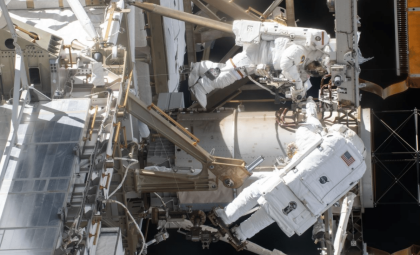
Alongside the biomedical work, the crew also focused on an essential task outside the station. Astronauts Hathaway, Menon, and Adenot devoted significant time inside the Quest airlock, servicing spacesuit equipment. They took turns swapping out parts in the suits to ready them for the upcoming extravehicular activity planned for August 18. Menon and Adenot are slated to conduct the spacewalk, expected to last approximately six and a half hours.
The primary objective will be to replace a high-speed data and communications antenna located on the station’s Z1 truss. This task underscores the extensive preparation necessary before astronauts venture into space. Each spacesuit component must be carefully inspected and configured, ensuring safe operation in the vacuum outside the ISS. The Quest airlock acts as the gateway between the pressurized interior and open space, playing a critical role in these preparations. For the crew, Tuesday’s equipment checks directly supported the forthcoming maintenance operation.
This antenna swap is part of ongoing upkeep essential for keeping the ISS functional after more than 20 years in orbit. External hardware endures the harsh space environment, including vacuum, radiation, and temperature swings. A functioning communication antenna is vital for data transmission, making its replacement a key operational activity rather than an experimental procedure. The extended spacewalk duration reflects the complexity of working in pressurized suits that provide life support and shield astronauts from space hazards. Careful choreography and thorough preparation inside Quest help ensure that astronauts can efficiently and safely execute their extravehicular tasks.
- Categories:
- News









0 comments
Sign in to Comment