

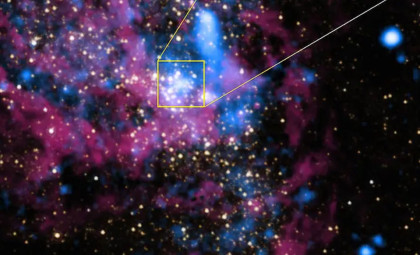
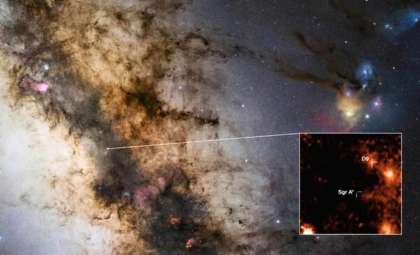
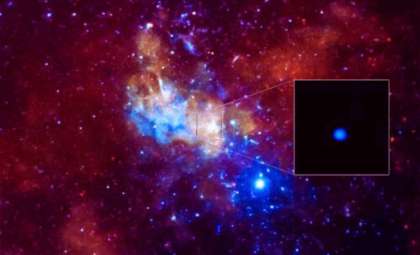
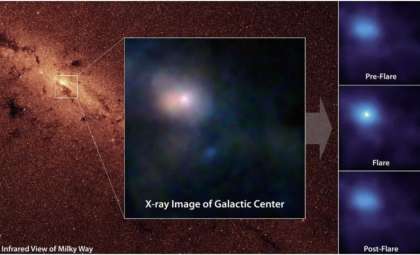
Utilizing the James Webb Space Telescope, scientists have identified water molecules and silicate dust grains encircling IRS 3, a massive star located just 0.55 light-years from Sagittarius A*, the Milky Way’s central black hole. This discovery highlights that dust creation and molecular materials can endure despite the extreme radiation near the galaxy’s core.
Sagittarius A* lies in a high-radiation zone with powerful stellar winds and gravitational forces, raising questions about the survivability of delicate molecules and dust particles. Ultraviolet and X-ray radiation in this area typically break down such components.
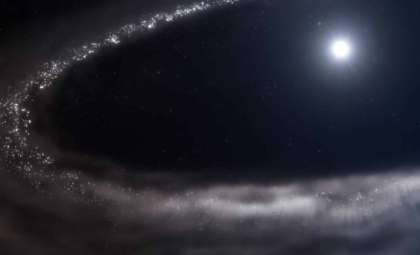
IRS 3 presents a unique chance to explore this issue. Estimated to be about 72 million years old and possessing around six times the Sun’s mass, this star is approaching the end of its lifecycle. During the asymptotic giant branch (AGB) phase, it is shedding gas and dust layers, enabling scientists to study dust formation close to the Galactic center.

Webb Identifies IRS 3’s Chemical Composition
Employing Webb’s Mid-Infrared Instrument (MIRI), researchers captured the most detailed infrared spectrum yet of IRS 3. This data resolved earlier ambiguities about the star’s chemical makeup. According to Florian Peißker and team in Astronomy & Astrophysics, previous ground observations allowed for the possibility of a carbon-rich star.

Webb’s spectrum, however, revealed two absorption bands exclusive to oxygen-rich and silicate-based dust, disproving the carbon-dominant theory and confirming IRS 3 as an oxygen-rich giant star.
“This is the first time a continuous mid-infrared spectrum has been collected for this star, allowing us to detect the features from the silicate dust and uncover the star’s true chemical identity,” said Dr. Macarena Garcia Marin, an astronomer at ESA.
Water Molecules Detected Despite Harsh Conditions
Another significant discovery in the spectrum was the presence of water molecules surrounding IRS 3. This finding is remarkable because ultraviolet and X-ray radiation near a black hole usually disintegrate such molecules. The study indicates that the star’s dense dust envelope effectively shields these fragile molecules from intense external radiation.
“The detection of water is especially exciting because it shows that molecular material can survive in an environment dominated by intense radiation,” Garcia Marin said. “This tells us that even close to a supermassive black hole, stars can continue contributing material back into their surroundings.”

Peißker emphasized that these findings shed light on star behavior in extreme cosmic environments.
“Galactic centers are among the most extreme environments, so understanding whether stars can continue enriching their surroundings there is an important question,” he said. “With Webb, we can directly observe how stars behave under these conditions and see that dust production remains remarkably resilient.”
Extensive Modeling Reveals IRS 3’s Dust Structure
To analyze Webb’s spectral data, the team employed the Hyperion radiative transfer code to simulate the gas and dust envelope around IRS 3. They assessed roughly 100,000 models to identify the best match.
The models suggest IRS 3 radiates with a luminosity about 60,000 times greater than the Sun. Its circumstellar dust envelope consists of multiple layered shells, each differing in temperature, density, and dust makeup.

The composition varies with distance: hot aluminum oxide dust forms nearer the star, while cooler silicate particles reside farther out, accompanied by a temperature drop of about 1,000 K across the shells.
“The detection of water is especially exciting because it shows that molecular material can survive in an environment dominated by intense radiation,” Dr. Macarena Garcia Marin stated. “This tells us that even close to a supermassive black hole, stars can continue contributing material back into their surroundings.”
- Categories:
- Space




0 comments
Sign in to Comment