

NASA’s Nancy Grace Roman Space Telescope has entered a critical phase in its pre-launch sequence at the Kennedy Space Center, moving one of the agency’s flagship observatories ever closer to its journey into deep space. NASA reports that teams are currently integrating Roman with SpaceX launch components in anticipation of a planned August 30, 2026 launch, with the project progressing nine months ahead of its original timeline.
Telescope Underway in Connection to Falcon Heavy Launch Platform
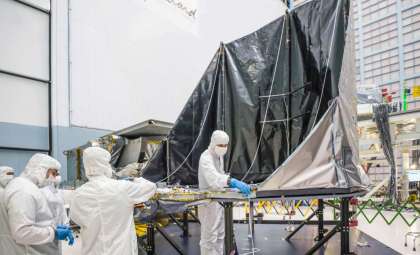
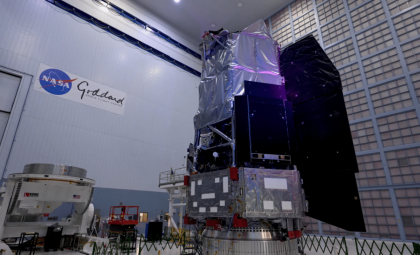
Inside the Payload Hazardous Servicing Facility in Florida, teams have shifted Roman’s status from spacecraft assembly to integrated launch preparation.
Technicians have attached the observatory to its payload adapter, a key interface that will link Roman to the launch vehicle. Subsequently, the telescope was mounted onto a strut payload attach fitting, a specialized mount engineered to handle large and heavy payloads.

This fitting establishes the necessary structural connection for Roman to attach securely to the second stage of SpaceX’s Falcon Heavy rocket.
This stage signals a crucial milestone: the observatory is no longer solely a spacecraft undergoing assembly but is now being treated as a launch payload that must withstand the demanding conditions of liftoff before embarking on its science mission.
The process also advances Roman toward a key final step before rocket integration called encapsulation.
Later this month, teams are scheduled to enclose the entire observatory within a Falcon Heavy payload fairing, which will shield it during launch and atmospheric travel.
Following encapsulation, the protected Roman will be moved to SpaceX’s hangar at Launch Complex 39A for integration with the Falcon Heavy launcher.
There, the telescope will be fully prepared for departure from Earth.

Launch Planned for August 30 at Kennedy Space Center
In its mission update on August 10, NASA and SpaceX confirmed their goal to lift off no earlier than 7:26 a.m. EDT on Sunday, August 30, 2026, at Launch Complex 39A at Kennedy Space Center.
A notable aspect is that the Roman mission remains nine months ahead of its planned schedule.
Although the schedule is early, essential pre-launch tasks continue within strict operational protocols to ensure that the spacecraft, its protective fairing, launch interfaces, and rocket are brought together smoothly.
The upcoming phases will see Roman encapsulated inside the Falcon Heavy’s fairing, then transported to SpaceX’s facility at pad 39A for final rocket integration.
These steps move Roman physically closer to launch while reducing remaining major tasks before liftoff.
NASA stresses the launch date as a target, not set in stone, allowing for any adjustments during the final preparation stages.
If all proceeds as planned, Roman will soon shift from a major NASA project into an active space observatory.
What follows launch could influence several key research areas in modern astrophysics.
Roman’s Potential to Revolutionize Understanding of Dark Energy and Dark Matter
Roman was designed specifically to explore cosmic phenomena invisible to traditional telescopes focusing on visible light.
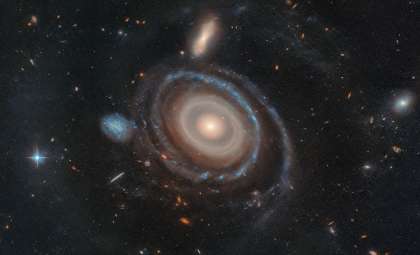
A primary focus is on dark energy, the mysterious force driving the accelerated expansion of the universe.
Despite strong evidence for this acceleration, the physics behind it still puzzle scientists. Roman aims to illuminate this mystery through large-scale surveys of the cosmos.
The observatory will also provide new insights into dark matter, a substance that does not emit light but exerts gravitational effects on galaxies and cosmic structures.
By mapping galaxy formation, clustering, and evolution over time, Roman will trace the influence of dark matter on the universe’s structure.
These goals tie into a wider scientific campaign to understand the universe’s growth and evolution.
Instead of studying galaxies individually, Roman’s extensive surveys will analyze patterns across vast populations, preserving clues about cosmic development and expansion.
Roman is built to deliver the kind of comprehensive observations necessary for this work.
Its scientific contributions will extend well beyond cosmology.
Thousands of New Exoplanets Await Discovery With Roman
In addition to cosmology, Roman is set to play a major role in discovering thousands of planets beyond our solar system.
This capability gives the telescope a unique scientific versatility, linking vast cosmic scale studies with investigations of planetary systems much closer to home.
By detecting large populations of exoplanets, Roman will help astronomers better understand how planetary systems form and how common various types of planets may be.
Instead of focusing only on individual planetary finds, Roman offers a statistical approach to exoplanet demographics across the galaxy.
NASA also envisions Roman as a stepping stone toward future missions aimed at examining potentially Earth-like planets in greater detail.
While Roman is not designed to detect life directly, it will set the stage for upcoming explorations by expanding known planet populations and improving the tools future missions can utilize.
This broader impact is important, as Roman will simultaneously advance research into exoplanets, galaxies, dark matter, and dark energy—fields that typically operate on vastly different scales.
- Categories:
- Nasa






0 comments
Sign in to Comment