

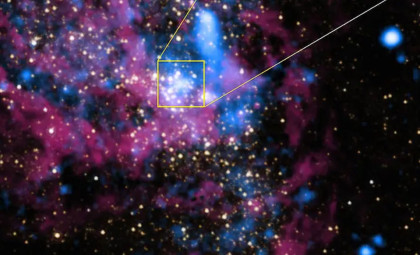
Dust particles swirling around supermassive black holes may be assembling into enormous planet-like structures. Advanced simulations reveal that a single active galactic nucleus (AGN) disk might harbor millions of these formations.
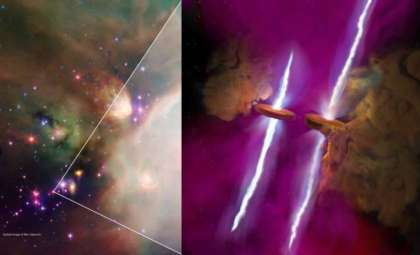
Researchers from New Mexico State University, Nicolaus Copernicus Astronomical Center, and CUNY Borough of Manhattan Community College have explored the dense dust rings encircling AGNs—the intensely luminous centers of galaxies energized by supermassive black holes devouring material. Their aim was to determine if processes similar to planet formation around young stars could also occur in such extreme environments.
Wladimir Lyra and his team uncovered striking parallels. Their computer models indicate that minuscule dust grains can gather, be concentrated through a phenomenon known as streaming instability, and eventually gravitationally collapse. These grains begin as tiny as a few nanometers up to fractions of a millimeter.

Dust Particles Cluster to Form Massive Bodies
The scientists simulated a magnetized AGN disk with dust inflowing from the surrounding interstellar medium. These particles, ranging from nanometers to sub-millimeter sizes, can stick and clump rather than remaining dispersed across the disk under simulated conditions.
Streaming instability drives dust into dense filaments. Once these filaments reach critical density, they collapse gravitationally, generating objects that range from Earth-sized through to super-Jupiter scale.
“We’re finding objects that are a thousand times the mass of the Earth, but built of pure dust,” Wladimir Lyra, an astrophysicist at New Mexico State University, said. “And not only that, but also some of these objects are approaching the mass of the Sun.”

Published in The Astrophysical Journal, the research estimates that these disks could produce tens of millions of planetary-mass objects. Over the typical 1-to-10-million-year lifespan of an AGN phase, growth may proceed through accretion of pebbles and gas.
From Dust to Stars: Possible Stellar Formation
Further evolution may push some bodies beyond planetary scales. The simulations suggest that certain formations could reach or exceed the hydrogen-fusion threshold, effectively becoming stars.
This contrasts with standard star formation, which usually involves a large gas cloud collapsing. In this scenario, as Lyra explains, the process starts small and builds upward via aggregation and accumulation.
“Our mechanism is the opposite,” Lyra explained. “You form from the bottom up. You first form the building blocks and then accrete gas and then boom, you form a star.”
Thus, tiny dust grains cluster into larger objects before gas accretion drives them past the stellar formation boundary.
“This is a mechanism of forming stars that we discovered for the first time,” Lyra said.
Black Hole Creation Within AGN Disks
The process potentially progresses further, as stars that arise within AGN disks could collapse into black holes. Additionally, small black holes traveling through the disk may behave similarly to emerging planets, migrating in orbit and merging with other objects to form more massive black holes—an idea called the “AGN channel”.
“That’s a completely different way to form heavy black holes than anything else in the Universe,” he added.

Some black holes formed this way could grow to significant sizes. Bhupendra Mishra points out they might reach masses hundreds or thousands of times that of the Sun. If these black holes spiral inward toward the central supermassive black hole, they could emit gravitational waves detectable by ESA’s Laser Interferometer Space Antenna (LISA), scheduled for launch in the 2030s.
“They’re hundreds or thousands of times the size of the Sun, and if they start to move towards the center, they also produce a signal which will be detected probably by LISA,” Mishra said.
- Categories:
- Space






0 comments
Sign in to Comment