

Tracking Particles Reaching Our Planet
For the first time ever, scientists have simulated a critical collision responsible for cosmic-ray particle showers by colliding oxygen ions and protons at CERN’s Large Hadron Collider. This breakthrough provides an unprecedentedly clear snapshot of how these vast cascades start. Published in Physical Review Letters, the findings can refine our understanding of the composition of ultra-high-energy cosmic rays and aid in identifying the powerful cosmic sources that emit them.
Bringing Cosmic Collisions Into the Lab
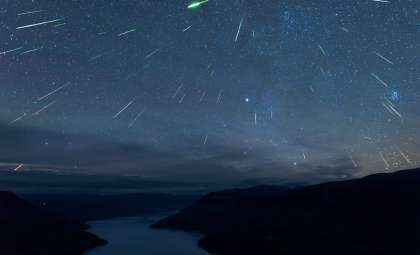
Particles generated by cosmic rays constantly pass through our bodies every second, following a complex chain of interactions beginning far above Earth’s atmosphere. Cosmic rays themselves consist of energetic atomic nuclei traveling through space. When one collides with atmospheric nuclei, it produces a chain reaction of secondary particles showering through the atmosphere before some reach Earth's surface. These extensive air showers have been studied for many years, yet their detailed origin remains elusive because the earliest collision stages cannot be observed directly. Hence, researchers rely heavily on computational models to reconstruct these interactions.
However, these models often differ, creating uncertainty in identifying and measuring the original cosmic ray’s properties. According to The Conversation, CERN’s new approach is to recreate these collisions in a controlled laboratory environment to analyze the resulting particle production. Starting July 1, 2025, the LHC performed its first proton-oxygen collisions. In this setup, the proton mimics an incoming cosmic ray particle, while oxygen represents one of the main atmospheric nuclei. Instead of inferring the shower after its development, physicists directly explore the fundamental particle interactions at the collision’s origin.

Testing Theories of Cosmic-Ray Production
The Physical Review Letters publication delivers the precise accelerator data that cosmic-ray models previously lacked. Utilizing the ATLAS experiment, scientists analyzed the particles created during proton-oxygen collisions, focusing on their production rates and energy distributions. The ATLAS detector’s comprehensive array of systems reconstructs particle trajectories with exceptional detail, aided by silicon tracking technology. This allows an in-depth examination of particle creation under cosmic-ray-like conditions. Researchers report that their measurements exceed the accuracy of existing model predictions by over tenfold for key observables.
This enhanced precision is crucial because simulations of air showers often extend particle behavior into unexplored regimes where direct data is sparse. Small inaccuracies in modeling the initial interaction can result in significant deviations in the simulated particle cascades detected at ground level. The fresh proton-oxygen data provides an essential benchmark to validate or challenge competing particle production models. Models matching this data gain reliability, while differences highlight where theoretical adjustments are necessary.
The Importance of Oxygen in Cosmic-Ray Studies
Although large datasets exist from proton-proton and heavy-ion collisions, the atmospheric environment is unique. Earth’s atmosphere is primarily composed of nitrogen and oxygen, so cosmic rays interact with atomic nuclei, not just protons. Proton-oxygen collisions replicate this nuclear setting more realistically, reflecting the initiation of atmospheric particle showers. High-energy impacts between protons and oxygen nuclei translate some collision energy into freshly produced particles emanating from the interaction point. These particles then continue to collide with atmospheric nuclei, generating successive particle generations.
Unstable particles such as pions and kaons decay into muons and neutrinos as the cascade evolves. By the time the resulting shower is recorded near Earth's surface, it represents the outcome of countless microscopic events. Understanding the earliest collision improves reconstruction of the initial cosmic ray’s identity, thus refining interpretations of the entire shower. This explains why a short experiment at CERN can profoundly impact long-term cosmic-ray observations by providing crucial laboratory data for fundamental interactions that underpin the modeling efforts.
Pioneering Insights Into a Century-Old Cosmic-Ray Enigma
The quest to unravel the origin of the highest-energy cosmic rays is a long-standing intersection of particle physics and astrophysics. Victor Hess proved their extraterrestrial origin in the early 1900s by measuring increased radiation at high altitudes during balloon flights, a discovery that earned him part of the 1936 Nobel Prize in Physics. Today, researchers have greatly expanded knowledge about these particles, yet precisely where and how the most energetic cosmic rays are accelerated remains a mystery. Potential sources include supernova remnants, active galaxies, and the vicinity of supermassive black holes, where strong magnetic fields and energetic jets might accelerate particles.
Tracking cosmic rays to their origins is complicated because most carry electric charge, causing their paths to bend under the influence of galactic and intergalactic magnetic fields. This prevents straightforward backtracking like that used with light. Instead, scientists piece together arrival directions, energies, compositions, and other data. Determining whether cosmic rays are mainly protons or heavier nuclei is vital, and CERN’s new measurements enhance the physics models that translate atmospheric shower data into particle composition information.
Unlocking Cosmic-Ray Composition Holds Broad Scientific Value
Instruments like Utah’s Telescope Array detect air showers generated by ultra-high-energy cosmic rays but seldom observe the primary particle pre-interaction. By analyzing shower characteristics and applying simulations, researchers estimate the nature of the initiating particle. Showers started by protons behave differently from those triggered by heavier nuclei, but this depends on the accuracy of nuclear interaction models. Misestimations in particle counts or energy distributions can skew composition inferences. The new proton-oxygen data provides a valuable experimentally based calibration point beyond merely theoretical extrapolations.
Scientists anticipate that these results will clarify the proportions of hydrogen nuclei versus heavier nuclei among energetic cosmic rays. This not only refines classification but informs astrophysical theories, since varying accelerators likely produce different particle mixtures, and particles of distinct masses and charges behave differently in magnetic fields. Consequently, improved composition knowledge constrains theories about both acceleration mechanisms and cosmic ray journeys across interstellar space. In this way, understanding tiny collisions inside the LHC sheds light on phenomena spanning vast cosmic distances.
ATLAS Bridges Particle Physics and Astrophysics
This research exemplifies how collider physics and astrophysics can collaboratively advance scientific understanding. The ATLAS detector was designed mainly to explore fundamental particle interactions and was instrumental in discovering the Higgs boson. Yet its capability to precisely characterize energetic collisions also makes it a valuable tool for addressing questions rooted in astrophysics. Historically, cosmic rays contributed to early particle physics discoveries by revealing new phenomena before accelerators were available.
Today, accelerators invert this relationship by producing controlled collisions that emulate atmospheric interactions. Proton-oxygen collisions are particularly vital, creating a link between accessible nuclear systems in the laboratory and those at play in cosmic-ray events in Earth's atmosphere. Incorporating this data into hadronic-interaction models used by air-shower observatories will enhance their accuracy. Future research will assess how much these measurements reduce discrepancies between simulations and observations, potentially resolving long-standing inconsistencies in cosmic-ray shower interpretations.
- Categories:
- News







0 comments
Sign in to Comment