

The NASA Nancy Grace Roman Space Telescope successfully completed its initial mid-course correction burn, an essential step in guiding the observatory toward its designated position deep in space.
NASA reports that this adjustment fine-tuned Roman’s flight path en route to the second Lagrange point, or L2.
Lasting roughly three minutes, this burn ensured the spacecraft remains on track for its forthcoming orbit insertion.
This event marks one of the first critical navigation operations following launch for a mission focused on some of the universe’s most profound mysteries.
As Roman approaches its operational orbit, scientists anticipate a groundbreaking period of expansive sky surveys.
Accurate Navigation Steering Roman Toward L2
The initial mid-course burn commenced at 12:02 p.m. EDT, when Roman engaged its thrusters to make precise trajectory corrections. This approximately three-minute maneuver adjusted its course while keeping the mission’s timeline intact toward arrival at L2.
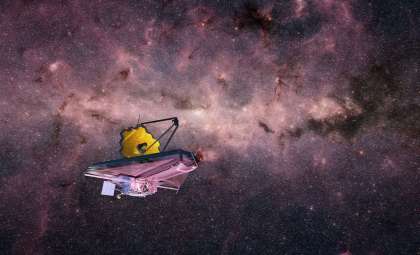
Located about 1.5 million kilometers from Earth in the anti-sunward direction, the L2 point offers a stable environment ideal for continuous astronomical observation. It’s a destination that other missions, like the James Webb Space Telescope, have also reached.

This burn was part of a pre-planned sequence of trajectory modifications. NASA has reserved a potential second correction later in the week should further refinements be necessary ahead of Roman’s approach phase.
Throughout the journey, the navigation team will keep a close watch on the spacecraft’s position and system performance. Each adjustment brings Roman closer to achieving the precision required for its scientific endeavors.
Success! Roman’s planned mid-course correction burn went as expected, ensuring that we are on track for our orbit around the second Lagrange point, a million miles from Earth. https://t.co/9Pun3svIu8
— Nancy Grace Roman Space Telescope (@NASARoman) August 31, 2026
Monitoring Roman’s Path Before Final Orbit Insertion
NASA has confirmed that Roman will enter orbit around L2 roughly 100 days post-launch, positioning it within its designated operational orbit.
During transit, mission teams will conduct the commissioning phase, scrutinizing spacecraft systems, calibrating instruments, and preparing for scientific observations.
Once established at L2, Roman will require minimal course corrections, relying mainly on minor station-keeping burns about every 28 days to maintain orbit.
This precise navigation underpins the critical accuracy needed for state-of-the-art space telescopes. Even minor course deviations during transit could influence arrival parameters and future data collection.
With its first successful burn, Roman has reached an early key milestone on its journey to becoming a flagship astronomy observatory.
An Observatory Designed to Unveil the Dark Universe
The Nancy Grace Roman Space Telescope aims to tackle fundamental astrophysical questions. Its extensive field of view enables comprehensive surveys of the sky, capturing phenomena hard to detect with existing technology.
A central mission objective is investigating dark energy and dark matter, mysterious components believed to shape the cosmos’s structure and accelerate its expansion. The telescope will also study galaxy evolution, planetary systems, and distant celestial bodies.
Unlike many earlier observatories, Roman pairs a highly capable infrared camera with an unparalleled survey scope, enabling astronomers to gather vast datasets across broad cosmic regions.
This mission will complement other space-based observatories, offering fresh perspectives on the universe and uncovering hidden populations of exoplanets, galaxies, and astronomical phenomena.
- Categories:
- Nasa






0 comments
Sign in to Comment